


Antique European School Oil on Canvas Painting of an Italianate Church and Bell Tower in Ornate Gilt Foliate Frame, Circa 1880–1910
Antique European School Oil on Canvas Painting of an Italianate Church and Bell Tower in Ornate Gilt Foliate Frame, Circa 1880–1910
Couldn't load pickup availability
Share
Additional Description
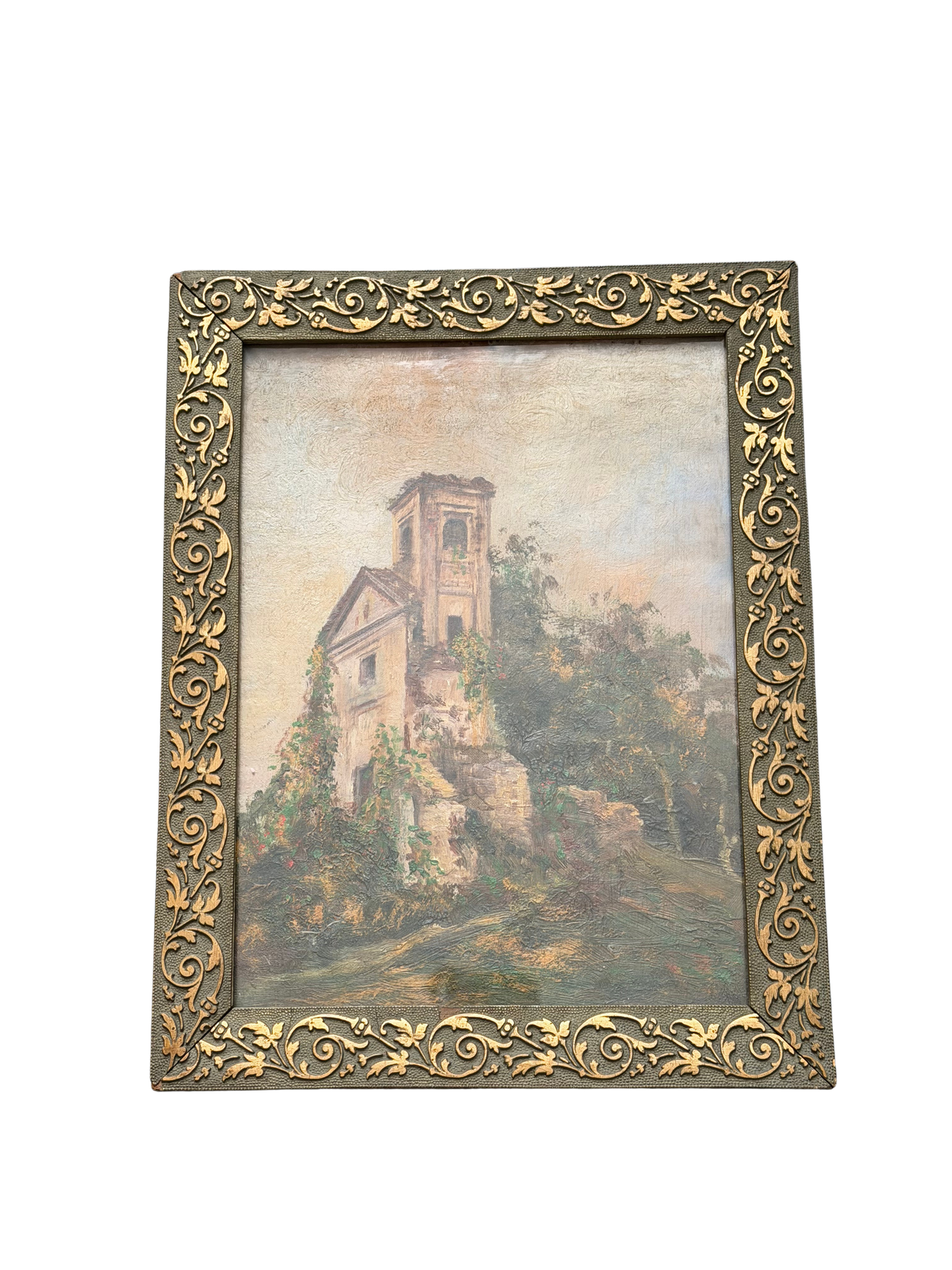
A romantic antique European School oil painting depicting a picturesque church and bell tower nestled among lush foliage and weathered stone ruins.
The composition features an old ecclesiastical building with a classical triangular pediment and square bell tower rising above an overgrown landscape. Climbing vines embrace the timeworn architecture, while an atmospheric pathway winds through the foreground beneath a softly illuminated sky.
Rendered in a rich palette of warm ochres, muted terracotta, olive greens, and golden yellows, the painting captures the quiet charm of an old European countryside. Expressive, textured brushwork brings movement and depth to the surrounding vegetation, with thicker applications of paint contrasting beautifully against the delicately rendered sky and architectural details.
The painting appears to have been executed on traditional woven artist's canvas, which is currently presented unstretched beneath glass. The visible construction suggests the canvas may have been removed from an earlier mounting or cut down from a larger composition, although its original format remains unconfirmed.
The work is housed in a particularly attractive antique decorative frame featuring an olive-bronze ground embellished with elaborate gilt foliate scrollwork, stylized leaves, and repeating floral ornamentation.
A wonderfully atmospheric work, ideal for a traditional salon, study, library, or gallery wall inspired by the romantic landscapes of Italy and Southern Europe.
## Era
Late 19th to Early 20th Century, circa 1880–1910.
European School, possibly Italian or French.
The painting's exact date and country of origin remain unidentified. A broader date range of approximately 1860–1920 cannot be excluded.
## History
Throughout the 19th century, European artists developed a fascination with picturesque architectural landscapes, particularly the ancient churches, monasteries, villas, and ruins of Italy.
Inspired by Romanticism and the tradition of the Grand Tour, painters frequently depicted historic buildings surrounded by untamed vegetation, emphasizing the beauty of weathered architecture and the passage of time.
These subjects remained popular during the latter decades of the 19th century, when landscape painting increasingly incorporated freer brushwork, textured surfaces, and expressive interpretations of natural light.
The present painting follows this tradition, portraying a secluded church or chapel surrounded by dense vegetation and aged stonework.
The building's square bell tower, simple classical pediment, warm plastered walls, and surrounding greenery suggest an Italianate setting, although the precise architectural location has not been identified.
The artist employs loose, directional brushstrokes and varied paint thicknesses, particularly within the foliage and foreground, creating a textured surface characteristic of many European landscape paintings of the late 19th and early 20th centuries.
The decorative olive-and-gold frame complements the work's subdued palette and reflects ornamental tastes associated with the Aesthetic Movement and turn-of-the-century interiors.
## Provenance
European School, artist unidentified.
No legible signature or date has been identified in the visible composition.
The painting retains an older decorative wooden frame with an aged paper-covered reverse, traditional fastening nails, and metal hanging hardware.
The original canvas mounting and framing history remain unknown.
## Materials
- Original oil painting on plain-weave textile canvas, possibly linen
- Expressive brushwork with areas of impasto
- Canvas presented apparently unstretched beneath glass
- Antique decorative wooden frame
- Textured olive-bronze finish with gilt foliate ornamentation
- Aged paper backing
- Metal hanging hardware and traditional fastening nails
## Dimensions
Measurements to be confirmed.
## Condition/Disclaimers
Fair antique condition with visible wear and localized paint losses consistent with age and historical handling.
The painting retains attractive original coloration and expressive, textured brushwork. Areas of cracking, abrasion, and paint loss are present, particularly within the architectural stonework and surrounding landscape. Several losses expose the underlying plain-weave canvas.
Close examination reveals a relatively open and regular textile weave beneath the painted surface, consistent with traditional woven artist's canvas.
The painting appears to be presented on loose or unstretched canvas beneath glass rather than secured to a conventional wooden stretcher. It is possible that the canvas was removed from an earlier mounting or reduced from a larger composition, although this cannot be confirmed without examining its concealed edges.
Some surface irregularities, possible varnish discoloration, and accumulated grime are visible.
The decorative frame exhibits age-related abrasions, minor finish losses, and general wear. The reverse retains an aged paper covering with discoloration, tears, and areas of separation exposing the canvas.
The painting has not been removed from its frame, and the original canvas dimensions, presence of old tack holes, and history of any alterations remain unknown.
No professional conservation or restoration history is available. The piece is offered in its present antique condition, with imperfections consistent with age and historical use.
## Value
**Estimated Antique Retail Value: $125–$275**
**Suggested Website Price: $225**
Valuation reflects the original oil medium, romantic European architectural subject, textured painting technique, and attractive decorative frame.
The unidentified artist, visible paint losses, and potentially altered canvas format limit its fine-art value. Nevertheless, the painting retains considerable decorative appeal, particularly for collectors of antique European landscapes and traditional interiors.