

Antique French Saint Hubert Hunting Trinket Dish with Stag Relief, Late 19th–Early 20th Century
Antique French Saint Hubert Hunting Trinket Dish with Stag Relief, Late 19th–Early 20th Century
Couldn't load pickup availability
Share
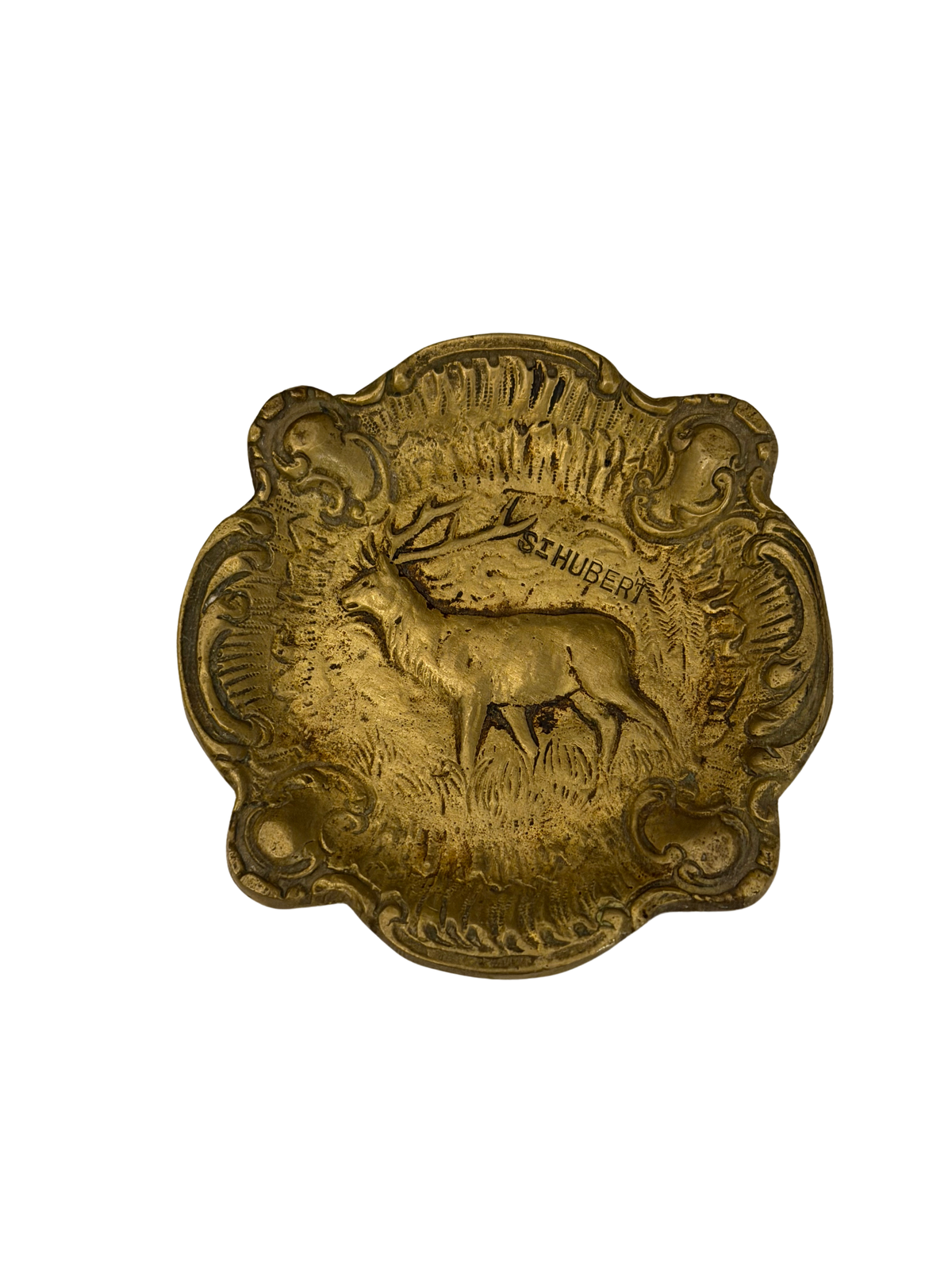
Item Title: Antique French Brass Saint Hubert Hunting Trinket Dish with Stag Relief, Late 19th–Early 20th Century
Additional Description
A charming antique brass trinket dish featuring a finely detailed stag beneath the inscription “ST HUBERT,” a reference to Saint Hubert, the patron saint of hunters.
The dish features an elaborately scalloped, asymmetrical border decorated with scrolling Rococo-inspired ornamentation, raised cartouches, and textured foliate motifs. At its center, a majestic stag stands in profile amid tall grasses, its branching antlers extending toward the upper portion of the composition.
Above the stag, the inscription “ST HUBERT” identifies the religious and hunting associations of the scene.
The brass retains a beautifully aged golden patina, with darker oxidation settled into the recessed details, enhancing the dimensionality of the relief work.
The shallow, slightly concave form makes this an attractive decorative catchall for jewelry, coins, or other small treasures, particularly suited to a gentleman's study, hunting lodge, or collected French interior.
Era
Likely late 19th to early 20th century, circa 1890–1930.
The historicizing Rococo ornamentation and hunting imagery are consistent with decorative brassware produced during this period. The dating remains provisional.
History
Saint Hubert of Liège (circa 656–727) is traditionally recognized as the patron saint of hunters, foresters, and hunting dogs.
According to medieval legend, Hubert was an enthusiastic hunter who experienced a religious conversion after encountering a magnificent stag bearing a crucifix between its antlers.
This vision inspired him to abandon his worldly pursuits and devote his life to the Church.
The story became particularly influential in France, Belgium, Germany, and other European regions with strong hunting traditions.
Saint Hubert's feast day, celebrated on November 3, remains associated with ceremonial hunts, blessings of hunting dogs, and religious observances within European hunting communities.
During the 19th and early 20th centuries, his image and associated stag symbolism appeared on decorative metalwork, hunting equipment, commemorative objects, and other sporting accessories.
The present dish reflects this tradition through its representation of a stag accompanied by the saint's name. Although no crucifix is visible between the antlers, the inscription firmly connects the imagery with Saint Hubert.
Provenance
Likely Continental European, possibly French or Belgian.
Specific provenance and original ownership are unknown.
Materials
Cast brass or brass-alloy metal with raised relief decoration and naturally aged patination.
The reverse exhibits a relatively smooth, shallowly concave surface with visible finishing marks. No identifiable manufacturer's mark is apparent in the photographs.
Dimensions
Approximate width: 3.5–4 inches, estimated from the photographs.
Exact dimensions to be confirmed.
Condition/Disclaimers
Good antique decorative condition, displaying age-related wear, surface scratches, oxidation, and areas of darker patination throughout.
Minor irregularities and wear are visible along the scalloped perimeter, consistent with handling and previous use.
The reverse exhibits scattered discoloration, light abrasions, and small areas of verdigris.
No major breaks or significant structural damage are apparent in the supplied photographs.
Exact age, metal composition, and country of manufacture have not been independently verified.