

Antique French School Oil on Canvas Portrait of Marie Mancini (1639–1715), Princess Colonna and First Love of Louis XIV, After Jacob Ferdinand Voet, Historically Attributed to Pierre Mignard
Antique French School Oil on Canvas Portrait of Marie Mancini (1639–1715), Princess Colonna and First Love of Louis XIV, After Jacob Ferdinand Voet, Historically Attributed to Pierre Mignard
Couldn't load pickup availability
Share
Item Title: Antique French School Oil on Canvas Portrait of Marie Mancini (1639–1715), Princess Colonna and First Love of Louis XIV, After Jacob Ferdinand Voet, Historically Attributed to Pierre Mignard, in Monumental Giltwood Floral Frame
Additional Description
An extraordinary, large-scale European aristocratic portrait depicting Marie Mancini (1639–1715), Princess of Paliano, the celebrated niece of Cardinal Mazarin and first great love of King Louis XIV of France.
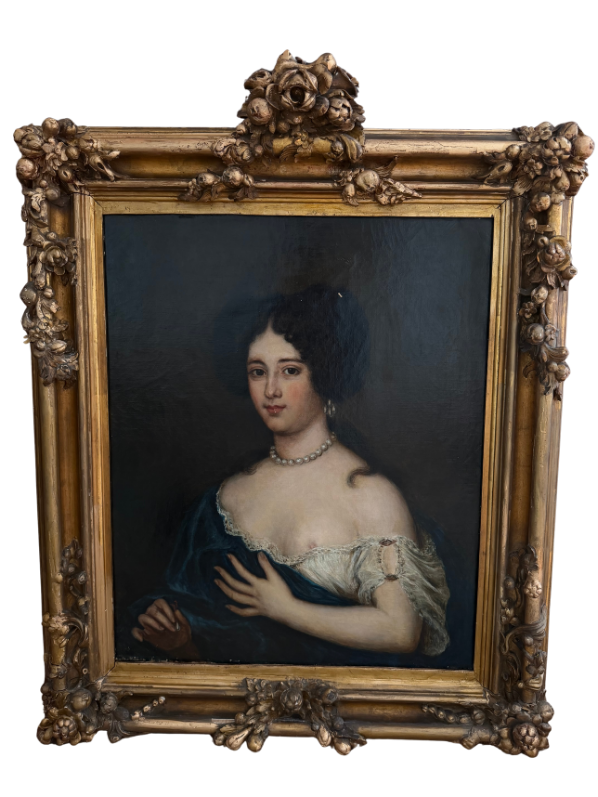
Executed in oil on canvas, this beautifully composed half-length portrait depicts a youthful noblewoman with dark, voluminous curls, luminous complexion, delicately flushed cheeks, and a composed, engaging expression. Her dark brown eyes gaze directly toward the viewer, while an understated smile lends the composition an intimate quality.
She wears a sumptuous white silk gown with finely rendered lace trimming, a delicately gathered neckline, and ornamental detailing at the sleeves. A luxurious deep sapphire-blue drapery envelops her shoulders and crosses her bodice, its rich folds contrasting dramatically with her pale complexion. A single strand of lustrous pearls encircles her neck, complemented by matching drop earrings.
Her right hand rests gracefully upon the blue drapery, while her left holds a small, slender object with a reddish detail and silvery tip, the precise identity of which remains uncertain.
Particularly intriguing is the exceptionally low neckline, revealing a small portion of the sitter's breast. Such partially exposed décolletage appeared in Baroque aristocratic portraiture, where idealized feminine beauty, fashionable undress, and classical allusion could intersect. The detail should not automatically be interpreted as evidence that the sitter was a royal mistress.
The painting's dark, atmospheric background creates a dramatic contrast with the illuminated face, pearl jewelry, and richly colored textiles, directing attention toward the sitter's elegance and aristocratic bearing.
The portrait is presented in an impressive, heavily ornamented giltwood and composition frame featuring elaborate sculptural garlands of roses, blossoms, foliage, and fruit. A prominent floral crest crowns the composition, while cascading botanical arrangements embellish the corners and sides. Additional floral ornamentation along the lower rail completes the frame's richly decorative appearance.
Measuring approximately 45 inches high and 34 inches wide overall, this is a commanding statement piece whose historical subject matter and remarkable presentation evoke the splendor of European palaces and aristocratic collections.
Era
Painting: European School, possibly 18th–19th century, after a late 17th-century portrait type. Exact date and attribution unconfirmed.
Original artistic influence: Baroque aristocratic portraiture, circa 1660–1680.
Frame: Likely 19th-century or later, in an elaborate Rococo Revival or Louis XV-inspired style. Further physical examination is recommended.
Historical attribution: Pierre Mignard (French, 1612–1695), possibly after Jacob Ferdinand Voet (Flemish, 1639–1689), as catalogued by Austin Auction Gallery.
Art historical analysis and attribution
The painting's connection to Jacob Ferdinand Voet is particularly compelling.
Voet was a Flemish portraitist who developed a distinguished career painting members of the European aristocracy, especially in Rome during the latter half of the 17th century. His portraits of noblewomen frequently feature voluminous dark hairstyles, pearl necklaces, low lace-trimmed necklines, luminous complexions, and dramatically colored drapery.
These characteristics are all evident in the present portrait.
A portrait of Maria Mancini attributed to Voet, preserved in the collections of Milan's Castello Sforzesco, exhibits notable similarities in the arrangement of the hair, pearl necklace, exposed shoulders, and facial presentation.
There is also an important historical precedent for confusion between these artists. The Rijksmuseum's portrait connected to the Mancini family and attributed to Voet was formerly associated with Pierre Mignard before its attribution was reconsidered. This demonstrates how closely their works have sometimes been connected in portrait scholarship.
The present work's costume, pose, and composition are consistent with the broader Voet portrait tradition. However, the exceptionally smooth facial modeling, somewhat simplified hands, and comparatively uniform treatment of the costume could suggest a later interpretation or copy of an earlier composition.
The visible canvas texture and fine age-related craquelure suggest an oil painting with some age, but these details alone cannot establish a 17th-century date.
The most defensible attribution at present is European School, after Jacob Ferdinand Voet, traditionally attributed to Pierre Mignard. A direct 17th-century attribution should be retained only as a historical auction attribution until independently substantiated.
History
Marie Mancini: The woman who nearly became Queen of France
Marie Mancini was born in Rome on August 28, 1639, into an influential Italian aristocratic family. Her uncle, Cardinal Jules Mazarin, served as chief minister to the young Louis XIV and was among the most powerful political figures in Europe.
Marie and her sisters were brought to the French court, where they became known as the Mazarinettes. Celebrated for their beauty, intelligence, and social accomplishments, the sisters occupied a privileged position within the royal household.
During the late 1650s, Marie developed an intense romantic relationship with the young Louis XIV. Their affection reportedly grew so serious that Louis considered marrying her.
However, the king's mother, Anne of Austria, and Cardinal Mazarin opposed the union. Political negotiations between France and Spain required Louis to marry the Spanish Infanta Maria Theresa, a marriage intended to secure peace between the two kingdoms.
Marie and Louis were separated in 1659, and the king married Maria Theresa in 1660.
In 1661, Marie married Lorenzo Onofrio Colonna, Prince of Paliano, entering one of Rome's wealthiest and most prestigious noble families. The marriage established her within the extraordinary artistic and cultural world of Roman aristocratic society.
Despite her elevated social position, the marriage became deeply troubled. In 1672, Marie fled her husband and began traveling across Europe, resisting the restrictions imposed upon her by marriage and aristocratic convention.
An unusually independent woman for her era, she subsequently published memoirs recounting her experiences, offering an important early example of autobiographical writing by a European noblewoman.
She died in Pisa in 1715, the same year as Louis XIV.
The artistic tradition
Portraits of noblewomen such as Marie Mancini played an important role in the visual culture of 17th-century Europe.
Artists including Pierre Mignard and Jacob Ferdinand Voet were celebrated for portraying aristocratic sitters with idealized beauty, elegant gestures, precious jewelry, and luxurious textiles.
These portraits served as expressions of social status, dynastic prestige, and cultural sophistication. They were frequently copied, reproduced, and reinterpreted by later artists, allowing images of celebrated historical figures to circulate long after their deaths.
The present work belongs to this tradition, depicting Marie Mancini as an embodiment of the elegance, beauty, and magnificence associated with the court of Louis XIV.
Its elaborate floral frame further enhances the portrait's palatial character, creating a presentation reminiscent of grand European galleries and historic aristocratic interiors.
Provenance
Acquired from Austin Auction Gallery, Austin, Texas, September 27, 2026.
- Auction: Day 3 – From Versailles to the Southwest Premier Auction Event
- Lot: 3073 (number visible in photograph; confirm against invoice)
- Auction attribution: Pierre Mignard (French, 1612–1695), possibly after Jacob Ferdinand Voet (Flemish/French, 1639–1689).
- Auction estimate: $1,500–$3,500.
- Hammer price: $1,100.
- Published price realized: $1,353, including buyer's premium.
Austin Auction Gallery
A small handwritten or printed label reading “RUSSELL” is affixed to the reverse of the frame, potentially identifying a previous owner, collector, or inventory reference.
A large white chalk notation, appearing to read “10” or “1Q,” is also present on the reverse of the canvas. Its significance remains undetermined.
No earlier documented ownership history has yet been established.
Materials
- Oil paint on canvas
- Wooden stretcher
- Ornately molded and applied decorative frame, apparently wood with gesso or composition ornament
- Gold-toned gilded finish, with possible later regilding or refinishing
- Metal hanging wire and hardware
- Original or historic canvas support; any lining or structural intervention requires inspection
Dimensions
Measurement Size
Painting, sight 30" H × 24.5" W
Overall framed 45" H × 34" W
Weight 27.75 lbs
Orientation Vertical
Medium Oil on canvas
Dimensions and weight as catalogued by Austin Auction Gallery.
Condition/Disclaimers
The painting presents beautifully overall, retaining strong visual impact, rich coloration, and finely detailed facial features.
Close examination of the provided photographs reveals several condition considerations.
Canvas and painted surface: Fine craquelure is visible across portions of the composition, particularly in the face, forehead, background, and dark drapery. This is consistent with aging oil paint but does not, by itself, establish the painting's date.
Minor scattered surface imperfections, abrasions, and small areas of possible paint loss are visible, most notably along the lower edge and within portions of the dark background. A small light-colored mark is also visible in the sitter's hair.
The face appears comparatively smooth and bright against the surrounding dark areas, potentially indicating historical cleaning or retouching; this cannot be confirmed from photographs.
Canvas reverse: The reverse displays a brown, aged canvas surface with scattered spotting and discoloration, along with wooden stretcher components. The images do not establish whether the canvas has been relined, and a conservator's inspection would be necessary to determine the extent of earlier restoration.
Frame: The substantial gilt frame exhibits age-related wear, scattered losses to the gilded finish, minor cracking, and localized separation around some applied floral ornaments. Areas of darker underlying material are visible where the gilding has worn. The frame appears structurally presentable in the supplied photographs, although the condition of its ornamentation should be assessed before transportation or installation.
Attribution and identification: Acquired under an attribution to Pierre Mignard, possibly after Jacob Ferdinand Voet. Neither the artist attribution nor the identity of the sitter has been conclusively authenticated. The work is offered in accordance with its historical auction description and apparent stylistic characteristics.
As with all antique paintings, variations in surface texture, minor restorations, and evidence of age should be anticipated. Sold as an antique work of art in its current condition.