



Antique Miniature Hand-Painted Woman Portrait in Bone-Inlaid Wooden Frame
Antique Miniature Hand-Painted Woman Portrait in Bone-Inlaid Wooden Frame
Couldn't load pickup availability
Share


This antique object features a finely painted miniature portrait of a young woman, executed in delicate tones and mounted behind glass within a square, bone-inlaid wooden frame. The portrait depicts a sitter shown in three-quarter view, wearing a pale gown with a blue ribbon at the neckline, a jeweled pendant, and a narrow headband adorned with a small ornament. The handling of the face, hair, and drapery suggests a trained hand, with soft modeling and restrained coloration typical of early miniature portrait work.
The portrait is set within a circular aperture, surrounded by a radiating inlay of bone or ivory-like segments arranged in a sunburst or halo pattern. These segments are inset into a dark wooden ground, creating strong contrast and architectural framing. The inlay shows age-appropriate cracking, shrinkage, and tonal variation, all consistent with natural organic material over time.
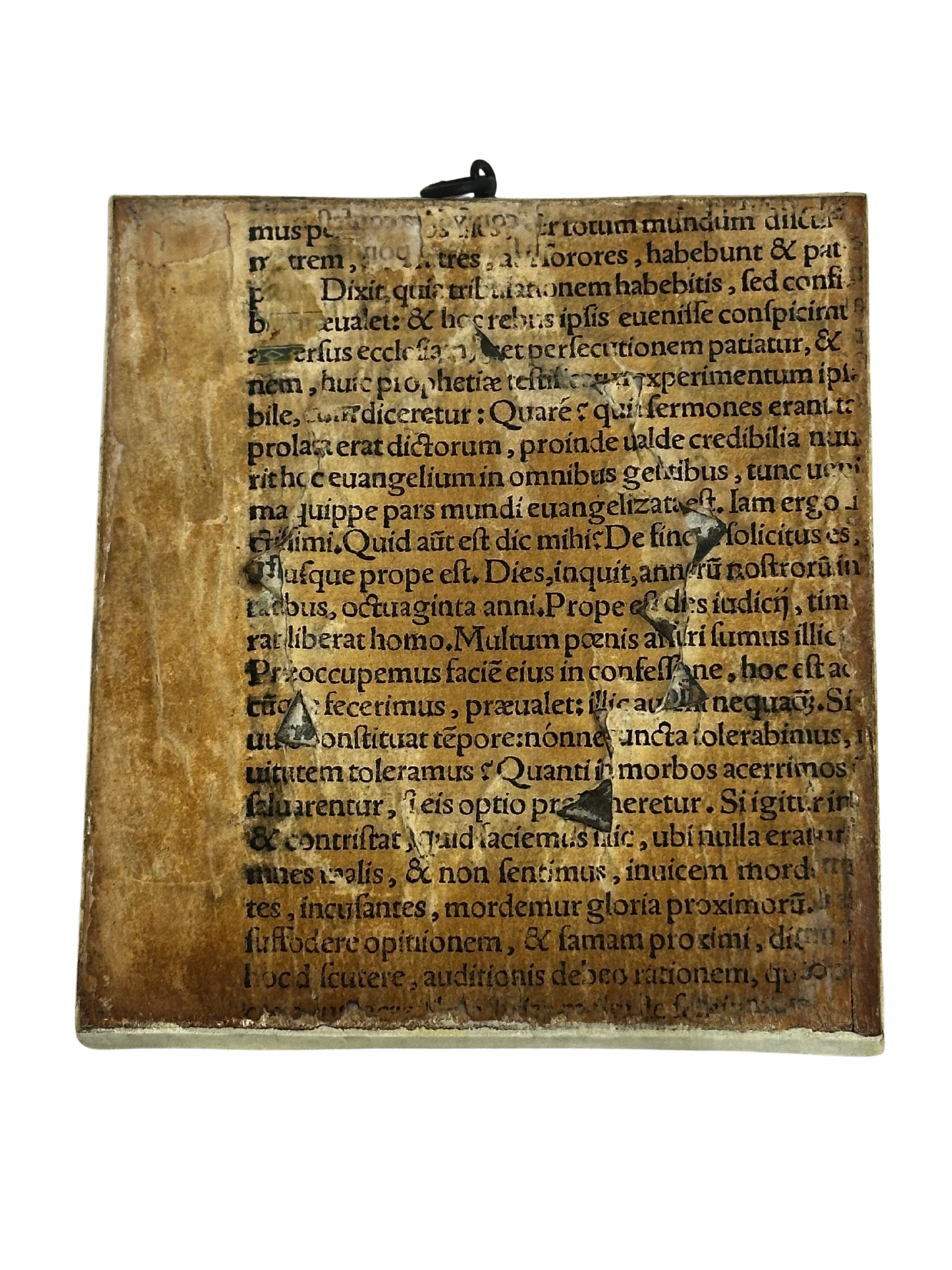
The frame retains an iron hanging loop affixed at the top edge. The reverse is particularly notable: it is backed with a sheet of early printed Latin text, likely taken from a theological or scholarly book, affixed as a backing material. Several small triangular metal tabs secure the backing in place. This use of recycled printed paper as a backing is historically consistent and adds both visual and documentary interest.
The surface of the portrait glass shows age-related haze, fine scratches, and light accretions. The painted image beneath appears stable, with no obvious active flaking visible in the photographs.
This antique object features a finely painted miniature portrait of a young woman, executed in delicate tones and mounted behind glass within a square, bone-inlaid wooden frame. The portrait depicts a sitter shown in three-quarter view, wearing a pale gown with a blue ribbon at the neckline, a jeweled pendant, and a narrow headband adorned with a small ornament. The handling of the face, hair, and drapery suggests a trained hand, with soft modeling and restrained coloration typical of early miniature portrait work.
The portrait is set within a circular aperture, surrounded by a radiating inlay of bone or ivory-like segments arranged in a sunburst or halo pattern. These segments are inset into a dark wooden ground, creating strong contrast and architectural framing. The inlay shows age-appropriate cracking, shrinkage, and tonal variation, all consistent with natural organic material over time.
The frame retains an iron hanging loop affixed at the top edge. The reverse is particularly notable: it is backed with a sheet of early printed Latin text, likely taken from a theological or scholarly book, affixed as a backing material. Several small triangular metal tabs secure the backing in place. This use of recycled printed paper as a backing is historically consistent and adds both visual and documentary interest.
The surface of the portrait glass shows age-related haze, fine scratches, and light accretions. The painted image beneath appears stable, with no obvious active flaking visible in the photographs.
4.75"h x 4"w
4.75"h x 4"w
Miniature portrait paintings were popular personal objects in Europe from the late 18th through the early 19th century, often commissioned as intimate keepsakes rather than formal state portraits. These works were typically painted in watercolor or gouache on vellum, paper, or thin card, and then mounted in lockets, frames, or decorative panels.
The surrounding bone or ivory-inlaid framing reflects decorative practices seen in both Continental and Anglo-European objects of the period, particularly in small personal or devotional items. The radiating inlay motif echoes neoclassical design language, emphasizing harmony and balance.
The use of recycled printed book pages as backing material was common in the period and can sometimes help broadly contextualize age, though it should not be relied upon for precise dating without further analysis. The Latin text visible here appears consistent with early printed theological or philosophical works.
Miniature portrait paintings were popular personal objects in Europe from the late 18th through the early 19th century, often commissioned as intimate keepsakes rather than formal state portraits. These works were typically painted in watercolor or gouache on vellum, paper, or thin card, and then mounted in lockets, frames, or decorative panels.
The surrounding bone or ivory-inlaid framing reflects decorative practices seen in both Continental and Anglo-European objects of the period, particularly in small personal or devotional items. The radiating inlay motif echoes neoclassical design language, emphasizing harmony and balance.
The use of recycled printed book pages as backing material was common in the period and can sometimes help broadly contextualize age, though it should not be relied upon for precise dating without further analysis. The Latin text visible here appears consistent with early printed theological or philosophical works.
19th Century
19th Century
Watercolor or gouache
Glass cover
Bone or ivory-like inlay (exact material untested)
Wooden frame with dark stained finish
Iron hanging loop
Printed paper backing with Latin text
Metal securing tabs
Watercolor or gouache
Glass cover
Bone or ivory-like inlay (exact material untested)
Wooden frame with dark stained finish
Iron hanging loop
Printed paper backing with Latin text
Metal securing tabs
Likely Continental European
Likely Continental European
Age-related cracking and separation to bone/ivory-like inlay
Surface haze, scratches, and accretions to the glass
Minor wear to frame edges and corners
Portrait surface appears stable but has not been examined out of frame
Antique object; imperfections are inherent and expected
Age-related cracking and separation to bone/ivory-like inlay
Surface haze, scratches, and accretions to the glass
Minor wear to frame edges and corners
Portrait surface appears stable but has not been examined out of frame
Antique object; imperfections are inherent and expected