

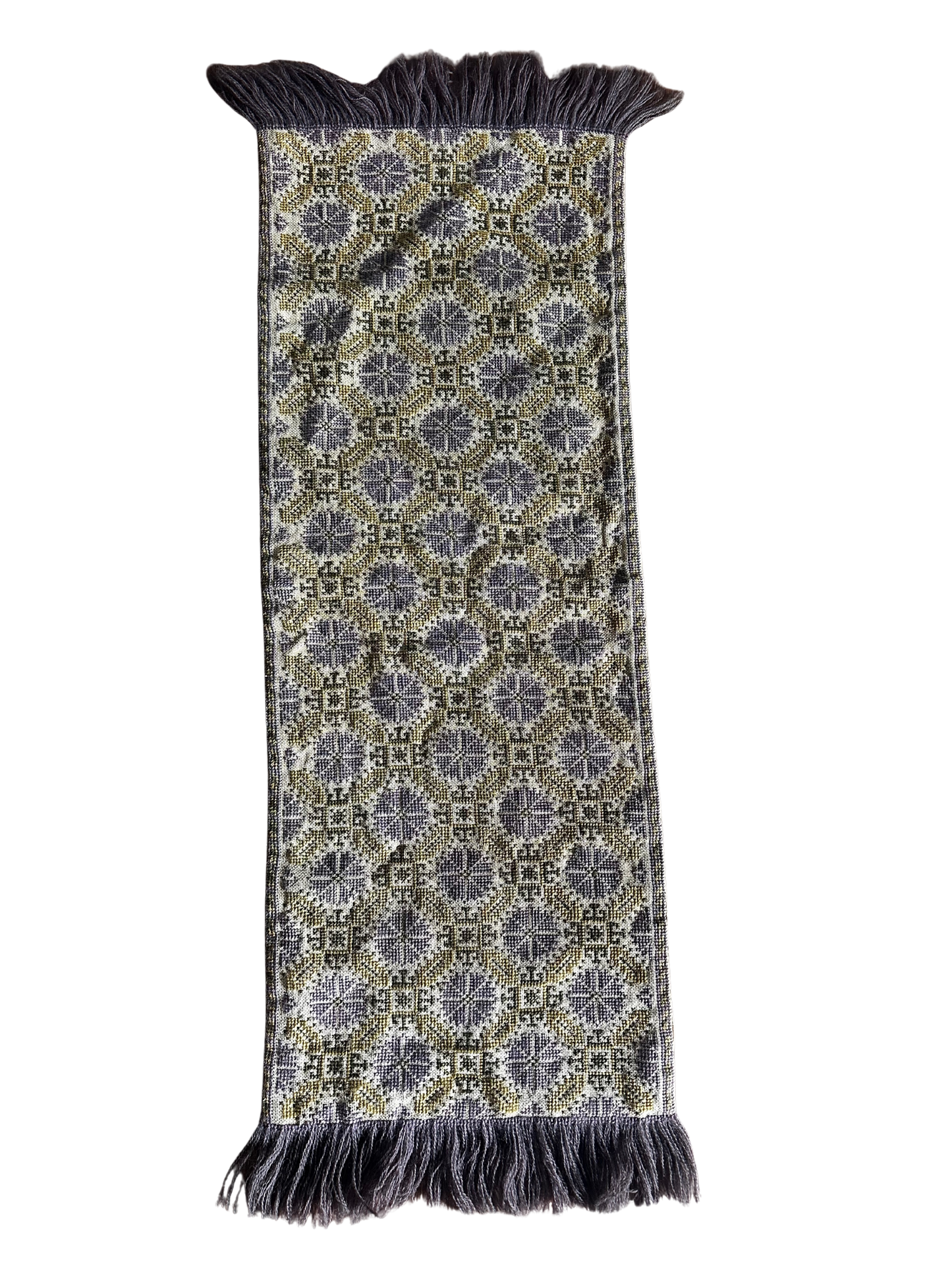
Antique Purple, Green, and Neutral Wool Woven Cross-Stitch Table Runner
Antique Purple, Green, and Neutral Wool Woven Cross-Stitch Table Runner
Couldn't load pickup availability
Share
Purple Green and Neutral Tone Woven Table Runner
hand-stitched wool table runner or ecclesiastical-style textile, very likely mid–late 19th century (ca. 1860–1900), and almost certainly European, with strong indicators of Central/Eastern European folk needlework tradition (Hungarian, Romanian, Slovak, or Ukrainian “Bereg” cross-stitch), or alternatively Germanic Alpine influence.
Stitching: Worked entirely in counted cross-stitch on an even-weave ground --> Indicates handwork, older than 1920s machine embroidery.
Colors: Muted gold/olive/ochre, dusky lavender/purple, black/charcoal --> Vegetable-dyed wool—earthy tones common in late 19th c. natural dyes, before aniline dyes became bright.
Pattern: Geometric rosettes with radiating spokes and diamond framing, repeated grid --> Typical of Eastern European folk textiles, especially Hungary/Transylvania and regions under Austro-Hungarian influence.
Fringe: Hand-applied twisted wool fringe (not rayon or silk) --> Suggests older, likely 19th c.
Backing: Simple, golden linen or cotton backing added (likely early–mid 20th c.). Suggests it was repurposed from a larger cloth into a runner. Past conservation.
“Worked ca. 1880–1900 using naturally dyed wool on linen. The muted tonal fading and hand-spun fringe confirm pre-aniline 19th-century origin. Later backed in the early 20th century for preservation, typical of genuine period textiles.”
Purple Green and Neutral Tone Woven Table Runner
hand-stitched wool table runner or ecclesiastical-style textile, very likely mid–late 19th century (ca. 1860–1900), and almost certainly European, with strong indicators of Central/Eastern European folk needlework tradition (Hungarian, Romanian, Slovak, or Ukrainian “Bereg” cross-stitch), or alternatively Germanic Alpine influence.
Stitching: Worked entirely in counted cross-stitch on an even-weave ground --> Indicates handwork, older than 1920s machine embroidery.
Colors: Muted gold/olive/ochre, dusky lavender/purple, black/charcoal --> Vegetable-dyed wool—earthy tones common in late 19th c. natural dyes, before aniline dyes became bright.
Pattern: Geometric rosettes with radiating spokes and diamond framing, repeated grid --> Typical of Eastern European folk textiles, especially Hungary/Transylvania and regions under Austro-Hungarian influence.
Fringe: Hand-applied twisted wool fringe (not rayon or silk) --> Suggests older, likely 19th c.
Backing: Simple, golden linen or cotton backing added (likely early–mid 20th c.). Suggests it was repurposed from a larger cloth into a runner. Past conservation.
“Worked ca. 1880–1900 using naturally dyed wool on linen. The muted tonal fading and hand-spun fringe confirm pre-aniline 19th-century origin. Later backed in the early 20th century for preservation, typical of genuine period textiles.”