


Architectural Study of an Ionic Capital Attributed to Phillip Douglas Creer, Charcoal Drawing
Architectural Study of an Ionic Capital Attributed to Phillip Douglas Creer, Charcoal Drawing
Couldn't load pickup availability
Share
Additional Description:
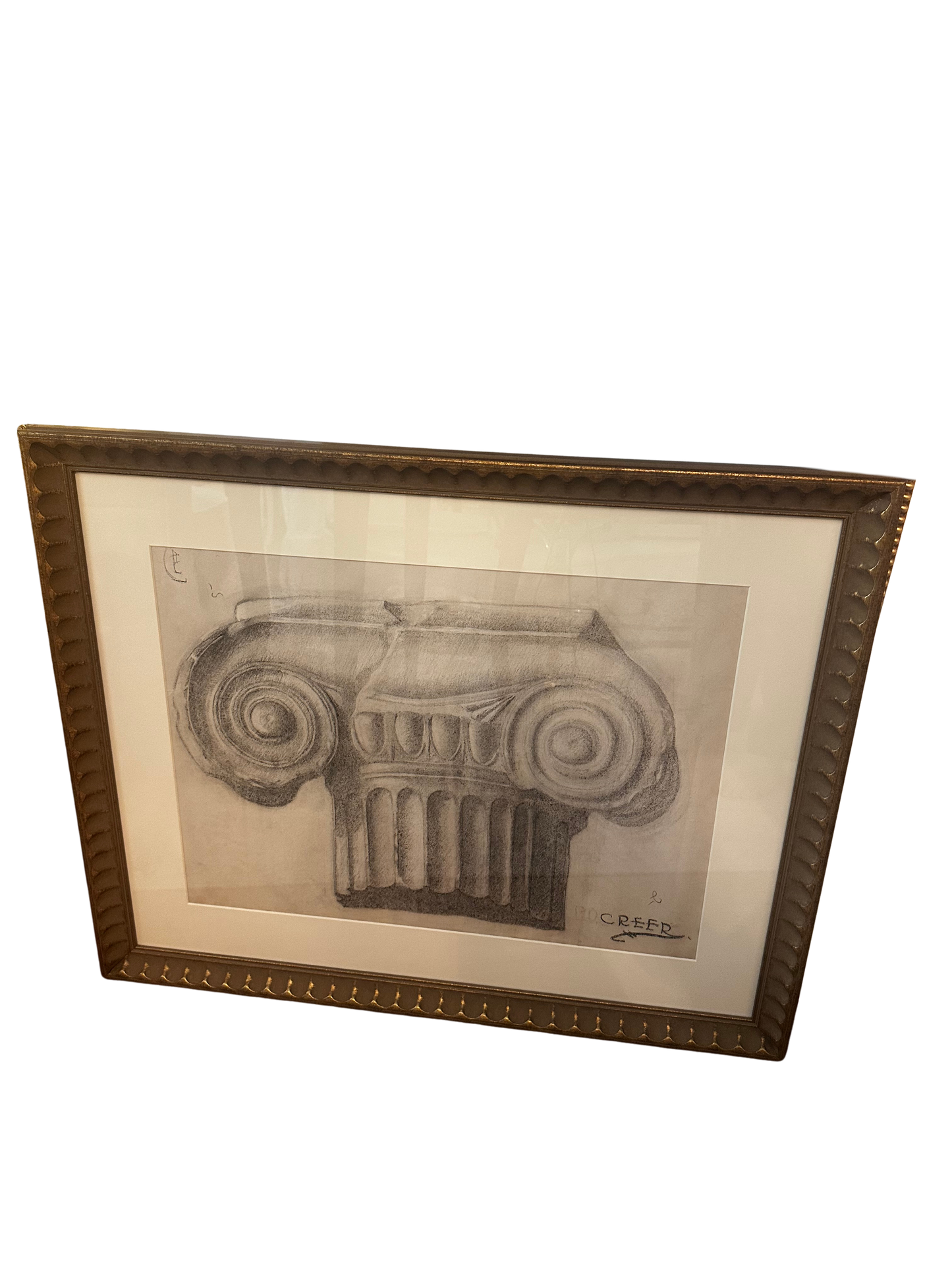
A striking academic architectural study depicting an Ionic column capital rendered in dramatic monochromatic shading, likely executed in charcoal or compressed charcoal on paper. The drawing focuses on the iconic volutes and fluted shaft of the classical order, emphasizing sculptural form, shadow, and architectural proportion through rich tonal gradation and confident draftsmanship.
The work appears to be a formal architectural or atelier study, likely produced as part of architectural training or restoration documentation. The artist carefully modeled the rounded volutes, egg-and-dart-inspired transitional detailing, and deeply shadowed fluting to create a powerful sense of monumentality despite the restrained composition.
Signed lower right “CREER,” which strongly suggests attribution to Phillip Douglas Creer, known for his architectural renderings, restoration interests, and classical architectural studies. Additional notation appears in the upper left margin, reinforcing the impression of this being a studio or academic reference drawing.
The piece is presented in an elegant giltwood frame with repeating carved bead ornamentation, complementing the neoclassical architectural subject beautifully.
Era:
Likely Mid-20th Century
History:
Architectural renderings and classical studies such as this were central to Beaux-Arts and classical architectural training throughout the late 19th and 20th centuries. Students and architects frequently produced detailed tonal studies of ancient architectural orders to understand proportion, shadow, and ornamentation.
If indeed by Phillip Douglas Creer, the drawing would connect to an architect and designer engaged with classical architectural vocabulary and preservation-oriented aesthetics. Works of this type bridge fine art and architectural draftsmanship, making them highly desirable among collectors of architectural studies and classically inspired interiors.
Provenance:
From a Texas estate collection. Attribution to Phillip Douglas Creer based on visible signature; further research recommended for definitive authentication.
Materials:
Charcoal or compressed charcoal on paper; archival matting under glass in giltwood frame.
Dimensions:
[Insert Dimensions]
Disclaimers:
Age-related toning, light surface wear, and minor spotting visible. Some reflections visible under glass. Frame shows expected wear including minor abrasions and finish inconsistencies. Attribution remains tentative pending further authentication or provenance documentation.
Additional Description:
A striking academic architectural study depicting an Ionic column capital rendered in dramatic monochromatic shading, likely executed in charcoal or compressed charcoal on paper. The drawing focuses on the iconic volutes and fluted shaft of the classical order, emphasizing sculptural form, shadow, and architectural proportion through rich tonal gradation and confident draftsmanship.
The work appears to be a formal architectural or atelier study, likely produced as part of architectural training or restoration documentation. The artist carefully modeled the rounded volutes, egg-and-dart-inspired transitional detailing, and deeply shadowed fluting to create a powerful sense of monumentality despite the restrained composition.
Signed lower right “CREER,” which strongly suggests attribution to Phillip Douglas Creer, known for his architectural renderings, restoration interests, and classical architectural studies. Additional notation appears in the upper left margin, reinforcing the impression of this being a studio or academic reference drawing.
The piece is presented in an elegant giltwood frame with repeating carved bead ornamentation, complementing the neoclassical architectural subject beautifully.
Era:
Likely Mid-20th Century
History:
Architectural renderings and classical studies such as this were central to Beaux-Arts and classical architectural training throughout the late 19th and 20th centuries. Students and architects frequently produced detailed tonal studies of ancient architectural orders to understand proportion, shadow, and ornamentation.
If indeed by Phillip Douglas Creer, the drawing would connect to an architect and designer engaged with classical architectural vocabulary and preservation-oriented aesthetics. Works of this type bridge fine art and architectural draftsmanship, making them highly desirable among collectors of architectural studies and classically inspired interiors.
Provenance:
From a Texas estate collection. Attribution to Phillip Douglas Creer based on visible signature; further research recommended for definitive authentication.
Materials:
Charcoal or compressed charcoal on paper; archival matting under glass in giltwood frame.
Dimensions:
[Insert Dimensions]
Disclaimers:
Age-related toning, light surface wear, and minor spotting visible. Some reflections visible under glass. Frame shows expected wear including minor abrasions and finish inconsistencies. Attribution remains tentative pending further authentication or provenance documentation.