

Belle Époque Dreyfous French Silk-Embroidered Photograph Frame with Hand-Colored T. H. Voigt Society Portrait
Belle Époque Dreyfous French Silk-Embroidered Photograph Frame with Hand-Colored T. H. Voigt Society Portrait
Couldn't load pickup availability
Share
Additional Description
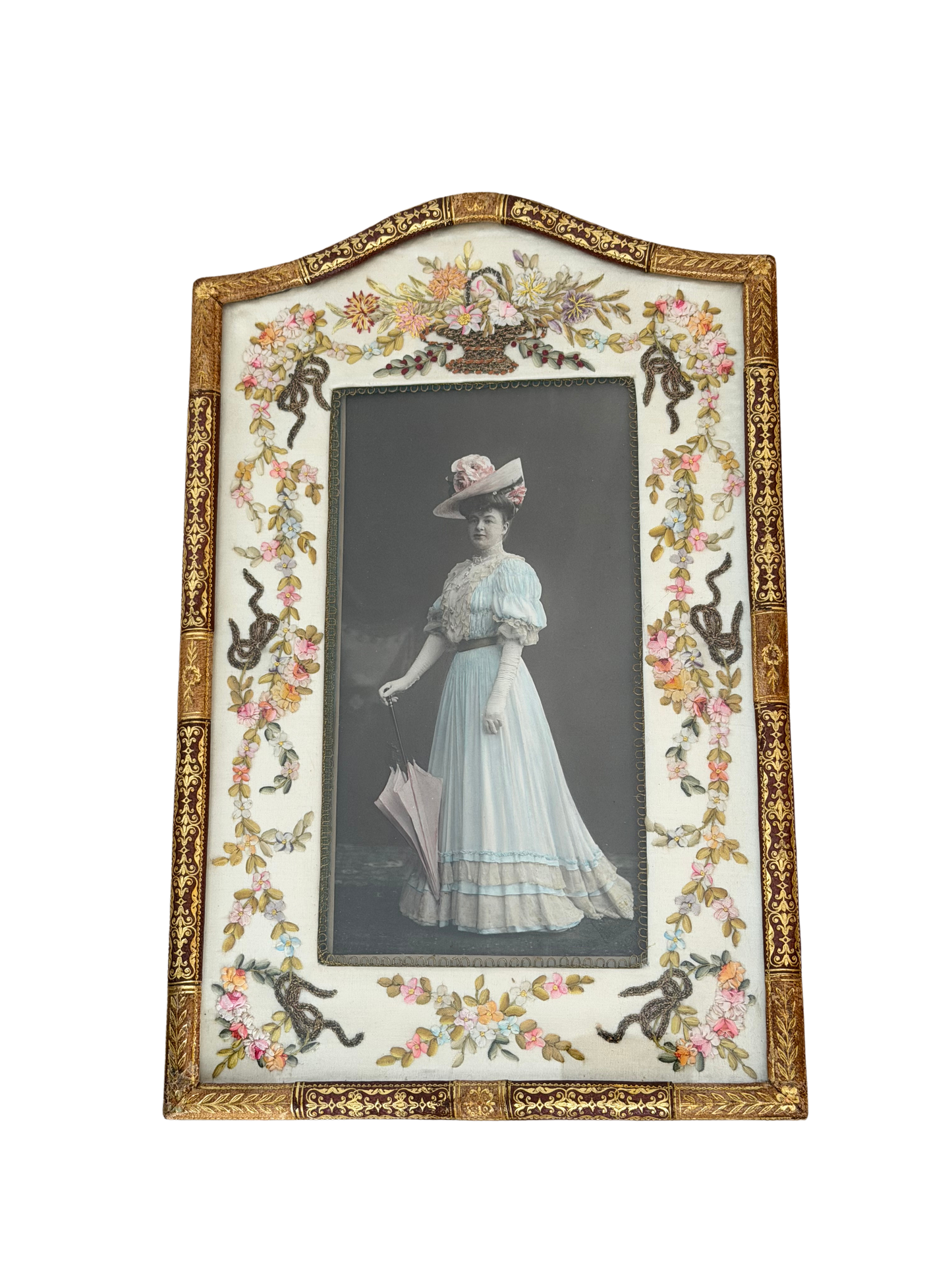
An exceptionally decorative Belle Époque photograph frame retailed by Dreyfous of Mount Street, London, enclosing a full-length, hand-colored studio portrait of an elegantly dressed woman holding a pink parasol.
The unidentified sitter is shown wearing a pale blue Edwardian day dress with puffed sleeves, a lace-trimmed bodice, tiered skirt, long white gloves, and a broad-brimmed hat lavishly adorned with pink roses. Delicate applied coloring accentuates the dress, flowers, parasol, and complexion while preserving the soft tonal quality of the original photographic image.
The portrait bears the impressed studio mark:
“T. H. Voigt / Frankfurt a/M. / Homburg v.d.H.”
The printed mount also identifies the T. H. Voigt studios in Frankfurt am Main and Homburg vor der Höhe. A handwritten or inscribed number appearing to read “4904” is visible at the lower right. This is most appropriately described as a studio negative, sitting, order, or inventory number rather than a confirmed date.
The portrait is presented within an elaborate French-made Dreyfous easel frame of arched architectural form. The ivory silk surround is richly embroidered with cascading floral garlands, baskets of flowers, scrolling ribbons, and ornamental flourishes worked in colored silk and metallic threads.
The outer frame is finished in alternating gilt and deep burgundy decorative panels embossed with scrolling foliate motifs. The reverse is covered in rose-pink woven silk and retains its hinged easel support, rotating brass closures, and gilt-stamped retailer’s mark:
“DREYFOUS, 19 MOUNT ST. W. / MADE IN FRANCE.”
The combination of fashionable portraiture, hand coloring, fine silk embroidery, metallic-thread ornament, and luxurious French presentation makes this a particularly refined example of turn-of-the-century photographic display.
Era
Circa 1903–1910.
The T. H. Voigt studio was continued after the death of its founder, Thomas Heinrich Voigt, by his widow and later in association with court photographer Wilhelm Hatzig. Archival sources indicate that Hatzig was connected with the studio from approximately 1903, which corresponds with the printed reverse identifying W. Hatzig-Voigt as proprietor.
The sitter’s clothing and the construction and decoration of the Dreyfous frame are likewise consistent with the first decade of the 20th century.
History
Thomas Heinrich Voigt was a German painter and photographer born in Bad Homburg in 1838. Trained initially as a painter, he became a prominent court photographer with studios in Bad Homburg and Frankfurt. His practice was associated with portraits of the German imperial family, European royalty, and affluent visitors to the fashionable spa resort of Homburg. He died in 1896.
Following his death, the studio continued under his established name. His widow Louise initially carried on the business, and from approximately 1903 the court photographer Wilhelm Hatzig became associated with the operation. Surviving institutional examples identify photographs with inscriptions naming Voigt, proprietor Wilhelm Hatzig, confirming the continuation of the prestigious studio identity into the early 20th century.
The reverse of this mount lists Voigt’s royal and imperial patronage and describes the establishment as a Hofphotograph, or court photographer. These elaborate printed credentials were part of the studio’s luxury branding and do not establish the identity or social rank of this particular sitter.
Dreyfous was a high-end retailer of antiques, furniture, and decorative objects active in London during the late 19th and early 20th centuries. The firm was French in origin and operated from premises in London’s fashionable Mayfair district. Surviving marked objects demonstrate that Dreyfous sold French-made luxury furnishings and decorative accessories through its Mount Street establishment.
Provenance
Private collection; acquired through the antiques trade.
The photograph remains accompanied by its T. H. Voigt studio mount and is currently fitted within the marked Dreyfous frame.
No documented family history, earlier collection record, or confirmed identification of the sitter accompanies the piece. Although the photograph and frame are period-compatible and appear to have been associated for a considerable time, their original pairing cannot be proven from the available evidence.
Materials
Hand-colored photographic portrait on mounted card
Ivory silk or satin embroidery ground
Colored silk embroidery threads
Metallic-wrapped embroidery threads
Glass glazing
Fabric-covered wood, board, or composition frame structure
Embossed and gilt-decorated leather or leather-effect outer covering
Rose-pink woven silk reverse covering
Hinged easel support
Brass or gilt-metal swivel closures
The outer material should be described as leather or leather-effect covering unless physical examination confirms genuine leather.
Dimensions
Exact dimensions were not supplied. Based on the scale shown, the approximate dimensions are:
Overall frame: 14–15 inches high × 10–11 inches wide
Visible photograph: 9–10 inches high × 5–6 inches wide
Exact measurements should be substituted before publication.
Condition
The frame and portrait present very attractively overall, with age-related wear consistent with an object more than a century old.
The photograph exhibits scattered foxing, spotting, surface dust, minor fading, and age toning. Some discoloration is visible through the pale portions of the dress and along the lower image. The applied coloring remains clear and visually appealing.
The embroidered silk surround displays generalized age toning, scattered small marks, minor fading, and possible isolated loose or weakened threads. The majority of the embroidery appears intact and retains good color.
The gilt and burgundy outer covering has rubbing, abrasions, minor cracking, small losses, and wear along the raised edges and corners. The reverse pink silk shows fading, staining, small punctures, edge wear, and losses near the lower edge and easel support.
The easel stand and brass closures remain present. The glazing shows dust and reflections and may have minor scratches not visible in the photographs.
Disclaimers
The photograph bears the T. H. Voigt studio name but was produced after the death of Thomas Heinrich Voigt and should be attributed to the continuing T. H. Voigt studio under W. Hatzig-Voigt, rather than personally to Thomas Heinrich Voigt.
The inscription at the lower right appears to read “4904.” It is described as a studio negative, sitting, order, or inventory reference. It has not been verified as a date, and the photograph should not be catalogued as dated 1904 without supporting studio documentation.
The sitter is unidentified. Her fashionable clothing, elaborate portrait presentation, and use of a court photography studio suggest an affluent or socially prominent client, but no claim of aristocratic, royal, or otherwise notable identity is intended.
The frame is marked Dreyfous, 19 Mount Street, London, Made in France. Dreyfous is treated as the retailer; the identity of the actual French frame manufacturer is unknown.
The photograph and frame are period-compatible, but it cannot be conclusively established that they were originally sold together.
The piece has not been dismantled or examined by a textile conservator, photograph conservator, or materials specialist. Dating, construction, materials, condition, and attribution are based on visible markings, photographic examination, and available historical sources.
Additional Description
An exceptionally decorative Belle Époque photograph frame retailed by Dreyfous of Mount Street, London, enclosing a full-length, hand-colored studio portrait of an elegantly dressed woman holding a pink parasol.
The unidentified sitter is shown wearing a pale blue Edwardian day dress with puffed sleeves, a lace-trimmed bodice, tiered skirt, long white gloves, and a broad-brimmed hat lavishly adorned with pink roses. Delicate applied coloring accentuates the dress, flowers, parasol, and complexion while preserving the soft tonal quality of the original photographic image.
The portrait bears the impressed studio mark:
“T. H. Voigt / Frankfurt a/M. / Homburg v.d.H.”
The printed mount also identifies the T. H. Voigt studios in Frankfurt am Main and Homburg vor der Höhe. A handwritten or inscribed number appearing to read “4904” is visible at the lower right. This is most appropriately described as a studio negative, sitting, order, or inventory number rather than a confirmed date.
The portrait is presented within an elaborate French-made Dreyfous easel frame of arched architectural form. The ivory silk surround is richly embroidered with cascading floral garlands, baskets of flowers, scrolling ribbons, and ornamental flourishes worked in colored silk and metallic threads.
The outer frame is finished in alternating gilt and deep burgundy decorative panels embossed with scrolling foliate motifs. The reverse is covered in rose-pink woven silk and retains its hinged easel support, rotating brass closures, and gilt-stamped retailer’s mark:
“DREYFOUS, 19 MOUNT ST. W. / MADE IN FRANCE.”
The combination of fashionable portraiture, hand coloring, fine silk embroidery, metallic-thread ornament, and luxurious French presentation makes this a particularly refined example of turn-of-the-century photographic display.
Era
Circa 1903–1910.
The T. H. Voigt studio was continued after the death of its founder, Thomas Heinrich Voigt, by his widow and later in association with court photographer Wilhelm Hatzig. Archival sources indicate that Hatzig was connected with the studio from approximately 1903, which corresponds with the printed reverse identifying W. Hatzig-Voigt as proprietor.
The sitter’s clothing and the construction and decoration of the Dreyfous frame are likewise consistent with the first decade of the 20th century.
History
Thomas Heinrich Voigt was a German painter and photographer born in Bad Homburg in 1838. Trained initially as a painter, he became a prominent court photographer with studios in Bad Homburg and Frankfurt. His practice was associated with portraits of the German imperial family, European royalty, and affluent visitors to the fashionable spa resort of Homburg. He died in 1896.
Following his death, the studio continued under his established name. His widow Louise initially carried on the business, and from approximately 1903 the court photographer Wilhelm Hatzig became associated with the operation. Surviving institutional examples identify photographs with inscriptions naming Voigt, proprietor Wilhelm Hatzig, confirming the continuation of the prestigious studio identity into the early 20th century.
The reverse of this mount lists Voigt’s royal and imperial patronage and describes the establishment as a Hofphotograph, or court photographer. These elaborate printed credentials were part of the studio’s luxury branding and do not establish the identity or social rank of this particular sitter.
Dreyfous was a high-end retailer of antiques, furniture, and decorative objects active in London during the late 19th and early 20th centuries. The firm was French in origin and operated from premises in London’s fashionable Mayfair district. Surviving marked objects demonstrate that Dreyfous sold French-made luxury furnishings and decorative accessories through its Mount Street establishment.
Provenance
Private collection; acquired through the antiques trade.
The photograph remains accompanied by its T. H. Voigt studio mount and is currently fitted within the marked Dreyfous frame.
No documented family history, earlier collection record, or confirmed identification of the sitter accompanies the piece. Although the photograph and frame are period-compatible and appear to have been associated for a considerable time, their original pairing cannot be proven from the available evidence.
Materials
Hand-colored photographic portrait on mounted card
Ivory silk or satin embroidery ground
Colored silk embroidery threads
Metallic-wrapped embroidery threads
Glass glazing
Fabric-covered wood, board, or composition frame structure
Embossed and gilt-decorated leather or leather-effect outer covering
Rose-pink woven silk reverse covering
Hinged easel support
Brass or gilt-metal swivel closures
The outer material should be described as leather or leather-effect covering unless physical examination confirms genuine leather.
Dimensions
Exact dimensions were not supplied. Based on the scale shown, the approximate dimensions are:
Overall frame: 14–15 inches high × 10–11 inches wide
Visible photograph: 9–10 inches high × 5–6 inches wide
Exact measurements should be substituted before publication.
Condition
The frame and portrait present very attractively overall, with age-related wear consistent with an object more than a century old.
The photograph exhibits scattered foxing, spotting, surface dust, minor fading, and age toning. Some discoloration is visible through the pale portions of the dress and along the lower image. The applied coloring remains clear and visually appealing.
The embroidered silk surround displays generalized age toning, scattered small marks, minor fading, and possible isolated loose or weakened threads. The majority of the embroidery appears intact and retains good color.
The gilt and burgundy outer covering has rubbing, abrasions, minor cracking, small losses, and wear along the raised edges and corners. The reverse pink silk shows fading, staining, small punctures, edge wear, and losses near the lower edge and easel support.
The easel stand and brass closures remain present. The glazing shows dust and reflections and may have minor scratches not visible in the photographs.
Disclaimers
The photograph bears the T. H. Voigt studio name but was produced after the death of Thomas Heinrich Voigt and should be attributed to the continuing T. H. Voigt studio under W. Hatzig-Voigt, rather than personally to Thomas Heinrich Voigt.
The inscription at the lower right appears to read “4904.” It is described as a studio negative, sitting, order, or inventory reference. It has not been verified as a date, and the photograph should not be catalogued as dated 1904 without supporting studio documentation.
The sitter is unidentified. Her fashionable clothing, elaborate portrait presentation, and use of a court photography studio suggest an affluent or socially prominent client, but no claim of aristocratic, royal, or otherwise notable identity is intended.
The frame is marked Dreyfous, 19 Mount Street, London, Made in France. Dreyfous is treated as the retailer; the identity of the actual French frame manufacturer is unknown.
The photograph and frame are period-compatible, but it cannot be conclusively established that they were originally sold together.
The piece has not been dismantled or examined by a textile conservator, photograph conservator, or materials specialist. Dating, construction, materials, condition, and attribution are based on visible markings, photographic examination, and available historical sources.