

Boulle Dual Perfume Bottle Caddy with Key (Monogrammed and Signed S Mal Paris) - Maison Smal L. Dujat (1850s)
Boulle Dual Perfume Bottle Caddy with Key (Monogrammed and Signed S Mal Paris) - Maison Smal L. Dujat (1850s)
Couldn't load pickup availability
Share
Boulle Perfume Box Holder with Bottles and Key (Monogrammed; Smal Paris)
Maison Smal L. Dujat (Louis Dujat) - Palais Royal, Galerie Montpensier 7 & 8 Paris
Circa 1850s
Lined in cream velvet or chamois
Contains two matching hand-blown, gilt enameled crystal perfume bottls, each with gilded starburst motifs typical of Baccarat, Saint Louis and other French suppliers
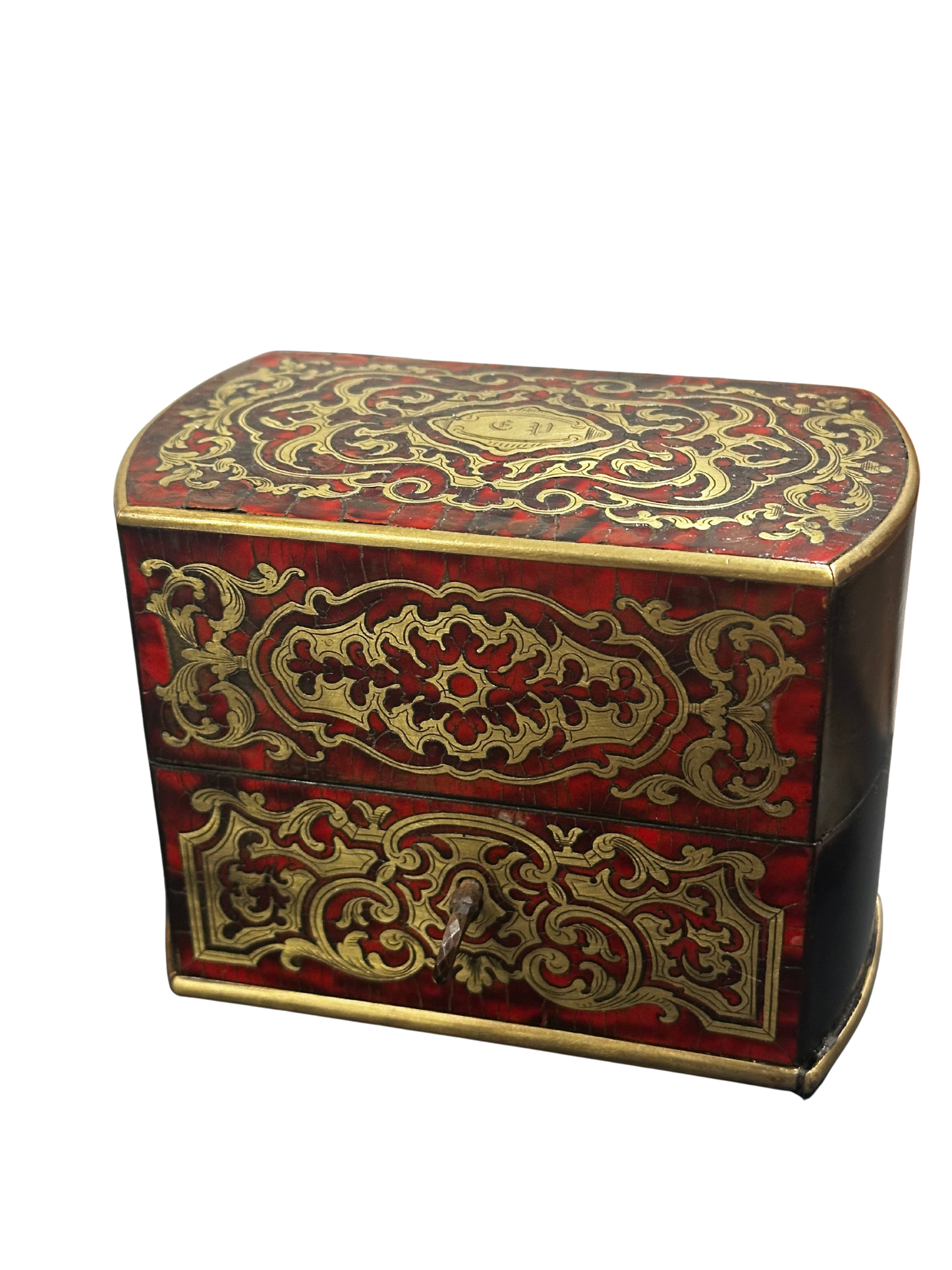
Surface shows translucent red-orange depth with variation and mottling beneath the brass
Faux shell usually reads flat or uniform; real has the glowing from withing warmth
Fine, irregular craquelure and separation lines visible here are consistent with the natural expansion/contraction of true shell over 170 years; organic network
Switch to faux shell didn't become common until 1880s-90s, after Maison Smal/Dujat timeline
Early and mi-19th century Boulle marquetry was constructed in layers rather than solid shell
Tortoise Boulle work sits on a veneered wood base, most often mahogany, oak or walnut; craftsman would first shape the box from soli wood; then, a thin veneer of tortoisesheel was glued to the surface using hot hide glue; needed the wooden backing for stability; tiny movements in the wood over time from humidity cause the hairline cracks and raised seams2
Boulle Perfume Box Holder with Bottles and Key (Monogrammed; Smal Paris)
Maison Smal L. Dujat (Louis Dujat) - Palais Royal, Galerie Montpensier 7 & 8 Paris
Circa 1850s
Lined in cream velvet or chamois
Contains two matching hand-blown, gilt enameled crystal perfume bottls, each with gilded starburst motifs typical of Baccarat, Saint Louis and other French suppliers
Surface shows translucent red-orange depth with variation and mottling beneath the brass
Faux shell usually reads flat or uniform; real has the glowing from withing warmth
Fine, irregular craquelure and separation lines visible here are consistent with the natural expansion/contraction of true shell over 170 years; organic network
Switch to faux shell didn't become common until 1880s-90s, after Maison Smal/Dujat timeline
Early and mi-19th century Boulle marquetry was constructed in layers rather than solid shell
Tortoise Boulle work sits on a veneered wood base, most often mahogany, oak or walnut; craftsman would first shape the box from soli wood; then, a thin veneer of tortoisesheel was glued to the surface using hot hide glue; needed the wooden backing for stability; tiny movements in the wood over time from humidity cause the hairline cracks and raised seams2