


Early 20th-Century European School Formal Garden Landscape with Reclining Lions, Signed “P. Hoote” or Similar
Early 20th-Century European School Formal Garden Landscape with Reclining Lions, Signed “P. Hoote” or Similar
Couldn't load pickup availability
Share
Additional Description:
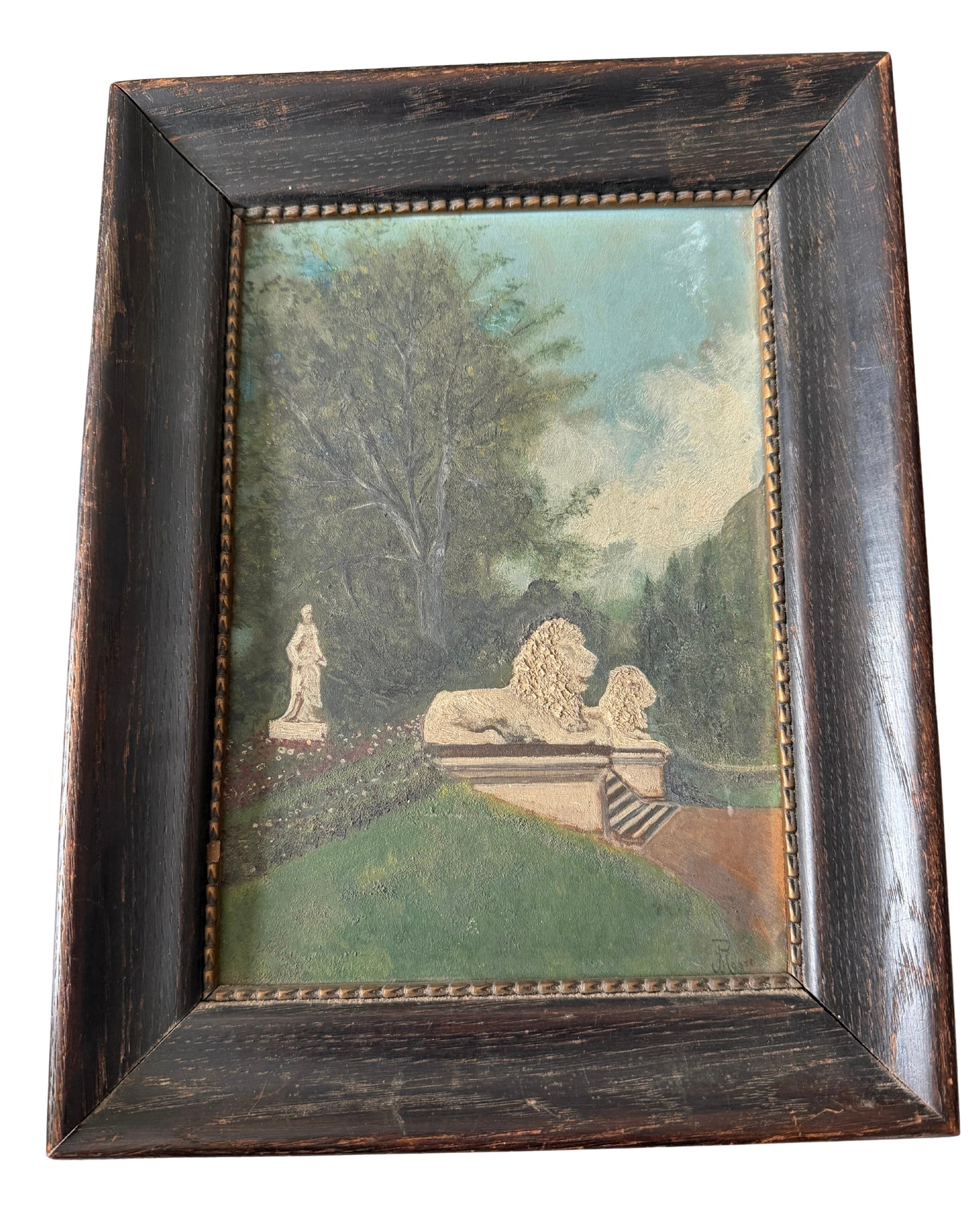
An atmospheric early 20th-century landscape depicting a formal European garden animated by classical sculpture. At the center of the composition, a monumental recumbent lion and lioness rest upon a stone plinth beside a short flight of steps. A solitary classical figure stands farther back among planted flower beds, mature trees, and dense, shadowed foliage.
The garden opens toward a distant mountainous landscape beneath a luminous blue-green sky with softly modeled clouds. The artist used notably textured paint in the trees, clouds, statuary, and the lions’ manes, creating a tactile, almost relief-like surface. The muted palette of moss green, blue-gray, cream, and warm brown gives the scene a romantic and slightly mysterious quality.
The work is signed at the lower right with a partially legible inscription that appears to read “P. Hoote,” “P. Hootes,” or similar. The artist has not been conclusively identified.
The painting is presented in a broad dark-stained wooden frame with a narrow gilt beaded liner, likely dating from the early to mid-20th century.
Era:
European, likely circa 1910–1940.
History:
Formal gardens incorporating classical statuary, architectural fragments, and sculpted animals were popular subjects in European painting during the late 19th and early 20th centuries. These scenes often reflected continued interest in aristocratic estates, Italianate gardens, historic parklands, and the romantic imagery of cultivated nature.
The reclining lions may depict sculptures from a specific garden or estate, although the location has not been identified. The composition may also be an imagined or interpretive garden view assembled by the artist from familiar classical elements.
The painting’s textured handling, subdued coloration, and decorative presentation are consistent with early 20th-century Continental landscape painting intended for domestic display.
Signature:
Signed lower right “P. Hoote,” “P. Hootes,” or similar. The signature is partially indistinct and may be read differently.
Provenance:
Acquired through the antiques and decorative arts trade. Earlier ownership, exhibition history, and original location are unknown.
Materials:
Oil on prepared artist’s board or canvas-textured board, housed in a dark-stained wooden frame with gilt beaded inner molding and paper backing.
Dimensions:
Please provide:
Sight height and width
Overall framed height and width
Frame depth
Condition:
Early 20th-century condition with wear consistent with age. The painted surface shows accumulated grime, scattered abrasions, light scratches, surface irregularities, and areas of pronounced impasto. Minor paint loss, discoloration, compression beneath the frame edge, and possible old retouching may be present.
The frame shows rubbing, scratches, finish loss, exposed wood, age-related separation at the corner joints, and wear to the gilt beaded liner. The reverse paper backing is heavily toned, torn, patched, and separating in areas. The painting has not been removed from the frame, and the reverse of the support has not been examined.
Disclaimers:
The artist has not been identified. The visible signature is transcribed as “P. Hoote,” “P. Hootes,” or similar, but the reading is not definitive. No attribution to a listed or documented artist is being made.
The precise country of origin, date, location depicted, medium, and support have not been professionally confirmed. The frame may be original, period-associated, or an early replacement. The painting has not been examined under ultraviolet light or evaluated by a professional conservator. Any cleaning or restoration should be undertaken only by a qualified paintings conservator.
Additional Description:
An atmospheric early 20th-century landscape depicting a formal European garden animated by classical sculpture. At the center of the composition, a monumental recumbent lion and lioness rest upon a stone plinth beside a short flight of steps. A solitary classical figure stands farther back among planted flower beds, mature trees, and dense, shadowed foliage.
The garden opens toward a distant mountainous landscape beneath a luminous blue-green sky with softly modeled clouds. The artist used notably textured paint in the trees, clouds, statuary, and the lions’ manes, creating a tactile, almost relief-like surface. The muted palette of moss green, blue-gray, cream, and warm brown gives the scene a romantic and slightly mysterious quality.
The work is signed at the lower right with a partially legible inscription that appears to read “P. Hoote,” “P. Hootes,” or similar. The artist has not been conclusively identified.
The painting is presented in a broad dark-stained wooden frame with a narrow gilt beaded liner, likely dating from the early to mid-20th century.
Era:
European, likely circa 1910–1940.
History:
Formal gardens incorporating classical statuary, architectural fragments, and sculpted animals were popular subjects in European painting during the late 19th and early 20th centuries. These scenes often reflected continued interest in aristocratic estates, Italianate gardens, historic parklands, and the romantic imagery of cultivated nature.
The reclining lions may depict sculptures from a specific garden or estate, although the location has not been identified. The composition may also be an imagined or interpretive garden view assembled by the artist from familiar classical elements.
The painting’s textured handling, subdued coloration, and decorative presentation are consistent with early 20th-century Continental landscape painting intended for domestic display.
Signature:
Signed lower right “P. Hoote,” “P. Hootes,” or similar. The signature is partially indistinct and may be read differently.
Provenance:
Acquired through the antiques and decorative arts trade. Earlier ownership, exhibition history, and original location are unknown.
Materials:
Oil on prepared artist’s board or canvas-textured board, housed in a dark-stained wooden frame with gilt beaded inner molding and paper backing.
Dimensions:
Please provide:
Sight height and width
Overall framed height and width
Frame depth
Condition:
Early 20th-century condition with wear consistent with age. The painted surface shows accumulated grime, scattered abrasions, light scratches, surface irregularities, and areas of pronounced impasto. Minor paint loss, discoloration, compression beneath the frame edge, and possible old retouching may be present.
The frame shows rubbing, scratches, finish loss, exposed wood, age-related separation at the corner joints, and wear to the gilt beaded liner. The reverse paper backing is heavily toned, torn, patched, and separating in areas. The painting has not been removed from the frame, and the reverse of the support has not been examined.
Disclaimers:
The artist has not been identified. The visible signature is transcribed as “P. Hoote,” “P. Hootes,” or similar, but the reading is not definitive. No attribution to a listed or documented artist is being made.
The precise country of origin, date, location depicted, medium, and support have not been professionally confirmed. The frame may be original, period-associated, or an early replacement. The painting has not been examined under ultraviolet light or evaluated by a professional conservator. Any cleaning or restoration should be undertaken only by a qualified paintings conservator.