


English Regency Rosewood Marquetry Work Box with Floral Inlay and Green Silk Interior, Circa 1820–1840
English Regency Rosewood Marquetry Work Box with Floral Inlay and Green Silk Interior, Circa 1820–1840
Couldn't load pickup availability
Share


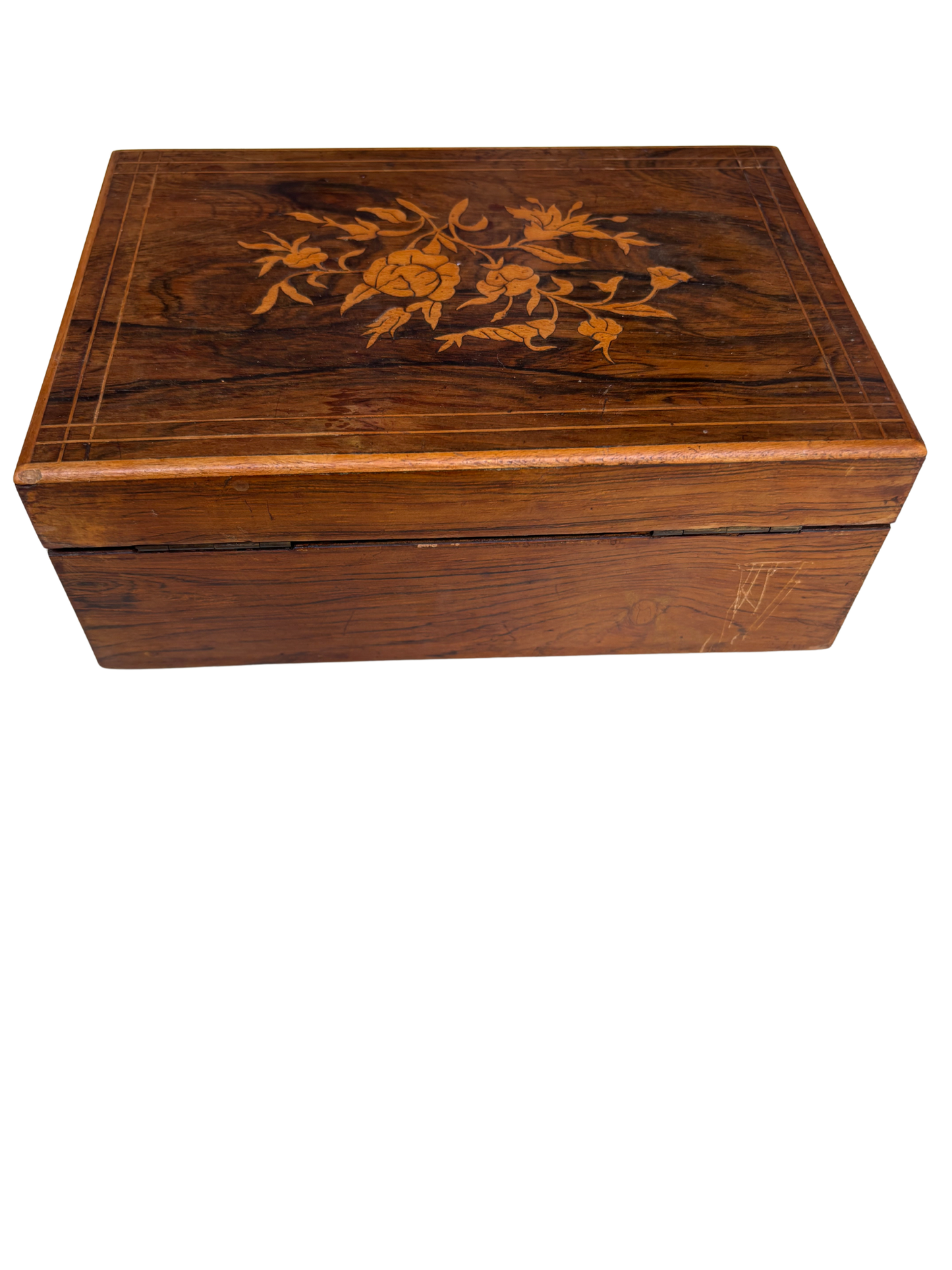
A charming English Regency work or sewing box crafted in richly figured rosewood and embellished with delicate floral marquetry and fine linear inlay.
The rectangular hinged lid is centered by an elegant floral spray composed of contrasting light-toned woods, depicting blossoms, leaves, and scrolling stems against the dramatic dark grain of the rosewood. Fine multiple-line stringing frames the lid and continues around the body, giving the otherwise restrained form a particularly refined appearance.
Opening the box reveals a striking fitted interior lined in vivid emerald-green patterned silk, decorated with repeating stylized floral or paisley-like motifs in pink, blue, yellow, and gold tones. The textile is edged with metallic braid, creating a wonderfully decorative contrast against the dark timber.
The box retains its period lock and key. The interior presently forms a single open compartment and may originally have held a removable fitted tray or sewing accessories, as was common among Regency and early Victorian work boxes.
Its combination of richly figured rosewood, floral marquetry, fine stringing, and jewel-toned textile lining makes this an especially attractive decorative box for display, jewelry, correspondence, or small collectibles.
A charming English Regency work or sewing box crafted in richly figured rosewood and embellished with delicate floral marquetry and fine linear inlay.
The rectangular hinged lid is centered by an elegant floral spray composed of contrasting light-toned woods, depicting blossoms, leaves, and scrolling stems against the dramatic dark grain of the rosewood. Fine multiple-line stringing frames the lid and continues around the body, giving the otherwise restrained form a particularly refined appearance.
Opening the box reveals a striking fitted interior lined in vivid emerald-green patterned silk, decorated with repeating stylized floral or paisley-like motifs in pink, blue, yellow, and gold tones. The textile is edged with metallic braid, creating a wonderfully decorative contrast against the dark timber.
The box retains its period lock and key. The interior presently forms a single open compartment and may originally have held a removable fitted tray or sewing accessories, as was common among Regency and early Victorian work boxes.
Its combination of richly figured rosewood, floral marquetry, fine stringing, and jewel-toned textile lining makes this an especially attractive decorative box for display, jewelry, correspondence, or small collectibles.
2.75"h x 7.5"w x 5.25"d
2.75"h x 7.5"w x 5.25"d
Decorative work boxes became fashionable personal accessories in Britain during the late Georgian and Regency periods, when needlework formed an important part of domestic and social life.
Produced by specialist cabinet and box makers, finer examples were constructed in fashionable exotic woods such as rosewood, mahogany, and coromandel and embellished with marquetry, brass, mother-of-pearl, or contrasting wood inlay. Interiors were frequently fitted with removable trays, small compartments, needle books, pincushions, and silk-lined storage areas.
Floral marquetry remained especially popular during the first half of the 19th century, while rosewood was prized for its pronounced grain and rich reddish-brown coloration. Boxes of this type often served as both practical sewing companions and decorative objects intended to be displayed within a lady's dressing room or drawing room.
Although the precise original function cannot be established with certainty from the surviving interior, the form and textile-lined compartment are most consistent with a work, sewing, or personal effects box.
Decorative work boxes became fashionable personal accessories in Britain during the late Georgian and Regency periods, when needlework formed an important part of domestic and social life.
Produced by specialist cabinet and box makers, finer examples were constructed in fashionable exotic woods such as rosewood, mahogany, and coromandel and embellished with marquetry, brass, mother-of-pearl, or contrasting wood inlay. Interiors were frequently fitted with removable trays, small compartments, needle books, pincushions, and silk-lined storage areas.
Floral marquetry remained especially popular during the first half of the 19th century, while rosewood was prized for its pronounced grain and rich reddish-brown coloration. Boxes of this type often served as both practical sewing companions and decorative objects intended to be displayed within a lady's dressing room or drawing room.
Although the precise original function cannot be established with certainty from the surviving interior, the form and textile-lined compartment are most consistent with a work, sewing, or personal effects box.
English Regency to early Victorian, circa 1820–1840
English Regency to early Victorian, circa 1820–1840
Rosewood veneer and secondary woods; contrasting wood floral marquetry and stringing; brass hinges and lock; iron or steel key; patterned silk textile; metallic braid trim.
Rosewood veneer and secondary woods; contrasting wood floral marquetry and stringing; brass hinges and lock; iron or steel key; patterned silk textile; metallic braid trim.
French; acquired in France. No maker's label or identifying mark observed in the photographs provided.
French; acquired in France. No maker's label or identifying mark observed in the photographs provided.
Antique condition consistent with approximately two centuries of age and use. The exterior retains an attractive aged surface with scattered scratches, abrasions, small veneer separations, finish variation, edge wear, and minor losses.
The lid and case show localized age-related movement and separation along certain veneer seams. The floral marquetry and linear inlay remain substantially intact.
The green textile interior displays fading, staining, wear, small losses, loose threads, and age-related deterioration. Evidence suggests that the box may originally have contained a removable fitted tray or additional interior fittings which are no longer present.
The lock and key are retained; functionality should not be assumed unless tested. Evidence of old repairs or later restoration may be present.
Please review all photographs carefully, as they form an important part of the condition description.
Antique condition consistent with approximately two centuries of age and use. The exterior retains an attractive aged surface with scattered scratches, abrasions, small veneer separations, finish variation, edge wear, and minor losses.
The lid and case show localized age-related movement and separation along certain veneer seams. The floral marquetry and linear inlay remain substantially intact.
The green textile interior displays fading, staining, wear, small losses, loose threads, and age-related deterioration. Evidence suggests that the box may originally have contained a removable fitted tray or additional interior fittings which are no longer present.
The lock and key are retained; functionality should not be assumed unless tested. Evidence of old repairs or later restoration may be present.
Please review all photographs carefully, as they form an important part of the condition description.