


English Victorian Carved Oak Three-Bottle Tantalus and Games Compendium with Cut Glass Decanters, Circa 1880–1900
English Victorian Carved Oak Three-Bottle Tantalus and Games Compendium with Cut Glass Decanters, Circa 1880–1900
Couldn't load pickup availability
Share


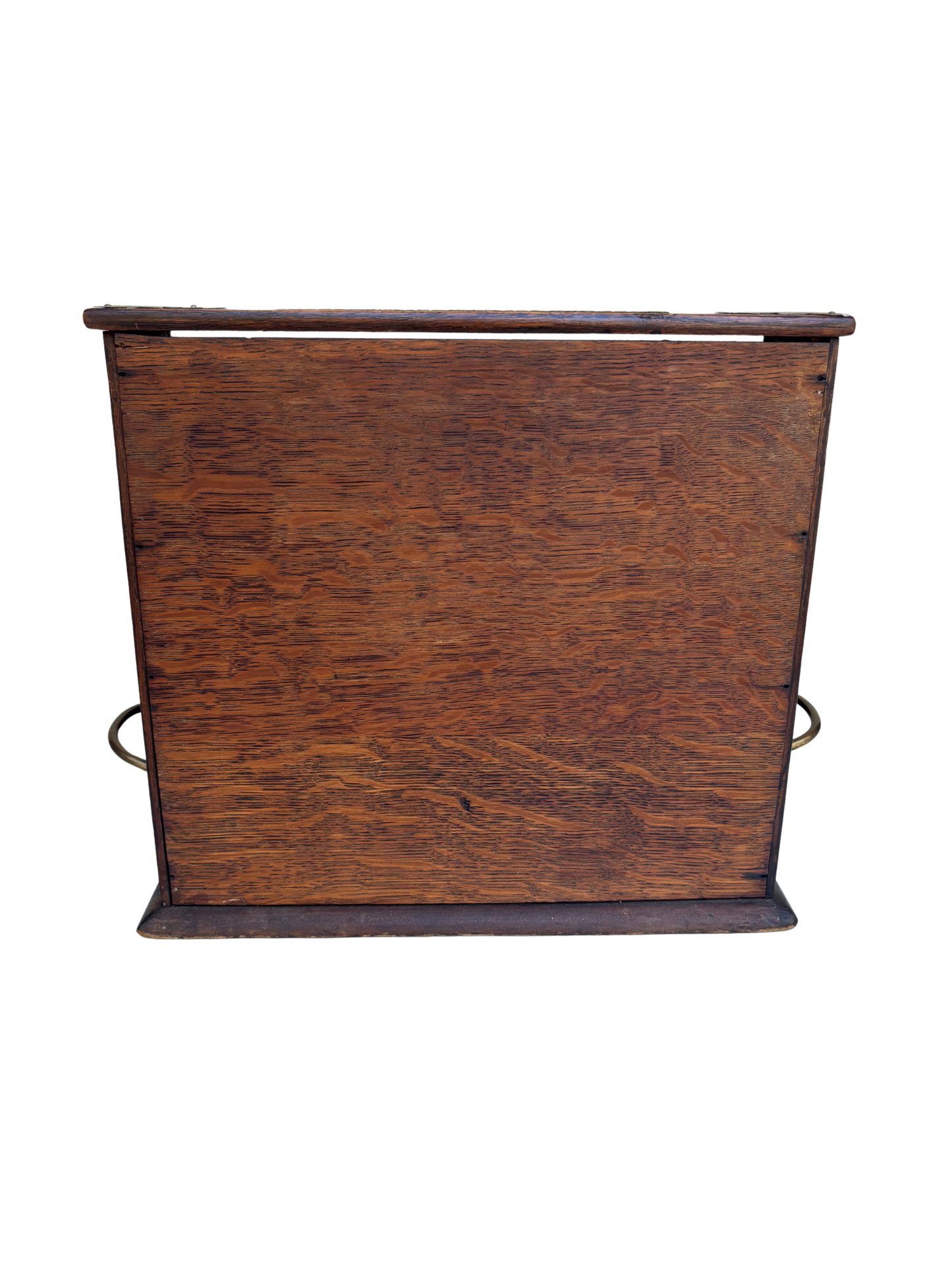
A substantial and highly decorative English Victorian three-bottle tantalus and games compendium, crafted in richly grained oak and fitted with three cut glass spirit decanters.
The architectural case is embellished throughout with carved geometric and scrolling motifs together with decorative white-metal mounts, corner brackets, escutcheon, and brass carrying handles to either side. A raised mirrored superstructure forms the backdrop for three square-form glass decanters, each molded or cut with a repeating geometric pattern and surmounted by a large faceted spherical stopper.
The lower cabinet incorporates two hinged folding panels that open outward to reveal a fitted and divided interior intended for drinking accessories, cards, cigars, or other gentleman's accoutrements. Additional velvet-lined compartments are positioned beneath the decanters, creating a particularly elaborate multifunctional drinks cabinet. There is a hidden compartment with three velvet-lined compartments shown once the button in front of the middle decanter is pressed.
The original-style key is retained; however, the locking mechanism is presently loose and non-functioning.
The mirrored back dramatically reflects the crystal decanters and their faceted stoppers, while the dark oak, carved decoration, and metal fittings give the piece the masculine Gothic Revival character associated with late Victorian smoking rooms, libraries, and gentleman's interiors.
An impressive survivor of Victorian entertaining culture and an exceptionally decorative addition to a home bar, library, or study.
A substantial and highly decorative English Victorian three-bottle tantalus and games compendium, crafted in richly grained oak and fitted with three cut glass spirit decanters.
The architectural case is embellished throughout with carved geometric and scrolling motifs together with decorative white-metal mounts, corner brackets, escutcheon, and brass carrying handles to either side. A raised mirrored superstructure forms the backdrop for three square-form glass decanters, each molded or cut with a repeating geometric pattern and surmounted by a large faceted spherical stopper.
The lower cabinet incorporates two hinged folding panels that open outward to reveal a fitted and divided interior intended for drinking accessories, cards, cigars, or other gentleman's accoutrements. Additional velvet-lined compartments are positioned beneath the decanters, creating a particularly elaborate multifunctional drinks cabinet. There is a hidden compartment with three velvet-lined compartments shown once the button in front of the middle decanter is pressed.
The original-style key is retained; however, the locking mechanism is presently loose and non-functioning.
The mirrored back dramatically reflects the crystal decanters and their faceted stoppers, while the dark oak, carved decoration, and metal fittings give the piece the masculine Gothic Revival character associated with late Victorian smoking rooms, libraries, and gentleman's interiors.
An impressive survivor of Victorian entertaining culture and an exceptionally decorative addition to a home bar, library, or study.
13"h x 14.5"w x 10.25"d
13"h x 14.5"w x 10.25"d
The tantalus became one of the most distinctive accessories of the Victorian drinks table. Designed to display valuable spirits while allowing them to be secured under lock and key, the form traditionally held two or three glass decanters within a wooden or metal framework.
The name references Tantalus of Greek mythology, who was condemned to remain tantalizingly close to food and water he could never reach—an apt analogy for visible liquor rendered inaccessible by a locked cabinet.
John Betjemann, of the prominent London cabinetmaking family Betjemann & Sons, patented an influential locking tantalus design in the late 19th century, and the form became especially fashionable from the 1880s onward.
More elaborate versions evolved into full drinks or gentleman's compendia, incorporating mirrored backs, compartments for glasses or smoking accessories, games, cards, and other entertaining necessities. Period examples are known with almost identical arrangements of three decanters above twin folding compartments and fitted interiors.
The present example belongs to this more elaborate class, combining the practical function of a locking spirit cabinet with the elaborate cabinetry and accessory storage expected in a well-appointed late Victorian interior.
The tantalus became one of the most distinctive accessories of the Victorian drinks table. Designed to display valuable spirits while allowing them to be secured under lock and key, the form traditionally held two or three glass decanters within a wooden or metal framework.
The name references Tantalus of Greek mythology, who was condemned to remain tantalizingly close to food and water he could never reach—an apt analogy for visible liquor rendered inaccessible by a locked cabinet.
John Betjemann, of the prominent London cabinetmaking family Betjemann & Sons, patented an influential locking tantalus design in the late 19th century, and the form became especially fashionable from the 1880s onward.
More elaborate versions evolved into full drinks or gentleman's compendia, incorporating mirrored backs, compartments for glasses or smoking accessories, games, cards, and other entertaining necessities. Period examples are known with almost identical arrangements of three decanters above twin folding compartments and fitted interiors.
The present example belongs to this more elaborate class, combining the practical function of a locking spirit cabinet with the elaborate cabinetry and accessory storage expected in a well-appointed late Victorian interior.
English Victorian, circa 1880–1900
English Victorian, circa 1880–1900
Oak and secondary woods; carved wood decoration; white-metal and brass hardware; mirrored glass; three molded or cut-glass spirit decanters with faceted glass stoppers; velvet or textile-lined interior compartments.
Oak and secondary woods; carved wood decoration; white-metal and brass hardware; mirrored glass; three molded or cut-glass spirit decanters with faceted glass stoppers; velvet or textile-lined interior compartments.
Likely English. No maker's mark or manufacturer's label observed in the photographs provided. Acquired via Austin, TX auction house.
Likely English. No maker's mark or manufacturer's label observed in the photographs provided. Acquired via Austin, TX auction house.
Antique condition consistent with age and use. The oak case exhibits scattered scratches, marks, abrasions, finish variation, edge wear, and minor losses consistent with more than a century of use.
Metal mounts display tarnish, oxidation, discoloration, and surface wear. The mirrored backing shows age-related deterioration and spotting.
The fitted interior exhibits wear, dust, discoloration, and losses to portions of the original textile or velvet lining. Interior dividers and compartments show age-related wear.
The locking mechanism is loose and presently non-functioning. A key is included but should be considered decorative unless the locking mechanism is professionally repaired. Care should be taken when operating the cabinet hardware.
Three glass decanters and faceted stoppers are included. As antique glass, minor scratches, manufacturing irregularities, flea bites, small edge nicks, or other age-related imperfections may be present; please inspect photographs carefully.
Evidence of previous repairs, hardware adjustment, or restoration may be present.
Please review all photographs carefully, as they form an important part of the condition description.
Antique condition consistent with age and use. The oak case exhibits scattered scratches, marks, abrasions, finish variation, edge wear, and minor losses consistent with more than a century of use.
Metal mounts display tarnish, oxidation, discoloration, and surface wear. The mirrored backing shows age-related deterioration and spotting.
The fitted interior exhibits wear, dust, discoloration, and losses to portions of the original textile or velvet lining. Interior dividers and compartments show age-related wear.
The locking mechanism is loose and presently non-functioning. A key is included but should be considered decorative unless the locking mechanism is professionally repaired. Care should be taken when operating the cabinet hardware.
Three glass decanters and faceted stoppers are included. As antique glass, minor scratches, manufacturing irregularities, flea bites, small edge nicks, or other age-related imperfections may be present; please inspect photographs carefully.
Evidence of previous repairs, hardware adjustment, or restoration may be present.
Please review all photographs carefully, as they form an important part of the condition description.