

French Needlepoint and Petite-Pointe Fragment with Myth of Europa Tapestry Fragment
French Needlepoint and Petite-Pointe Fragment with Myth of Europa Tapestry Fragment
Couldn't load pickup availability
Share
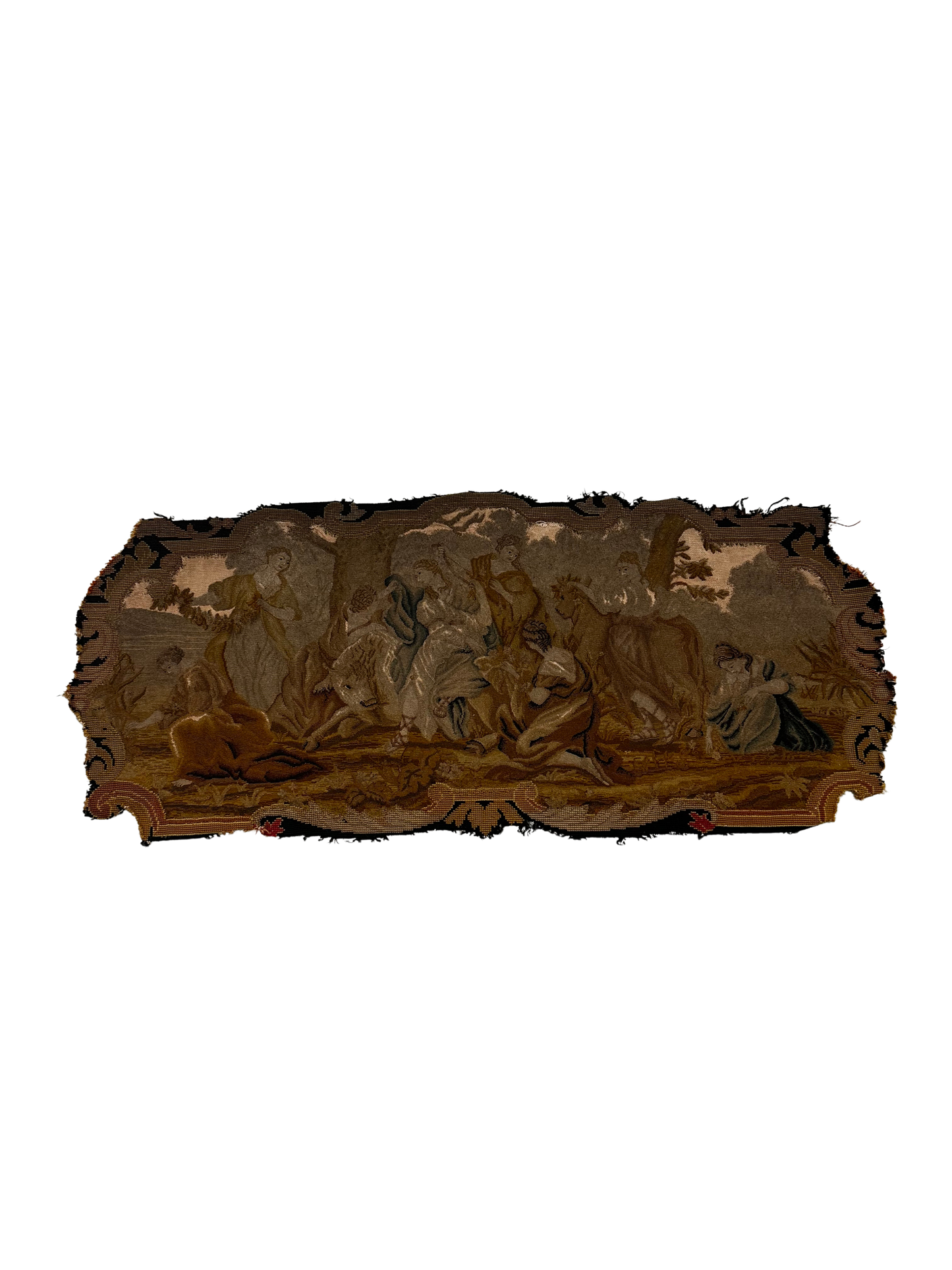
Additional Description: Myth of Europa with Zeus disguished as the white bull and her handmaidens in a verdant landscape, foliated scrollwork framing; Attendant maidens gesturing, reacting, or preparing garlands; pastoral, wooded landscape with animals and flowing. drapery. Likely part of a larger panel. Needlepoint (gros point) for large areas, ground, and figures and Petit point used selectively in faces, hands, and fine drapery transitions.
Era: Late 18th / Early 19th C (1780 - 1815)
History: The Rape (Abduction of Europa) is the story of "Europa", a Phoenician princess, daughter of King Agenor of Tyre. According to Greek mythology, she caught the attention of Zeus, king of the gods, who became enamored with her beauty. To approach her without fear, Zeus transformed himself into a gentle white bull, calm and magnificent. While Europa was gathering flowers with her companions, she was drawn to the animal and climbed onto its back. At that moment, the bull surged forward and carried her across the sea to the island of Crete. There, Zeus revealed his true identity. Europa became the mother of several important mythological figures, including Minos, the future king of Crete. Zeus honored her by giving her name to the continent of Europe, and the bull was later placed among the stars as the constellation Taurus. The needlework shows calm, lyrical movement rathern than violent drama, typical of woven adaptations. It was extremely popular in tapestry cartoons from late 17th through 18th C.
Provenance :Collection of Kathryn V. Alexander, an antiques dealer and designer with over 20 years of experience operating shops in New Orleans, Louisiana and Middleburg, Viriginia. Kathryn retired in 2020 and now lives in Georgetown, TX. Likely France, Italy, Netherlands (Continental US) / Austin Auction House
Materials: Wool, Silk
Dimensions: 19"h x 43"w
Disclaimers: Some areas of wear to the fragment; thread separation
Additional Description: Myth of Europa with Zeus disguished as the white bull and her handmaidens in a verdant landscape, foliated scrollwork framing; Attendant maidens gesturing, reacting, or preparing garlands; pastoral, wooded landscape with animals and flowing. drapery. Likely part of a larger panel. Needlepoint (gros point) for large areas, ground, and figures and Petit point used selectively in faces, hands, and fine drapery transitions.
Era: Late 18th / Early 19th C (1780 - 1815)
History: The Rape (Abduction of Europa) is the story of "Europa", a Phoenician princess, daughter of King Agenor of Tyre. According to Greek mythology, she caught the attention of Zeus, king of the gods, who became enamored with her beauty. To approach her without fear, Zeus transformed himself into a gentle white bull, calm and magnificent. While Europa was gathering flowers with her companions, she was drawn to the animal and climbed onto its back. At that moment, the bull surged forward and carried her across the sea to the island of Crete. There, Zeus revealed his true identity. Europa became the mother of several important mythological figures, including Minos, the future king of Crete. Zeus honored her by giving her name to the continent of Europe, and the bull was later placed among the stars as the constellation Taurus. The needlework shows calm, lyrical movement rathern than violent drama, typical of woven adaptations. It was extremely popular in tapestry cartoons from late 17th through 18th C.
Provenance :Collection of Kathryn V. Alexander, an antiques dealer and designer with over 20 years of experience operating shops in New Orleans, Louisiana and Middleburg, Viriginia. Kathryn retired in 2020 and now lives in Georgetown, TX. Likely France, Italy, Netherlands (Continental US) / Austin Auction House
Materials: Wool, Silk
Dimensions: 19"h x 43"w
Disclaimers: Some areas of wear to the fragment; thread separation