

French School Still Life of Fruit with Wicker Basket, Signed (Marie Chev… / Cheval? – indistinct)
French School Still Life of Fruit with Wicker Basket, Signed (Marie Chev… / Cheval? – indistinct)
Couldn't load pickup availability
Share
Additional Description:
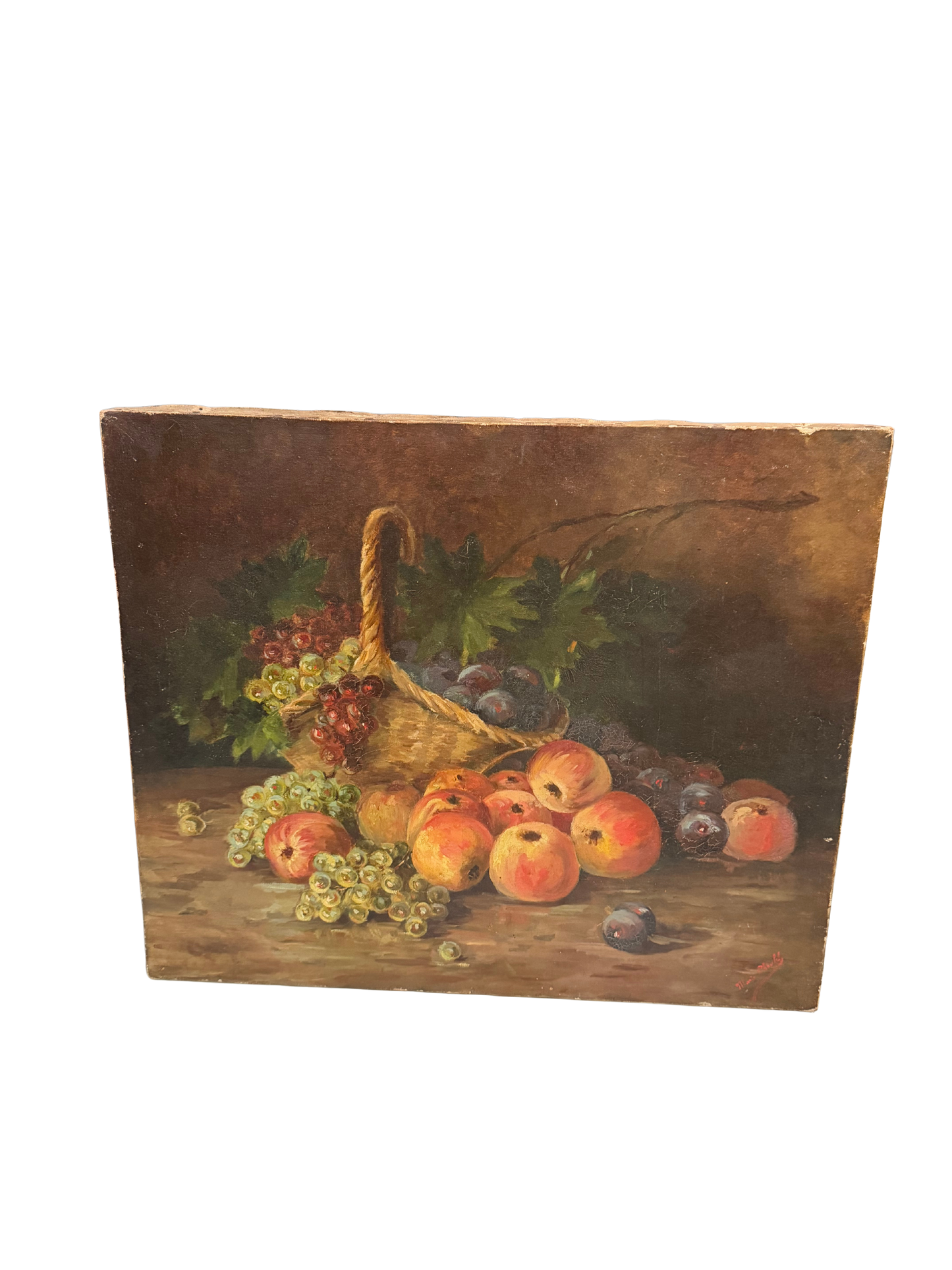
A richly toned oil on canvas still life depicting an abundant arrangement of fruit spilling from a woven wicker basket. The composition features clusters of green and red grapes, apples, and dark plums set upon a wooden surface, with vine leaves and a warm, shadowed background creating depth and atmosphere. The painter demonstrates a confident academic hand, particularly in the treatment of light on the grapes—each orb rendered with reflective highlights and subtle translucency—and the soft bloom on the apples. The basket is handled with textured, impasto strokes that contrast nicely with the smoother fruit surfaces.
The palette leans toward deep umbers, olives, and golden reds, giving the work a distinctly Continental, possibly French or Belgian studio character. The painting is signed in red at the lower right, appearing to read “Marie Chev…” or “Marie Cheval…”, though the final letters are not fully legible. The signature style and placement suggest a late 19th to early 20th century decorative studio painter rather than a widely documented academic master, though the quality is above purely decorative factory work.
The canvas is stretched on a simple wooden stretcher and appears to retain an older backing configuration. No gallery labels are present, but the construction and materials are consistent with European studio work of the period.
Era:
Late 19th to early 20th century (circa 1880–1920)
History:
Fruit still lifes were a cornerstone of European academic and decorative painting traditions, especially in France and Belgium, where artists trained in ateliers often produced richly composed works for the decorative arts market. These paintings balanced technical skill with commercial appeal, making them popular for interior decoration. The emphasis on abundance—overflowing baskets, ripe fruit, and dramatic lighting—echoes earlier Dutch Golden Age still life traditions while being adapted for 19th-century tastes.
Signed works like this often represent independent studio painters whose works circulated regionally rather than through major salons, which is why many names remain difficult to trace today.
Provenance:
Likely Continental European, possibly French or Belgian; artist signature present but not definitively identified
Materials:
Oil on canvas; wooden stretcher; later backing board elements present
Dimensions:
Leave blank
Disclaimers:
Signature is partially legible and should be recorded as “Marie Chev… (indistinct)” unless further research confirms attribution. Surface shows areas of craquelure, minor paint wear, and edge abrasion consistent with age. Canvas edges show some wear and possible past handling or reframing. Backing and hardware appear later additions. No evidence of major restoration observed in photos, though professional inspection is recommended for confirmation.
Additional Description:
A richly toned oil on canvas still life depicting an abundant arrangement of fruit spilling from a woven wicker basket. The composition features clusters of green and red grapes, apples, and dark plums set upon a wooden surface, with vine leaves and a warm, shadowed background creating depth and atmosphere. The painter demonstrates a confident academic hand, particularly in the treatment of light on the grapes—each orb rendered with reflective highlights and subtle translucency—and the soft bloom on the apples. The basket is handled with textured, impasto strokes that contrast nicely with the smoother fruit surfaces.
The palette leans toward deep umbers, olives, and golden reds, giving the work a distinctly Continental, possibly French or Belgian studio character. The painting is signed in red at the lower right, appearing to read “Marie Chev…” or “Marie Cheval…”, though the final letters are not fully legible. The signature style and placement suggest a late 19th to early 20th century decorative studio painter rather than a widely documented academic master, though the quality is above purely decorative factory work.
The canvas is stretched on a simple wooden stretcher and appears to retain an older backing configuration. No gallery labels are present, but the construction and materials are consistent with European studio work of the period.
Era:
Late 19th to early 20th century (circa 1880–1920)
History:
Fruit still lifes were a cornerstone of European academic and decorative painting traditions, especially in France and Belgium, where artists trained in ateliers often produced richly composed works for the decorative arts market. These paintings balanced technical skill with commercial appeal, making them popular for interior decoration. The emphasis on abundance—overflowing baskets, ripe fruit, and dramatic lighting—echoes earlier Dutch Golden Age still life traditions while being adapted for 19th-century tastes.
Signed works like this often represent independent studio painters whose works circulated regionally rather than through major salons, which is why many names remain difficult to trace today.
Provenance:
Likely Continental European, possibly French or Belgian; artist signature present but not definitively identified
Materials:
Oil on canvas; wooden stretcher; later backing board elements present
Dimensions:
Leave blank
Disclaimers:
Signature is partially legible and should be recorded as “Marie Chev… (indistinct)” unless further research confirms attribution. Surface shows areas of craquelure, minor paint wear, and edge abrasion consistent with age. Canvas edges show some wear and possible past handling or reframing. Backing and hardware appear later additions. No evidence of major restoration observed in photos, though professional inspection is recommended for confirmation.