


French White Opaline “Bulle de Savon” Vase with Ormolu Rim
French White Opaline “Bulle de Savon” Vase with Ormolu Rim
Couldn't load pickup availability
Share


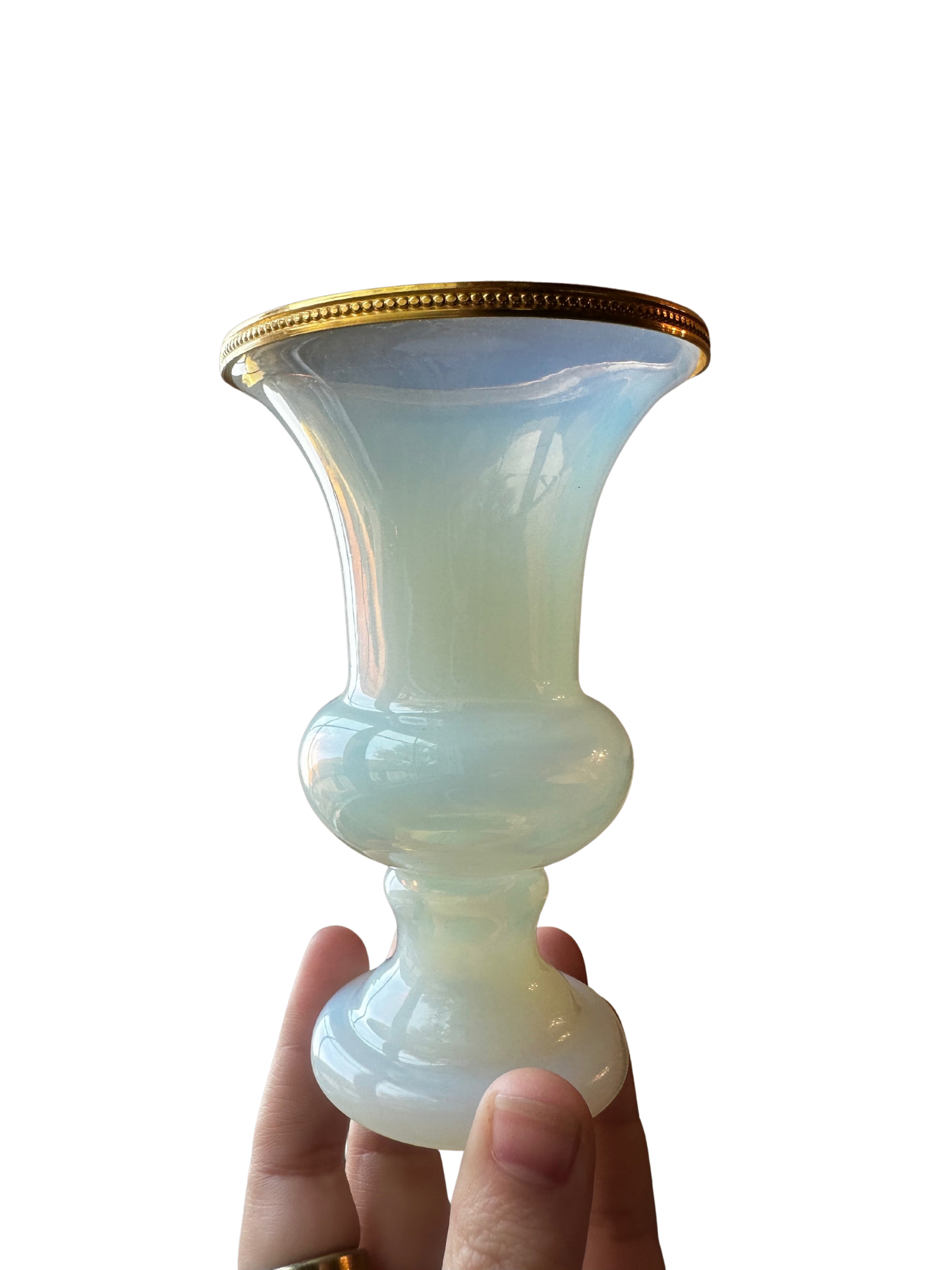
An elegant French white opaline glass vase exhibiting distinct bulle de savon (soap bubble) iridescence, visible as soft rainbow hues across the surface and especially pronounced when backlit. The vase is blown in a classical trumpet form with a flared mouth, rounded shoulder, narrow waist, and stepped circular foot. The rim is fitted with a finely beaded ormolu, which appears original and well-seated. The glass has a milky white body with luminous opalescence, shifting to warm amber and iridescent tones under light—hallmarks of soap-bubble opaline rather than standard opaque opaline.
An elegant French white opaline glass vase exhibiting distinct bulle de savon (soap bubble) iridescence, visible as soft rainbow hues across the surface and especially pronounced when backlit. The vase is blown in a classical trumpet form with a flared mouth, rounded shoulder, narrow waist, and stepped circular foot. The rim is fitted with a finely beaded ormolu, which appears original and well-seated. The glass has a milky white body with luminous opalescence, shifting to warm amber and iridescent tones under light—hallmarks of soap-bubble opaline rather than standard opaque opaline.
5"h x 3.25"w
5"h x 3.25"w
Bulle de savon opaline emerged in France in the second half of the 19th century as glassmakers experimented with surface treatments and metallic salts to create iridescent effects. Unlike later Art Nouveau or early 20th-century iridized glass, soap-bubble opaline retains a restrained, ethereal finish intended to glow subtly under candlelight. Such vases were luxury decorative objects, often displayed on mantels or consoles and frequently enhanced with gilt metal mounts to complement Second Empire interiors. Many examples were produced by Parisian and regional workshops, with only a portion bearing factory marks.
Bulle de savon opaline emerged in France in the second half of the 19th century as glassmakers experimented with surface treatments and metallic salts to create iridescent effects. Unlike later Art Nouveau or early 20th-century iridized glass, soap-bubble opaline retains a restrained, ethereal finish intended to glow subtly under candlelight. Such vases were luxury decorative objects, often displayed on mantels or consoles and frequently enhanced with gilt metal mounts to complement Second Empire interiors. Many examples were produced by Parisian and regional workshops, with only a portion bearing factory marks.
Mid–late 19th century (circa 1860–1890)
Mid–late 19th century (circa 1860–1890)
Hand-blown white opaline glass with bulle de savon iridescence; ormolu rim
Hand-blown white opaline glass with bulle de savon iridescence; ormolu rim
France
France
N/A
N/A