



Giltwood Architectural Decorative Plinth Fragment
Giltwood Architectural Decorative Plinth Fragment
Couldn't load pickup availability
Share


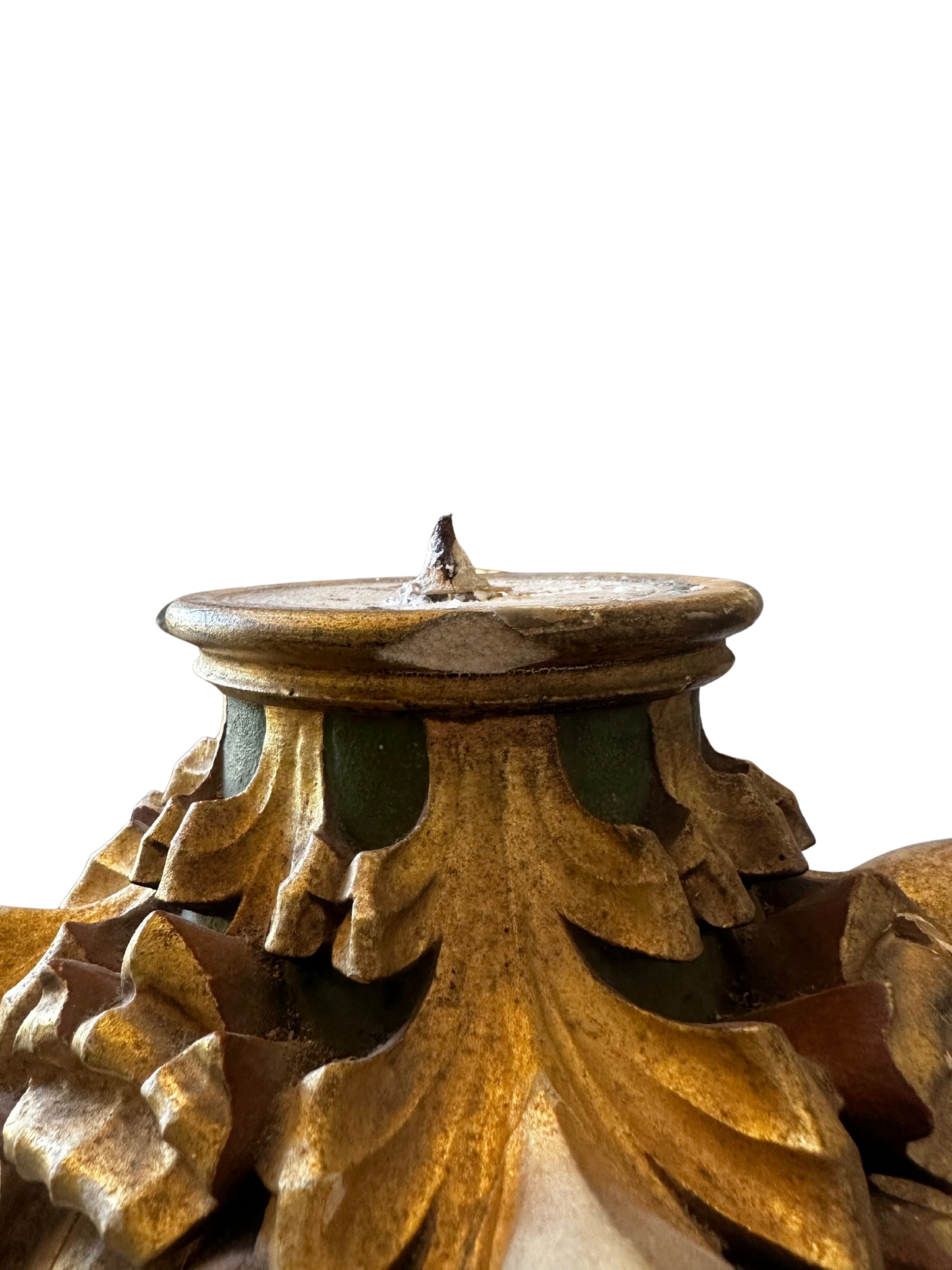
A carved and gilded wooden architectural element, originally conceived as candle base or decorative plinths, likely adapted from larger architectural ornament. It features bold acanthus leaf carving, scrolling volutes, and rounded foliate terminals, arranged symmetrically around a central cylindrical platform. The top retains iron prickets embedded in hardened stone/wax and residue, indicating historical use as candle supports or attached to a larger stone column.
The carving is deep and hand-worked, with visible tool marks beneath the gilt surface. Gilding is water-gilded over gesso, now heavily worn, revealing red and white ground layers beneath. Areas of green-painted ground are visible within recesses, a common polychrome contrast used to heighten depth in giltwood ornament. The base is squared and decorated with a trompe-l’œil checkerboard paint treatment, likely intended to imitate inlaid stone or marble.
The underside shows stone and rough finishing, consistent with architectural elements rather than fine cabinet objects. Overall form, materials, and wear strongly suggest this was once mounted or integrated into a larger decorative scheme (such as wall appliqués, altar furnishings, or furniture mounts) and later repurposed as a freestanding candle base.
A carved and gilded wooden architectural element, originally conceived as candle base or decorative plinths, likely adapted from larger architectural ornament. It features bold acanthus leaf carving, scrolling volutes, and rounded foliate terminals, arranged symmetrically around a central cylindrical platform. The top retains iron prickets embedded in hardened stone/wax and residue, indicating historical use as candle supports or attached to a larger stone column.
The carving is deep and hand-worked, with visible tool marks beneath the gilt surface. Gilding is water-gilded over gesso, now heavily worn, revealing red and white ground layers beneath. Areas of green-painted ground are visible within recesses, a common polychrome contrast used to heighten depth in giltwood ornament. The base is squared and decorated with a trompe-l’œil checkerboard paint treatment, likely intended to imitate inlaid stone or marble.
The underside shows stone and rough finishing, consistent with architectural elements rather than fine cabinet objects. Overall form, materials, and wear strongly suggest this was once mounted or integrated into a larger decorative scheme (such as wall appliqués, altar furnishings, or furniture mounts) and later repurposed as a freestanding candle base.
6.75"h x 6.75"w x 6.75"d (Each)
6.75"h x 6.75"w x 6.75"d (Each)
Giltwood architectural ornament flourished in the late 18th century, particularly in ecclesiastical interiors, salons, and grand domestic settings. Elements such as acanthus-carved brackets, plinths, and appliqués were often produced in workshops specializing in ornamental carving and gilding, then assembled into larger decorative programs.
Smaller architectural fragments were frequently salvaged and reused in the 19th century as decorative objects, including candle bases, altar pieces, or mantel ornaments. The presence of original candle prickets and wax residue suggests these pieces entered secondary use relatively early, rather than being modern adaptations.
Giltwood architectural ornament flourished in the late 18th century, particularly in ecclesiastical interiors, salons, and grand domestic settings. Elements such as acanthus-carved brackets, plinths, and appliqués were often produced in workshops specializing in ornamental carving and gilding, then assembled into larger decorative programs.
Smaller architectural fragments were frequently salvaged and reused in the 19th century as decorative objects, including candle bases, altar pieces, or mantel ornaments. The presence of original candle prickets and wax residue suggests these pieces entered secondary use relatively early, rather than being modern adaptations.
Late 18th to early 19th century (circa 1780–1820), Neoclassical / Late Baroque transition
Late 18th to early 19th century (circa 1780–1820), Neoclassical / Late Baroque transition
Hand-carved wood
Gesso and stone ground
Water gilding (gold leaf)
Polychrome paint (green ground accents)
Iron candle prickets
Residual wax
Hand-carved wood
Gesso and stone ground
Water gilding (gold leaf)
Polychrome paint (green ground accents)
Iron candle prickets
Residual wax
Likely Continental Europe (possibly France or Italy)
Likely Continental Europe (possibly France or Italy)
Significant age-related wear throughout, including losses to carving, chips, cracks, and areas of exposed gesso and stone. Gilding is worn and rubbed, with scattered losses. Bases show abrasions, paint loss, and edge wear. Candle prickets are oxidized and embedded in old wax. These pieces likely began life as architectural fragments and were later repurposed; original placement unknown.
Significant age-related wear throughout, including losses to carving, chips, cracks, and areas of exposed gesso and stone. Gilding is worn and rubbed, with scattered losses. Bases show abrasions, paint loss, and edge wear. Candle prickets are oxidized and embedded in old wax. These pieces likely began life as architectural fragments and were later repurposed; original placement unknown.