

Late 19th / Early 20th Century Abalone Shell Mosaic Jewelry Box
Late 19th / Early 20th Century Abalone Shell Mosaic Jewelry Box
Couldn't load pickup availability
Share
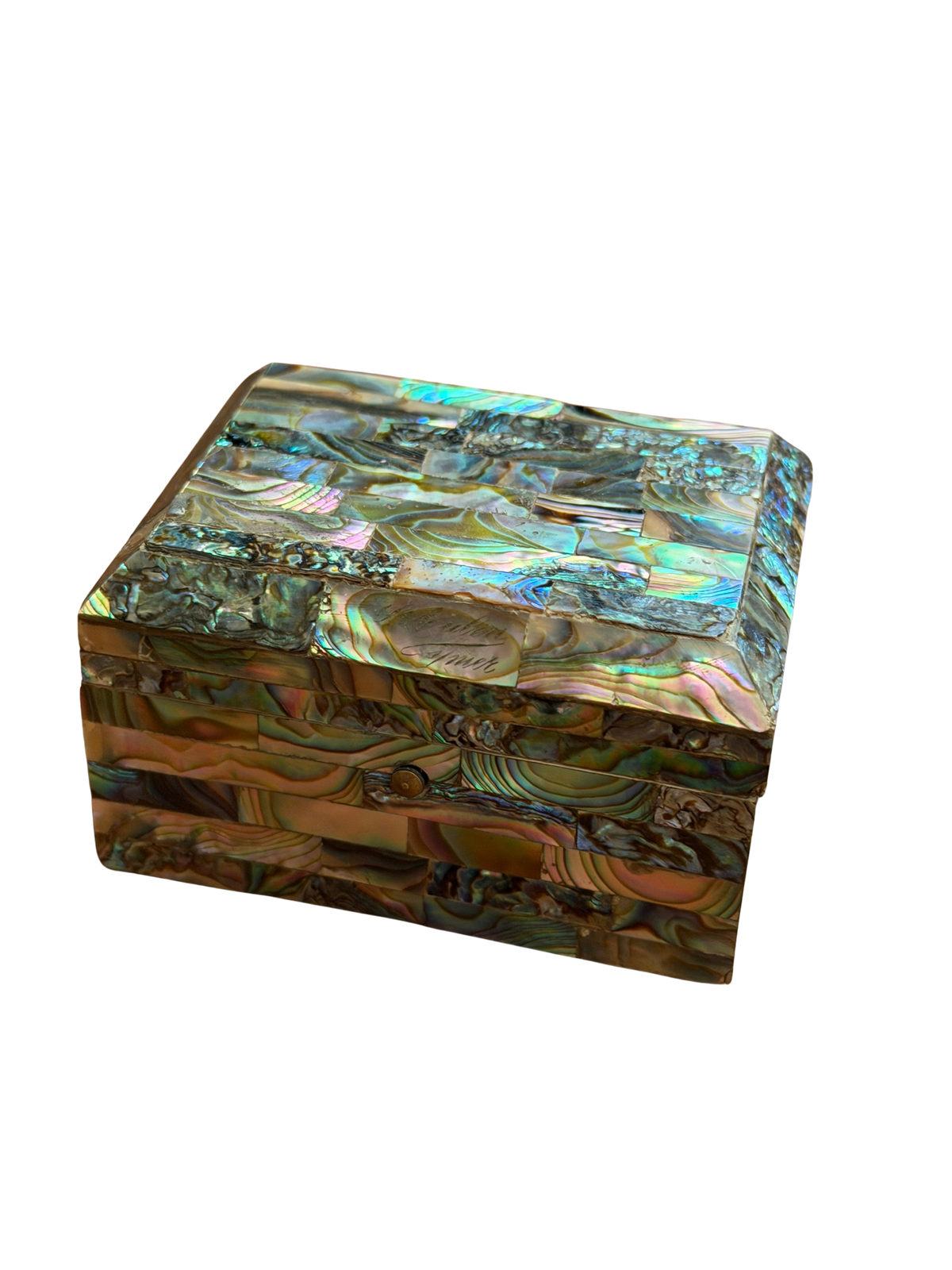
A beautiful antique abalone shell mosaic jewelry or keepsake box, entirely clad in individually cut sections of highly iridescent shell displaying flashes of emerald green, turquoise, rose, violet, and gold.
The rectangular box is constructed with a gently sloping lid and fitted with a small metal push-button closure. The exterior is assembled from numerous pieces of abalone / mother-of-pearl shell, deliberately arranged to highlight the dramatic natural color and banding of the material. Some sections retain the rougher, richly textured outer surface of the shell, creating an appealing contrast with the polished nacre.
Set prominently into the front edge of the lid is an elongated shell plaque bearing a finely engraved cursive inscription or signature. The lettering appears to read approximately “S. [Raulin / Paulin?]” with a second word below, although I would not transcribe it definitively from the present photographs. It may represent a maker, retailer, owner, or presentation inscription rather than merely decoration.
The hinged lid opens to reveal a fitted interior lined in vivid crimson-red velvet, while the underside is finished in textured black material and raised on four small metal feet.
Era
Late 19th to Early 20th Century
Circa 1890–1920
History
Decorative boxes clad in abalone and mother-of-pearl became fashionable during the late 19th and early 20th centuries, when highly iridescent shell was used for jewelry boxes, card cases, writing accessories, souvenir objects, and small luxury goods.
Rather than using large uninterrupted sheets of shell, makers often assembled small mosaic-like sections over a wooden or composition core. This allowed naturally irregular pieces of shell to be utilized while creating a highly decorative, almost jewel-like surface.
Abalone was particularly prized because of its intense spectrum of greens, blues, purples, and pinks. Boxes of this type could function as jewelry caskets, trinket boxes, or presentation boxes, and many were fitted with velvet interiors to protect their contents.
Inscription
An inset shell plaque along the front of the lid bears an engraved cursive inscription.
The first line appears to begin with an ornate “S.” followed by a surname or place name, while the second line is less certain. Because several letters overlap the shell's natural banding, I would describe it in the listing as:
“Engraved with a period cursive inscription/signature to a mother-of-pearl plaque.”
I would avoid committing to a specific name until another photograph taken straight-on under raking light makes the engraving clearer.
Provenance
European or American, exact origin unknown.
The form and shell-mosaic construction are consistent with decorative boxes produced internationally around the turn of the 20th century. Without a legible maker's inscription or internal label, a more specific geographic attribution cannot presently be confirmed.
Materials
Abalone shell / mother-of-pearl mosaic
Wood or composition carcass
Metal hinge and push-button closure
Crimson velvet interior
Textured black underside
Metal feet
Dimensions
Approximately [insert width] W × [insert depth] D × [insert height] H
Condition
Good antique condition with wear consistent with age and use.
The shell retains excellent iridescence and color variation. There are expected surface scratches, small edge chips, hairline fractures, minor losses, lifting, and irregularities between individual shell sections. These are especially visible along the edges and lid and are consistent with the delicate mosaic construction.
Metal hardware displays age-related oxidation and patination. Interior velvet shows light wear and soiling but remains attractive and richly colored.
The box retains its hinged lid, front closure, lined interior, and four feet.
Please review photographs closely for the most complete representation of condition.
Disclaimers
Dating and attribution are based on construction, materials, and decorative style and should be considered approximate.
The exterior is composed of natural shell; variations in color, texture, cracks, inclusions, and irregular edges are inherent to the material as well as its age.
The engraved inscription has not been definitively deciphered and is therefore described conservatively.
A beautiful antique abalone shell mosaic jewelry or keepsake box, entirely clad in individually cut sections of highly iridescent shell displaying flashes of emerald green, turquoise, rose, violet, and gold.
The rectangular box is constructed with a gently sloping lid and fitted with a small metal push-button closure. The exterior is assembled from numerous pieces of abalone / mother-of-pearl shell, deliberately arranged to highlight the dramatic natural color and banding of the material. Some sections retain the rougher, richly textured outer surface of the shell, creating an appealing contrast with the polished nacre.
Set prominently into the front edge of the lid is an elongated shell plaque bearing a finely engraved cursive inscription or signature. The lettering appears to read approximately “S. [Raulin / Paulin?]” with a second word below, although I would not transcribe it definitively from the present photographs. It may represent a maker, retailer, owner, or presentation inscription rather than merely decoration.
The hinged lid opens to reveal a fitted interior lined in vivid crimson-red velvet, while the underside is finished in textured black material and raised on four small metal feet.
Era
Late 19th to Early 20th Century
Circa 1890–1920
History
Decorative boxes clad in abalone and mother-of-pearl became fashionable during the late 19th and early 20th centuries, when highly iridescent shell was used for jewelry boxes, card cases, writing accessories, souvenir objects, and small luxury goods.
Rather than using large uninterrupted sheets of shell, makers often assembled small mosaic-like sections over a wooden or composition core. This allowed naturally irregular pieces of shell to be utilized while creating a highly decorative, almost jewel-like surface.
Abalone was particularly prized because of its intense spectrum of greens, blues, purples, and pinks. Boxes of this type could function as jewelry caskets, trinket boxes, or presentation boxes, and many were fitted with velvet interiors to protect their contents.
Inscription
An inset shell plaque along the front of the lid bears an engraved cursive inscription.
The first line appears to begin with an ornate “S.” followed by a surname or place name, while the second line is less certain. Because several letters overlap the shell's natural banding, I would describe it in the listing as:
“Engraved with a period cursive inscription/signature to a mother-of-pearl plaque.”
I would avoid committing to a specific name until another photograph taken straight-on under raking light makes the engraving clearer.
Provenance
European or American, exact origin unknown.
The form and shell-mosaic construction are consistent with decorative boxes produced internationally around the turn of the 20th century. Without a legible maker's inscription or internal label, a more specific geographic attribution cannot presently be confirmed.
Materials
Abalone shell / mother-of-pearl mosaic
Wood or composition carcass
Metal hinge and push-button closure
Crimson velvet interior
Textured black underside
Metal feet
Dimensions
Approximately [insert width] W × [insert depth] D × [insert height] H
Condition
Good antique condition with wear consistent with age and use.
The shell retains excellent iridescence and color variation. There are expected surface scratches, small edge chips, hairline fractures, minor losses, lifting, and irregularities between individual shell sections. These are especially visible along the edges and lid and are consistent with the delicate mosaic construction.
Metal hardware displays age-related oxidation and patination. Interior velvet shows light wear and soiling but remains attractive and richly colored.
The box retains its hinged lid, front closure, lined interior, and four feet.
Please review photographs closely for the most complete representation of condition.
Disclaimers
Dating and attribution are based on construction, materials, and decorative style and should be considered approximate.
The exterior is composed of natural shell; variations in color, texture, cracks, inclusions, and irregular edges are inherent to the material as well as its age.
The engraved inscription has not been definitively deciphered and is therefore described conservatively.