

Monumental Carved Griffin / Mythical Beast Gothic Revival Bench or Furniture Supports, Pair
Monumental Carved Griffin / Mythical Beast Gothic Revival Bench or Furniture Supports, Pair
Couldn't load pickup availability
Share
Additional Description:
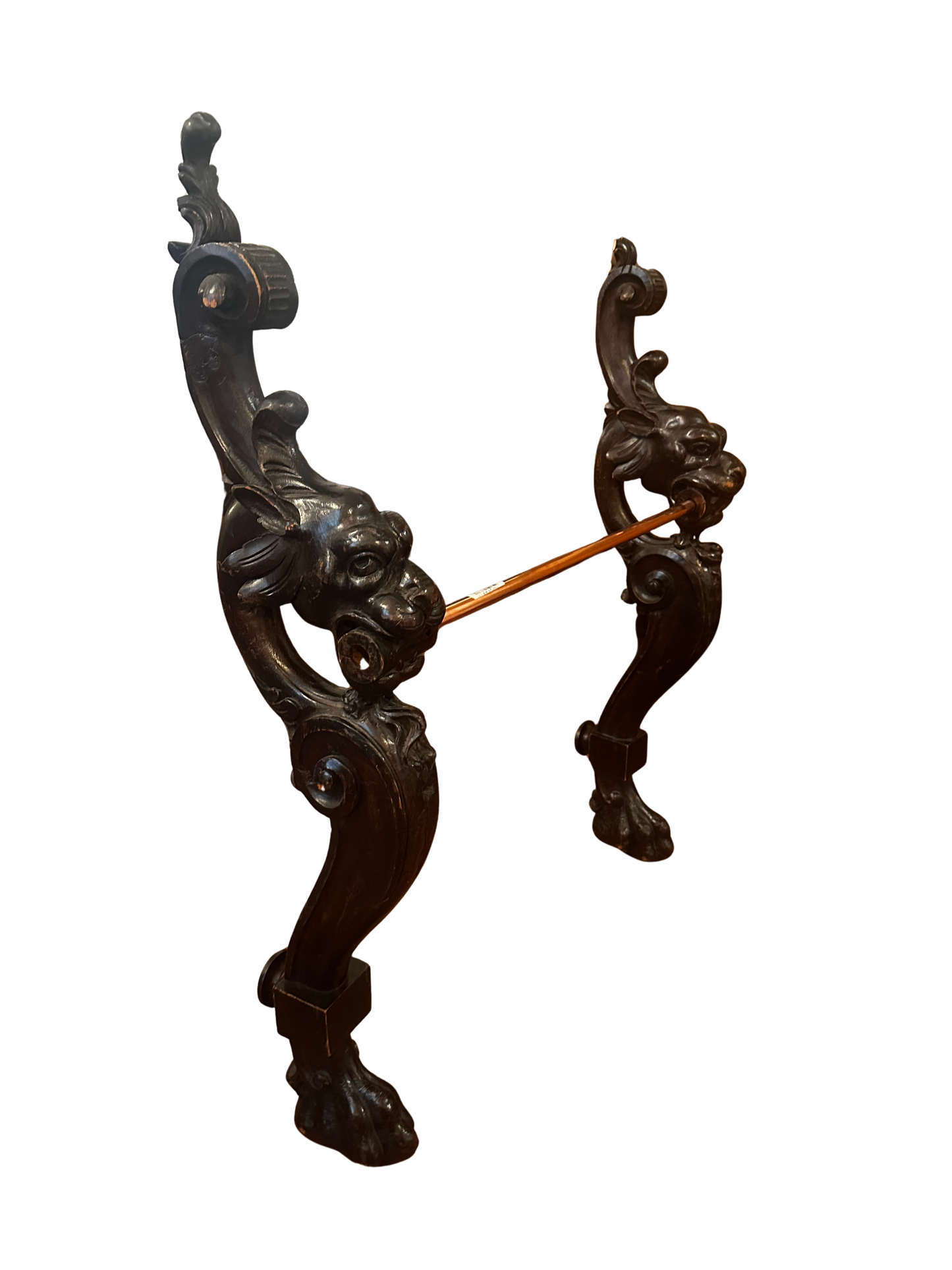
An exceptionally dramatic and sculptural pair of monumental carved wooden griffin-form supports, likely originating from a large Gothic Revival or Renaissance Revival bench, settle, hall chair, or architectural furnishing from the late 19th century. These imposing carvings feature fantastical winged beast or griffin heads with deeply carved scrolling necks, foliate details, rounded bosses, and stylized wings integrated into the sweeping silhouette.
The carvings exhibit an impressive sense of movement and theatricality, with elongated arched forms terminating in expressive beast heads with protruding muzzles and alert eyes. The scrolling upper terminals and large circular mounting bosses suggest these originally functioned structurally as side supports or armature elements for a substantial piece of furniture. The surviving mortise and mounting hardware remnants reinforce their original functional role.
The dark ebonized or heavily stained finish gives the pair a striking medieval aesthetic, highly evocative of Gothic ecclesiastical carving and the romantic historic revival styles popular during the Victorian period. The exaggerated carving, deeply undercut details, and bold silhouette create extraordinary decorative presence even as standalone sculptural objects.
Now repurposed beautifully as decorative sculptural fragments, these pieces would make exceptional wall-mounted architectural ornaments, console supports, bookshelf displays, or statement pieces in a maximalist, château-inspired, or old-world interior.
Particularly attractive is the whimsical yet slightly grotesque character of the creature heads — blending dragon, griffin, gargoyle, and winged lion influences in a manner commonly seen in Gothic Revival decorative arts.
Era:
Late 19th Century to Early 20th Century
(ca. 1870–1910)
History:
During the Gothic Revival movement of the 19th century, designers and cabinetmakers drew heavily upon medieval European architecture and ecclesiastical carving for inspiration. Mythical creatures such as griffins, gargoyles, dragons, and winged beasts became highly fashionable motifs in furniture, church furnishings, overmantels, hall benches, and architectural interiors.
Large carved supports such as these were often used on settles, throne chairs, library furniture, choir stalls, or elaborate hall seating meant to evoke medieval grandeur and aristocratic lineage. Their dramatic forms were designed not merely for utility, but to create a theatrical sense of old-world permanence and fantasy.
The whimsical facial modeling and scrolling silhouette also show influence from Renaissance Revival and even Black Forest carving traditions, though the overall form feels most aligned with Victorian Gothic Revival craftsmanship.
Provenance:
Likely Continental European or English in influence. Acquired from the secondary antiques market.
Materials:
Hand-carved wood with dark stained or ebonized finish
Dimensions:
[Please Add]
Disclaimers:
Age-related wear throughout including scratches, finish wear, scuffs, abrasions, shrinkage cracks, small losses, and remnants of old mounting hardware. Likely removed from a larger original furniture or architectural structure. One support shows visible old drill holes and attachment remnants. Surface wear and patina consistent with age and use. Exact original form and attribution remain speculative.
Additional Description:
An exceptionally dramatic and sculptural pair of monumental carved wooden griffin-form supports, likely originating from a large Gothic Revival or Renaissance Revival bench, settle, hall chair, or architectural furnishing from the late 19th century. These imposing carvings feature fantastical winged beast or griffin heads with deeply carved scrolling necks, foliate details, rounded bosses, and stylized wings integrated into the sweeping silhouette.
The carvings exhibit an impressive sense of movement and theatricality, with elongated arched forms terminating in expressive beast heads with protruding muzzles and alert eyes. The scrolling upper terminals and large circular mounting bosses suggest these originally functioned structurally as side supports or armature elements for a substantial piece of furniture. The surviving mortise and mounting hardware remnants reinforce their original functional role.
The dark ebonized or heavily stained finish gives the pair a striking medieval aesthetic, highly evocative of Gothic ecclesiastical carving and the romantic historic revival styles popular during the Victorian period. The exaggerated carving, deeply undercut details, and bold silhouette create extraordinary decorative presence even as standalone sculptural objects.
Now repurposed beautifully as decorative sculptural fragments, these pieces would make exceptional wall-mounted architectural ornaments, console supports, bookshelf displays, or statement pieces in a maximalist, château-inspired, or old-world interior.
Particularly attractive is the whimsical yet slightly grotesque character of the creature heads — blending dragon, griffin, gargoyle, and winged lion influences in a manner commonly seen in Gothic Revival decorative arts.
Era:
Late 19th Century to Early 20th Century
(ca. 1870–1910)
History:
During the Gothic Revival movement of the 19th century, designers and cabinetmakers drew heavily upon medieval European architecture and ecclesiastical carving for inspiration. Mythical creatures such as griffins, gargoyles, dragons, and winged beasts became highly fashionable motifs in furniture, church furnishings, overmantels, hall benches, and architectural interiors.
Large carved supports such as these were often used on settles, throne chairs, library furniture, choir stalls, or elaborate hall seating meant to evoke medieval grandeur and aristocratic lineage. Their dramatic forms were designed not merely for utility, but to create a theatrical sense of old-world permanence and fantasy.
The whimsical facial modeling and scrolling silhouette also show influence from Renaissance Revival and even Black Forest carving traditions, though the overall form feels most aligned with Victorian Gothic Revival craftsmanship.
Provenance:
Likely Continental European or English in influence. Acquired from the secondary antiques market.
Materials:
Hand-carved wood with dark stained or ebonized finish
Dimensions:
[Please Add]
Disclaimers:
Age-related wear throughout including scratches, finish wear, scuffs, abrasions, shrinkage cracks, small losses, and remnants of old mounting hardware. Likely removed from a larger original furniture or architectural structure. One support shows visible old drill holes and attachment remnants. Surface wear and patina consistent with age and use. Exact original form and attribution remain speculative.