


Moonlit Venetian Lagoon Scene, after Ippolito Caffi – Signed Gracco Mattioni
Moonlit Venetian Lagoon Scene, after Ippolito Caffi – Signed Gracco Mattioni
Couldn't load pickup availability
Share
Additional Description:
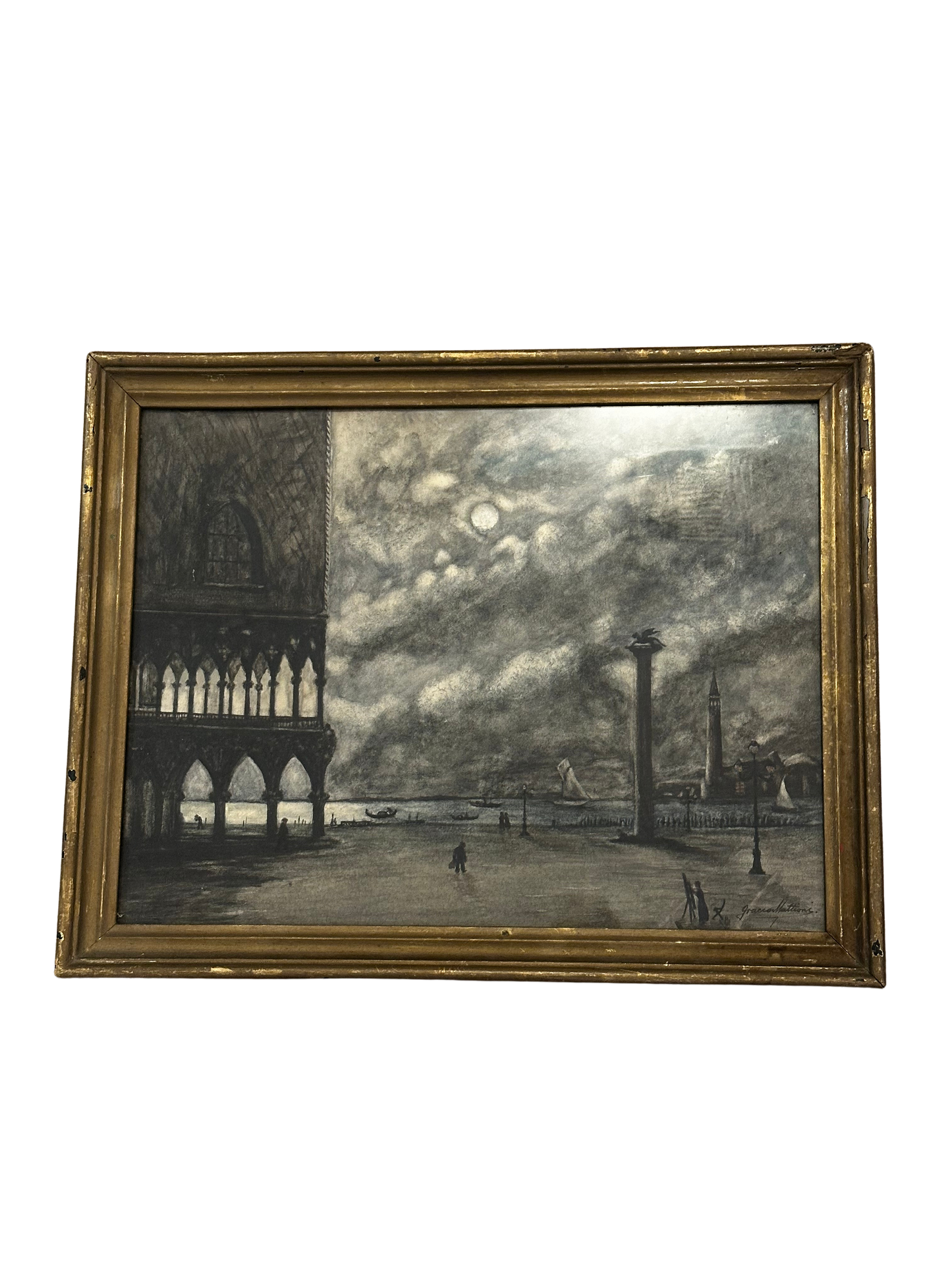
A beautifully atmospheric Venetian lagoon scene rendered in charcoal on paper, depicting the iconic waterfront of Piazza San Marco under a luminous, cloud-filled night sky. The composition captures the Gothic arcade of the Doge’s Palace at left, its delicate tracery silhouetted against the glowing lagoon, while the column of Saint Mark—topped with the winged lion—rises prominently in the distance alongside a slender campanile.
The scene is animated by softly rendered figures strolling along the promenade and gondolas drifting across the water, all enveloped in a moody, tonal landscape. The sky is particularly compelling, with layered charcoal work creating depth and movement around a glowing moon—imbuing the piece with a romantic, almost theatrical quality.
Executed in charcoal with subtle tonal gradation and blending, the work emphasizes atmosphere over strict architectural precision. Small touches of muted color in the lamps and figures add warmth and visual intrigue, enhancing the nocturnal ambiance.
This composition strongly reflects the influence of Ippolito Caffi, the celebrated Italian painter known for his dramatic depictions of Venice—particularly his fascination with light effects, moonlit scenes, and atmospheric conditions. While not by Caffi, the present work clearly draws upon that tradition, translating it into a softer, tonal work on paper likely intended for collectors of Venetian views.
Signed lower right “Gracco Mattioni,” an artist working within this Continental tradition, likely producing evocative interpretations of Venice for a discerning audience.
Presented in a period giltwood frame, which complements the tonal palette and enhances the Old World character of the piece.
Era:
Late 19th to early 20th century (circa 1890–1920)
History:
Venice has long stood at the center of European artistic imagination, particularly during and after the Grand Tour period, when travelers sought visual mementos of the city’s beauty. By the 19th century, artists such as Ippolito Caffi revolutionized Venetian painting by shifting focus from precise architectural vedute to dramatic interpretations of light, atmosphere, and time of day.
Moonlit and nocturnal scenes became especially prized for their emotional resonance and technical challenge. Works such as this reflect the continuation of that tradition into the late 19th and early 20th centuries, when artists created atmospheric interpretations inspired by earlier masters for both local patrons and international collectors.
Provenance:
Continental Europe, likely Italy; acquired as part of a curated antiques collection.
Materials:
Charcoal on paper with subtle colored accents; under glass; giltwood frame; early backing.
Dimensions:
21.75” x 16.5”
Disclaimers:
Paper exhibits age-appropriate toning and surface wear. Minor marks and handling visible under close inspection. Frame shows light wear and patina consistent with age. Backing paper is heavily deteriorated with tears and losses, typical of early framing methods, but does not impact the front-facing presentation.
Additional Description:
A beautifully atmospheric Venetian lagoon scene rendered in charcoal on paper, depicting the iconic waterfront of Piazza San Marco under a luminous, cloud-filled night sky. The composition captures the Gothic arcade of the Doge’s Palace at left, its delicate tracery silhouetted against the glowing lagoon, while the column of Saint Mark—topped with the winged lion—rises prominently in the distance alongside a slender campanile.
The scene is animated by softly rendered figures strolling along the promenade and gondolas drifting across the water, all enveloped in a moody, tonal landscape. The sky is particularly compelling, with layered charcoal work creating depth and movement around a glowing moon—imbuing the piece with a romantic, almost theatrical quality.
Executed in charcoal with subtle tonal gradation and blending, the work emphasizes atmosphere over strict architectural precision. Small touches of muted color in the lamps and figures add warmth and visual intrigue, enhancing the nocturnal ambiance.
This composition strongly reflects the influence of Ippolito Caffi, the celebrated Italian painter known for his dramatic depictions of Venice—particularly his fascination with light effects, moonlit scenes, and atmospheric conditions. While not by Caffi, the present work clearly draws upon that tradition, translating it into a softer, tonal work on paper likely intended for collectors of Venetian views.
Signed lower right “Gracco Mattioni,” an artist working within this Continental tradition, likely producing evocative interpretations of Venice for a discerning audience.
Presented in a period giltwood frame, which complements the tonal palette and enhances the Old World character of the piece.
Era:
Late 19th to early 20th century (circa 1890–1920)
History:
Venice has long stood at the center of European artistic imagination, particularly during and after the Grand Tour period, when travelers sought visual mementos of the city’s beauty. By the 19th century, artists such as Ippolito Caffi revolutionized Venetian painting by shifting focus from precise architectural vedute to dramatic interpretations of light, atmosphere, and time of day.
Moonlit and nocturnal scenes became especially prized for their emotional resonance and technical challenge. Works such as this reflect the continuation of that tradition into the late 19th and early 20th centuries, when artists created atmospheric interpretations inspired by earlier masters for both local patrons and international collectors.
Provenance:
Continental Europe, likely Italy; acquired as part of a curated antiques collection.
Materials:
Charcoal on paper with subtle colored accents; under glass; giltwood frame; early backing.
Dimensions:
21.75” x 16.5”
Disclaimers:
Paper exhibits age-appropriate toning and surface wear. Minor marks and handling visible under close inspection. Frame shows light wear and patina consistent with age. Backing paper is heavily deteriorated with tears and losses, typical of early framing methods, but does not impact the front-facing presentation.