


Pair of Monumental Carved Wooden Scroll Corbels / Architectural Brackets
Pair of Monumental Carved Wooden Scroll Corbels / Architectural Brackets
Couldn't load pickup availability
Share


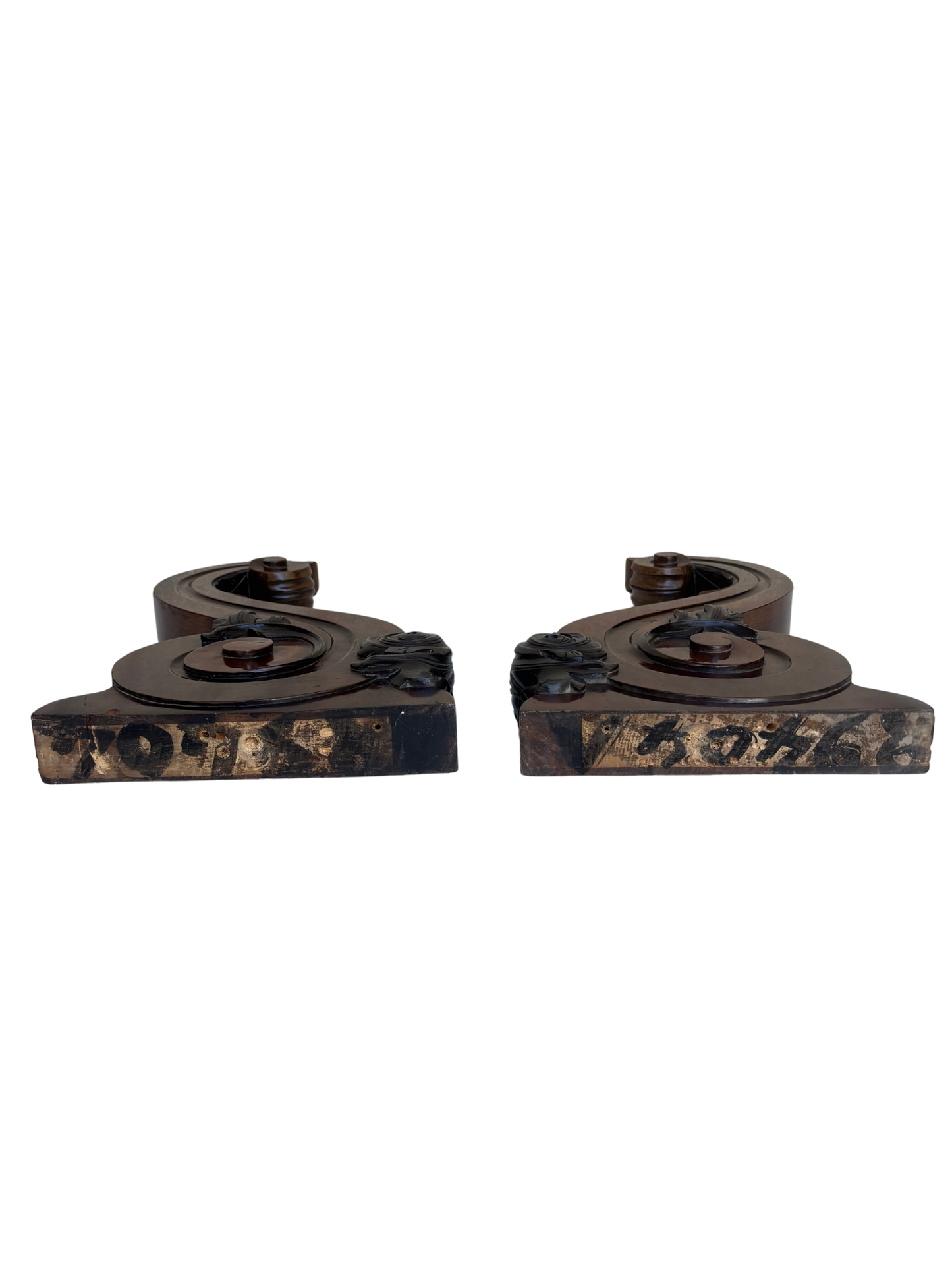
A handsome pair of large carved wooden scroll-form corbels or architectural brackets, executed in richly figured hardwood with deep hand-carved foliate and volute decoration. Each features a bold scrolling profile terminating in a large spiral volute, with carved leaf motifs and stylized botanical ornament throughout.
The substantial scale and robust construction suggest these pieces originally served as decorative architectural supports, overmantel elements, stair hall ornament, furniture components, or brackets from a large piece of Victorian or Classical Revival furniture. Their dramatic form also lends them well to modern decorative use as custom console supports, shelf brackets, fireplace decoration, or sculptural display elements.
The warm patinated wood and bold carving create a strong visual statement, whether displayed individually or incorporated into a restoration or design project.
Era
.
History
Large carved corbels and brackets were widely employed during the Victorian period and throughout the various Classical, Renaissance Revival, and Gothic Revival movements of the 19th century. Such elements were often incorporated into architectural interiors, grand staircases, overmantels, sideboards, church furnishings, and custom cabinetry.
The scrolling volute form seen here derives from classical architecture and was adapted by cabinetmakers and woodcarvers throughout Europe and North America during the 19th century. The substantial carving and scale suggest these were produced for an important decorative purpose rather than simple utilitarian support.
Provenance
.
Materials
Carved hardwood, likely walnut or mahogany.
Dimensions
[Insert dimensions]
Disclaimers
Good antique condition consistent with age and use. Surface wear, minor losses, scattered scratches, shrinkage, finish wear, and age-related imperfections throughout. Evidence of previous installation and use may be present. Sold as decorative architectural elements. Please review photographs carefully as they form part of the description.
A handsome pair of large carved wooden scroll-form corbels or architectural brackets, executed in richly figured hardwood with deep hand-carved foliate and volute decoration. Each features a bold scrolling profile terminating in a large spiral volute, with carved leaf motifs and stylized botanical ornament throughout.
The substantial scale and robust construction suggest these pieces originally served as decorative architectural supports, overmantel elements, stair hall ornament, furniture components, or brackets from a large piece of Victorian or Classical Revival furniture. Their dramatic form also lends them well to modern decorative use as custom console supports, shelf brackets, fireplace decoration, or sculptural display elements.
The warm patinated wood and bold carving create a strong visual statement, whether displayed individually or incorporated into a restoration or design project.
Era
.
History
Large carved corbels and brackets were widely employed during the Victorian period and throughout the various Classical, Renaissance Revival, and Gothic Revival movements of the 19th century. Such elements were often incorporated into architectural interiors, grand staircases, overmantels, sideboards, church furnishings, and custom cabinetry.
The scrolling volute form seen here derives from classical architecture and was adapted by cabinetmakers and woodcarvers throughout Europe and North America during the 19th century. The substantial carving and scale suggest these were produced for an important decorative purpose rather than simple utilitarian support.
Provenance
.
Materials
Carved hardwood, likely walnut or mahogany.
Dimensions
[Insert dimensions]
Disclaimers
Good antique condition consistent with age and use. Surface wear, minor losses, scattered scratches, shrinkage, finish wear, and age-related imperfections throughout. Evidence of previous installation and use may be present. Sold as decorative architectural elements. Please review photographs carefully as they form part of the description.
20.75"h x 2.5"w x 10.25"d
20.75"h x 2.5"w x 10.25"d
Large carved corbels and brackets were widely employed during the Victorian period and throughout the various Classical, Renaissance Revival, and Gothic Revival movements of the 19th century. Such elements were often incorporated into architectural interiors, grand staircases, overmantels, sideboards, church furnishings, and custom cabinetry.
The scrolling volute form seen here derives from classical architecture and was adapted by cabinetmakers and woodcarvers throughout Europe and North America during the 19th century. The substantial carving and scale suggest these were produced for an important decorative purpose rather than simple utilitarian support.
Large carved corbels and brackets were widely employed during the Victorian period and throughout the various Classical, Renaissance Revival, and Gothic Revival movements of the 19th century. Such elements were often incorporated into architectural interiors, grand staircases, overmantels, sideboards, church furnishings, and custom cabinetry.
The scrolling volute form seen here derives from classical architecture and was adapted by cabinetmakers and woodcarvers throughout Europe and North America during the 19th century. The substantial carving and scale suggest these were produced for an important decorative purpose rather than simple utilitarian support.
Late 19th century, circa 1860–1900
Late 19th century, circa 1860–1900
Carved hardwood, likely walnut or mahogany
Carved hardwood, likely walnut or mahogany
Acquired from an Austin, TX auction house
Acquired from an Austin, TX auction house
Good antique condition consistent with age and use. Surface wear, minor losses, scattered scratches, shrinkage, finish wear, and age-related imperfections throughout. Evidence of previous installation and use may be present. Sold as decorative architectural elements. Please review photographs carefully as they form part of the description.
Good antique condition consistent with age and use. Surface wear, minor losses, scattered scratches, shrinkage, finish wear, and age-related imperfections throughout. Evidence of previous installation and use may be present. Sold as decorative architectural elements. Please review photographs carefully as they form part of the description.