

Portrait of Mary Queen of Scots in Mourning Attire, After Nicholas Hilliard (d. 1619)
Portrait of Mary Queen of Scots in Mourning Attire, After Nicholas Hilliard (d. 1619)
Couldn't load pickup availability
Share
Additional Description:
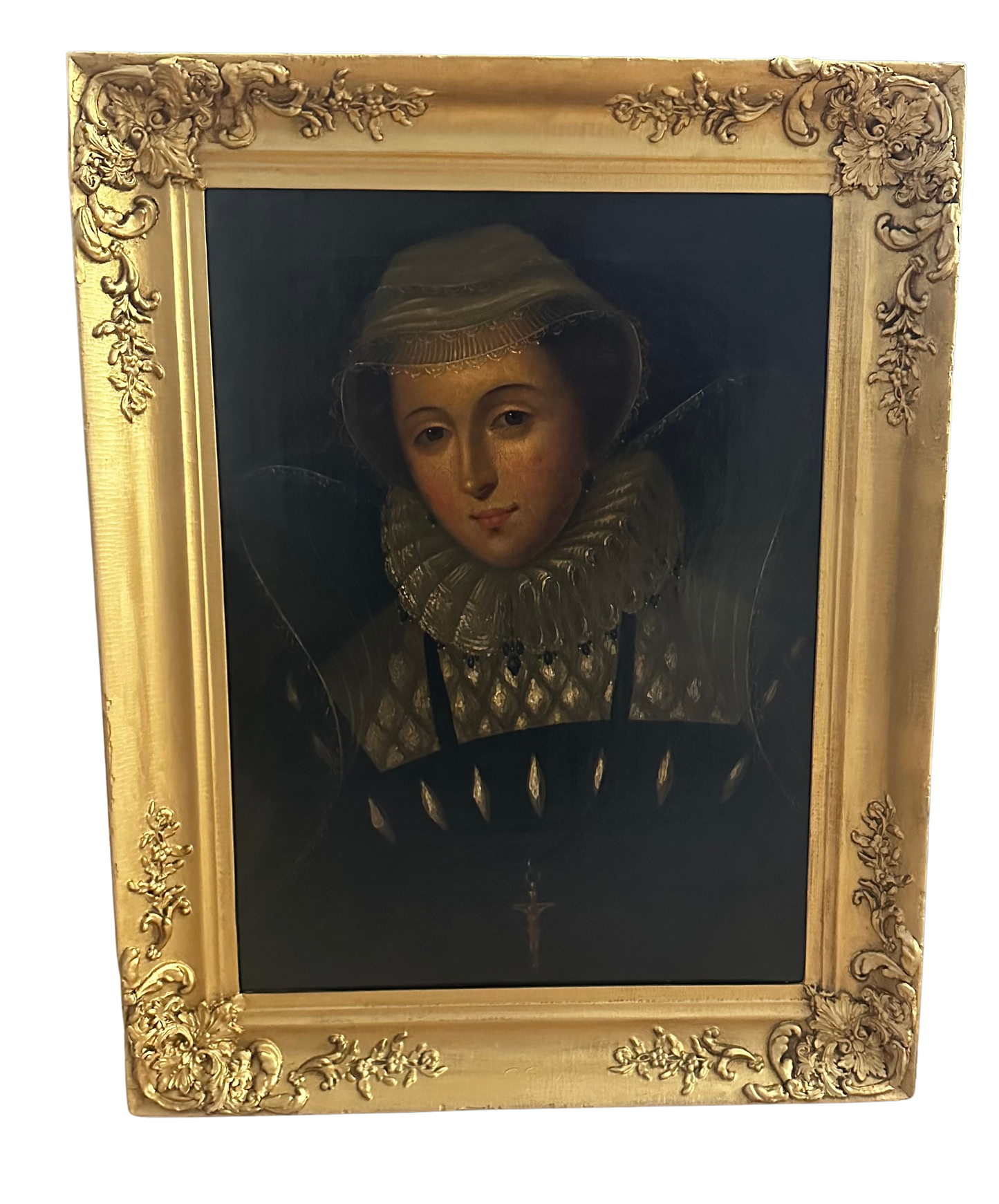
A hauntingly elegant antique oil portrait depicting Mary, Queen of Scots in somber mourning dress after the celebrated Tudor portrait tradition associated with Nicholas Hilliard. The queen is portrayed with a delicate translucent veil cap, dramatic lace ruff, jeweled black gown with gilded ornamentation, and a subtle cruciform pendant suspended at the bodice — reinforcing the Catholic symbolism and tragic mythology long associated with Mary Stuart.
Rendered against a dark atmospheric background, the sitter’s luminous face emerges with remarkable softness and refinement. The painting possesses an intimate and emotionally restrained quality that differs from many overtly decorative later Victorian Tudor revival works. The facial modeling, muted tonal transitions, and restrained handling of the costume details suggest the possibility of an earlier historicist interpretation rather than a purely late Victorian decorative reproduction.
The work appears to have undergone substantial historical restoration and structural conservation. Examination of the reverse and edges suggests the canvas was likely relined or mounted onto a secondary support and may have been trimmed down from a larger original composition during a past restoration campaign. Surface variations, flattened paint passages, uneven varnish sheen, and edge irregularities support this assessment. Craquelure throughout the facial passages and darker painted areas appears consistent with significant age.
The composition closely aligns with romanticized depictions of Mary Stuart popularized in the late 18th and early 19th centuries, when renewed fascination with Tudor and Stuart history inspired reinterpretations of earlier royal portrait types. The black costume and restrained veil strongly evoke mourning iconography associated with Mary following the death of Francis II of France and her later tragic legacy.
Housed in a later giltwood and composition frame with Rococo-inspired corner ornamentation.
Era:
Possibly late 18th to early 19th century, later restored and relined during the 19th or early 20th century.
History:
Mary, Queen of Scots remains one of the most enduring and romanticized figures in European royal history. Queen of Scotland from infancy and briefly Queen Consort of France, her turbulent political life, forced abdication, imprisonment, and execution under Elizabeth I transformed her into a lasting symbol of beauty, tragedy, Catholic martyrdom, and doomed royalty.
Nicholas Hilliard was among the foremost portrait artists of the Elizabethan era, renowned for his refined depictions of aristocratic and royal sitters. Portrait types associated with Mary Stuart and the Tudor court continued to inspire artists for centuries afterward.
During the late 18th and early 19th centuries, renewed fascination with medievalism, romantic tragedy, and British royal history led artists and collectors to revisit iconic historical figures such as Mary Queen of Scots. Portraits inspired by earlier Tudor prototypes became especially desirable among collectors furnishing grand interiors in the Gothic Revival and Romantic taste.
Provenance:
Likely British or Continental School historical portrait adaptation after the Nicholas Hilliard tradition. Acquired through the secondary art market.
Materials:
Oil on canvas, relined or mounted canvas support, later stretcher, giltwood and composition frame.
Dimensions:
Frame: 27.25” H x 21.75” W
Sight: 22.25” H x 16.75” W
Disclaimers:
Painting exhibits age-related craquelure, surface wear, abrasions, varnish inconsistencies, and evidence of historical restoration. Likely relined and possibly reduced from its original dimensions during a past conservation effort. Surface texture variations and restored passages visible under angled lighting. Frame displays age-related wear, minor losses, and restorations consistent with age and handling.
Additional Description:
A hauntingly elegant antique oil portrait depicting Mary, Queen of Scots in somber mourning dress after the celebrated Tudor portrait tradition associated with Nicholas Hilliard. The queen is portrayed with a delicate translucent veil cap, dramatic lace ruff, jeweled black gown with gilded ornamentation, and a subtle cruciform pendant suspended at the bodice — reinforcing the Catholic symbolism and tragic mythology long associated with Mary Stuart.
Rendered against a dark atmospheric background, the sitter’s luminous face emerges with remarkable softness and refinement. The painting possesses an intimate and emotionally restrained quality that differs from many overtly decorative later Victorian Tudor revival works. The facial modeling, muted tonal transitions, and restrained handling of the costume details suggest the possibility of an earlier historicist interpretation rather than a purely late Victorian decorative reproduction.
The work appears to have undergone substantial historical restoration and structural conservation. Examination of the reverse and edges suggests the canvas was likely relined or mounted onto a secondary support and may have been trimmed down from a larger original composition during a past restoration campaign. Surface variations, flattened paint passages, uneven varnish sheen, and edge irregularities support this assessment. Craquelure throughout the facial passages and darker painted areas appears consistent with significant age.
The composition closely aligns with romanticized depictions of Mary Stuart popularized in the late 18th and early 19th centuries, when renewed fascination with Tudor and Stuart history inspired reinterpretations of earlier royal portrait types. The black costume and restrained veil strongly evoke mourning iconography associated with Mary following the death of Francis II of France and her later tragic legacy.
Housed in a later giltwood and composition frame with Rococo-inspired corner ornamentation.
Era:
Possibly late 18th to early 19th century, later restored and relined during the 19th or early 20th century.
History:
Mary, Queen of Scots remains one of the most enduring and romanticized figures in European royal history. Queen of Scotland from infancy and briefly Queen Consort of France, her turbulent political life, forced abdication, imprisonment, and execution under Elizabeth I transformed her into a lasting symbol of beauty, tragedy, Catholic martyrdom, and doomed royalty.
Nicholas Hilliard was among the foremost portrait artists of the Elizabethan era, renowned for his refined depictions of aristocratic and royal sitters. Portrait types associated with Mary Stuart and the Tudor court continued to inspire artists for centuries afterward.
During the late 18th and early 19th centuries, renewed fascination with medievalism, romantic tragedy, and British royal history led artists and collectors to revisit iconic historical figures such as Mary Queen of Scots. Portraits inspired by earlier Tudor prototypes became especially desirable among collectors furnishing grand interiors in the Gothic Revival and Romantic taste.
Provenance:
Likely British or Continental School historical portrait adaptation after the Nicholas Hilliard tradition. Acquired through the secondary art market.
Materials:
Oil on canvas, relined or mounted canvas support, later stretcher, giltwood and composition frame.
Dimensions:
Frame: 27.25” H x 21.75” W
Sight: 22.25” H x 16.75” W
Disclaimers:
Painting exhibits age-related craquelure, surface wear, abrasions, varnish inconsistencies, and evidence of historical restoration. Likely relined and possibly reduced from its original dimensions during a past conservation effort. Surface texture variations and restored passages visible under angled lighting. Frame displays age-related wear, minor losses, and restorations consistent with age and handling.