


Set of Three Antique French Aubusson-Style Tapestry Panels with Pastoral Animal Scenes, Likely from a Folding Room Screen (Paravent), 19th Century
Set of Three Antique French Aubusson-Style Tapestry Panels with Pastoral Animal Scenes, Likely from a Folding Room Screen (Paravent), 19th Century
Couldn't load pickup availability
Share
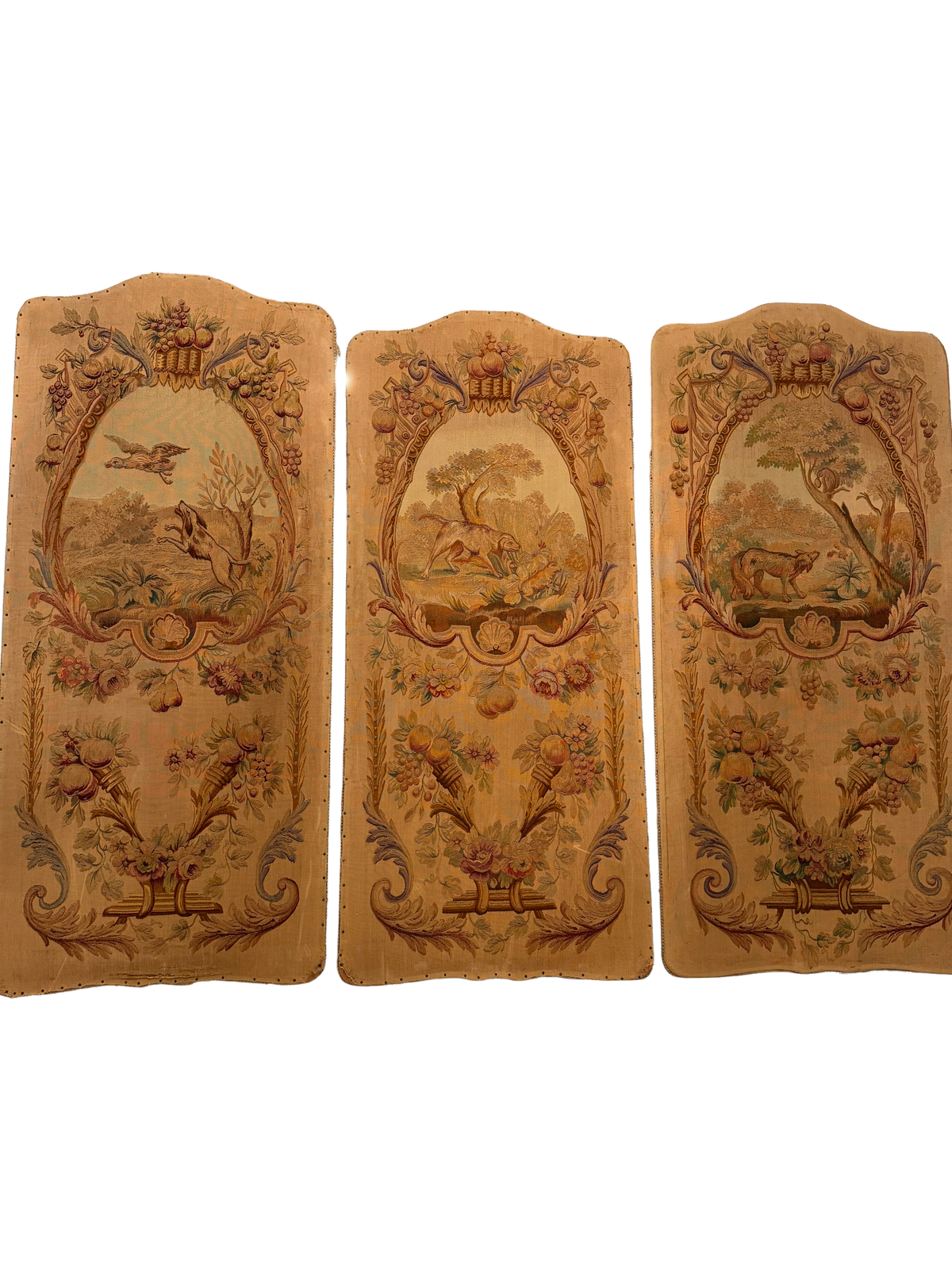
Item Title: Set of Three Antique French Aubusson-Style Tapestry Panels with Pastoral Animal Scenes, Likely from a Folding Room Screen (Paravent), 19th Century
Additional Description
An exceptional decorative set of three antique French-style tapestry panels, believed to have originally formed the textile inserts of a folding room screen, or paravent. Featuring charming pastoral animal scenes, elaborate Rococo-inspired ornamentation, and beautifully muted colors, the panels evoke the elegance of historic French château interiors.
Each elongated rectangular panel features gently scalloped upper and lower edges, with an oval pastoral scene framed by elaborate scrolling acanthus foliage, architectural flourishes, cascading fruit, and floral garlands.
he three central compositions portray distinct woodland scenes:
Panel I — The Pursuit: A leaping hound-like animal beneath a bird in flight, depicted against a tranquil wooded landscape.
Panel II — The Chase: A hunting dog pursuing a smaller animal, possibly a rabbit, through a wooded clearing.
Panel III — The Woodland Scene: A fox-like animal standing beneath a tree occupied by a smaller woodland creature, possibly a squirrel, surrounded by foliage and distant countryside.
The scenes recall the tradition of French animal fables, particularly those associated with Jean de La Fontaine, whose celebrated stories frequently inspired decorative textiles and paintings during the 18th and 19th centuries.
Surrounding each pastoral medallion is a richly ornamented border of scrolling foliage, baskets of fruit, flowering branches, and architectural motifs. The lower portions feature symmetrical floral arrangements and overflowing cornucopias, culminating in elegant Rococo-style scrollwork.
The woven textiles retain a beautifully softened palette of golden ochre, dusty rose, muted lavender, sage green, pale blue, and warm brown against a natural beige ground. The fine detailing and tonal variation create a painterly quality while preserving the distinctive texture of woven fabric.
Each tapestry is mounted onto an individual shaped wooden panel with a fabric backing, with small metal tacks securing the textile along the perimeter.
The coordinated compositions, shaped silhouettes, and individual rigid supports suggest that the panels may originally have been incorporated into a three-fold decorative room screen. The original surrounding screen framework is no longer present, and the panels now survive as three separate decorative elements.
Together, they create an elegant textile triptych, equally suited to display above a settee, along a hallway, within a library, or incorporated into architectural wall paneling.
Era
Likely 19th century, circa 1850–1900.
French Rococo Revival style, drawing inspiration from the decorative traditions of the Louis XV and Louis XVI periods.
The compositions incorporate 18th-century ornamental vocabulary, including pastoral medallions, floral garlands, scrolling acanthus leaves, and fruit-filled cornucopias.
An earlier date remains possible, although the precise age of the textiles and their existing wooden supports has not been independently established.
History
The decorative tradition represented by these panels developed from the celebrated tapestry workshops of France, particularly those associated with Aubusson, Beauvais, and the royal Gobelins manufactory.
During the 18th century, French tapestry makers frequently incorporated pastoral landscapes, woodland animals, hunting scenes, and allegorical compositions into textiles intended for sophisticated domestic interiors.
Such subjects were often framed by elaborate Rococo ornamentation, including scrolling foliage, architectural cartouches, baskets of fruit, and floral garlands.
Animal fables were particularly fashionable decorative subjects, inspired in part by the celebrated writings of Jean de La Fontaine.
His Fables, first published in 1668, drew upon earlier storytelling traditions to explore human behavior through animal characters. Their popularity made them enduring sources of inspiration for French painters, engravers, and tapestry designers.
During the 18th century, French workshops produced tapestry series illustrating these stories, frequently incorporating animals within idealized landscapes.
The panels' compositions reflect this broader decorative tradition, although the specific scenes have not been conclusively identified as illustrations of particular fables.
French folding screens and decorative tapestry inserts
Folding room screens, known in France as paravents, became fashionable elements of aristocratic and affluent domestic interiors during the 17th and 18th centuries.
They served both practical and decorative purposes, providing privacy, shielding occupants from drafts, and dividing interior spaces.
Fine examples incorporated carved and gilded wooden frames surrounding panels of silk, tapestry, needlework, painted canvas, or other decorative textiles.
Three- and four-panel screens were particularly adaptable, allowing them to be arranged according to the proportions of a room.
During the 19th century, the revival of historical French decorative styles encouraged renewed interest in Rococo-inspired furniture, tapestries, and folding screens.
The present set is believed to have originally formed part of such a furnishing. Its three coordinated compositions, individual wooden supports, shaped borders, and perimeter tacking are compatible with textile inserts designed for a decorative screen.
However, the original configuration cannot be established definitively without additional evidence of the former framework or mounting system.
Provenance
Possibly French or Continental European, 19th century.
Believed to have originally formed the decorative textile inserts of a folding room screen (paravent).
The original screen framework is no longer present, and the three panels are currently mounted separately on individual wooden supports with fabric backing.
Original commission, manufacturer, and previous ownership history remain undocumented.
Materials
Woven textile, possibly wool with cotton, silk, or other fibers.
Polychrome tapestry-style decoration featuring pastoral animal scenes and Rococo-inspired floral ornamentation.
Shaped wooden support panels, fabric backing, and metal upholstery tacks securing the textiles around their perimeters.
The precise textile composition and weaving method have not been verified. Attribution to a specific French tapestry manufactory, including Aubusson, remains unconfirmed.
Dimensions
48.25"h x 22.75"w
Set of three elongated rectangular panels with shaped upper and lower edges.
Condition/Disclaimers
Good antique decorative condition overall, with age-related wear consistent with the textiles' presumed 19th-century origins, previous use, and subsequent mounting.
The woven surfaces retain an attractive muted coloration throughout, with visible fading and variations in tone.
Areas of discoloration, scattered spotting, and age-related staining are present across the natural beige grounds.
The textiles exhibit localized wear, minor fraying, and occasional loose threads, particularly near the lower borders and perimeter edges.
Small areas of textile separation and irregularities are visible along some edges where the fabric has been secured to the wooden supports.
The perimeter tacks remain visible, with minor variations in spacing and alignment.
The shaped wooden supports exhibit slight irregularities and wear consistent with previous handling and use.
The panels retain fabric backing, although the condition of the concealed textile reverses and wooden support surfaces has not been fully examined.
The panels are believed to have originally formed part of a decorative folding room screen; however, the original framework is no longer present and their initial function has not been conclusively verified.
The term Aubusson-style refers to the decorative tradition and appearance of the textiles and should not be interpreted as a confirmed attribution to the Aubusson manufactory or weaving workshops.
Precise dating, geographic origin, fiber composition, weaving technique, and original use remain subject to further research.