


Vintage French-Style Alabaster Composite Maiden Bust with Pierced Lace Bonnet Mid to Late 20th Century
Vintage French-Style Alabaster Composite Maiden Bust with Pierced Lace Bonnet Mid to Late 20th Century
Couldn't load pickup availability
Share


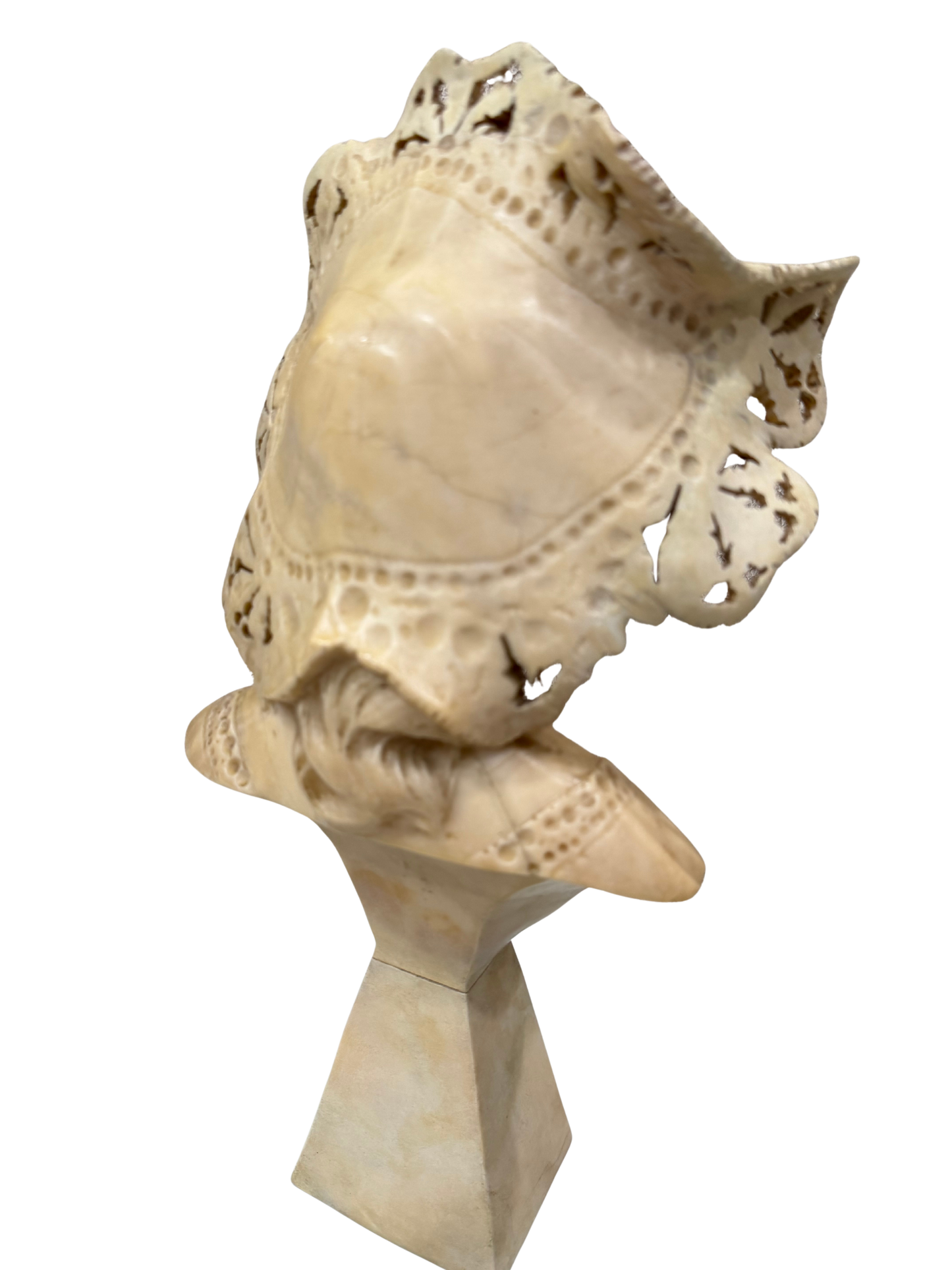
A striking vintage decorative bust depicting an elegant young woman wearing an elaborate pierced bonnet inspired by the traditional lace headdresses of Normandy, France.
The maiden is modeled with softly rendered features, downcast eyes, and flowing curled hair. Her dress is accented with eyelet-style trim and a floral spray across the bodice, while the dramatically flared bonnet is worked with intricate openwork floral and foliate motifs designed to imitate fine lace.
The sculpture is executed in a creamy alabaster- or marble-based composite material, likely incorporating stone powder with a resin or binder, giving the surface the soft coloration and subtle veining associated with carved stone while allowing for highly detailed molded decoration.
The bust is mounted on a tall tapered pedestal with naturalistic marble-like veining. Its romantic Belle Époque-inspired subject and elaborate lacework make it a particularly decorative statement piece for a traditional, French, or collected interior.
A striking vintage decorative bust depicting an elegant young woman wearing an elaborate pierced bonnet inspired by the traditional lace headdresses of Normandy, France.
The maiden is modeled with softly rendered features, downcast eyes, and flowing curled hair. Her dress is accented with eyelet-style trim and a floral spray across the bodice, while the dramatically flared bonnet is worked with intricate openwork floral and foliate motifs designed to imitate fine lace.
The sculpture is executed in a creamy alabaster- or marble-based composite material, likely incorporating stone powder with a resin or binder, giving the surface the soft coloration and subtle veining associated with carved stone while allowing for highly detailed molded decoration.
The bust is mounted on a tall tapered pedestal with naturalistic marble-like veining. Its romantic Belle Époque-inspired subject and elaborate lacework make it a particularly decorative statement piece for a traditional, French, or collected interior.
16.5"h x 7.75"w x 3.5"d
16.5"h x 7.75"w x 3.5"d
During the late 19th century, French carving centers including Dieppe became particularly associated with finely worked portrait busts of women in regional costume, often featuring elaborate pierced bonnets intended to resemble delicate textile lace.
The romantic imagery remained popular well into the 20th century and was subsequently reproduced in decorative materials including alabaster composites, marble-dust resin, and other cast stone mixtures.
This example appears to belong to that later decorative tradition. Its subject, elaborate bonnet, curled hairstyle, floral bodice, and overall silhouette closely reference Belle Époque and Victorian French sculpture, while the material and construction are more consistent with a later molded composite than with a 19th-century hand-carved ivory example.
During the late 19th century, French carving centers including Dieppe became particularly associated with finely worked portrait busts of women in regional costume, often featuring elaborate pierced bonnets intended to resemble delicate textile lace.
The romantic imagery remained popular well into the 20th century and was subsequently reproduced in decorative materials including alabaster composites, marble-dust resin, and other cast stone mixtures.
This example appears to belong to that later decorative tradition. Its subject, elaborate bonnet, curled hairstyle, floral bodice, and overall silhouette closely reference Belle Époque and Victorian French sculpture, while the material and construction are more consistent with a later molded composite than with a 19th-century hand-carved ivory example.
Mid to Late 20th Century Likely produced as a decorative revival piece inspired by late-19th-century French and Dieppe-style portrait busts.
Mid to Late 20th Century Likely produced as a decorative revival piece inspired by late-19th-century French and Dieppe-style portrait busts.
Alabaster / marble composite
Stone or marble powder
Resin or similar binding material
Faux-veined composite pedestal
Material attribution is based on visual examination and has not been laboratory tested.
Alabaster / marble composite
Stone or marble powder
Resin or similar binding material
Faux-veined composite pedestal
Material attribution is based on visual examination and has not been laboratory tested.
Austin Estate
Austin Estate
Vintage condition with age-appropriate surface wear, discoloration, and variation throughout. The intricate pierced bonnet displays numerous delicate openwork elements and should be handled carefully.
Fine lines, surface marks, tonal variation, and areas of darker coloration are visible throughout the sculpture and pedestal. Please review all photographs carefully for the most accurate representation of condition.
This piece is described as alabaster / marble composite based upon its visible surface, coloration, construction, and molded detailing. The exact composition has not been scientifically tested.
The sculpture is a later decorative work inspired by antique French and Dieppe-style busts and is not being represented as an original 19th-century Dieppe ivory carving.
As with many vintage molded decorative objects, minor casting irregularities, surface variation, and differences in coloration are expected and contribute to the character of the piece.
Vintage condition with age-appropriate surface wear, discoloration, and variation throughout. The intricate pierced bonnet displays numerous delicate openwork elements and should be handled carefully.
Fine lines, surface marks, tonal variation, and areas of darker coloration are visible throughout the sculpture and pedestal. Please review all photographs carefully for the most accurate representation of condition.
This piece is described as alabaster / marble composite based upon its visible surface, coloration, construction, and molded detailing. The exact composition has not been scientifically tested.
The sculpture is a later decorative work inspired by antique French and Dieppe-style busts and is not being represented as an original 19th-century Dieppe ivory carving.
As with many vintage molded decorative objects, minor casting irregularities, surface variation, and differences in coloration are expected and contribute to the character of the piece.