

17th C (1672) Clavis Graeca Novi Testamenti (The Greek Key to the New Testament)
17th C (1672) Clavis Graeca Novi Testamenti (The Greek Key to the New Testament)
Impossible de charger la disponibilité du service de retrait
Partager
17th C Clavis Graeca Novi Testamenti (The Greek Key to the New Testament)
Author: Johannes Leusden (1624-1699) – prominent 17th c Dutch Orientalists and Hebraists at the University of Utrecht
Publisher: Georgius à Poolsum (Georgii à Poolsum Bibliopola); Ultrajecti (Utrecht, Netherlands); 1672 (MDCLXXII)
Language: Latin, with Greek and Hebrew text references
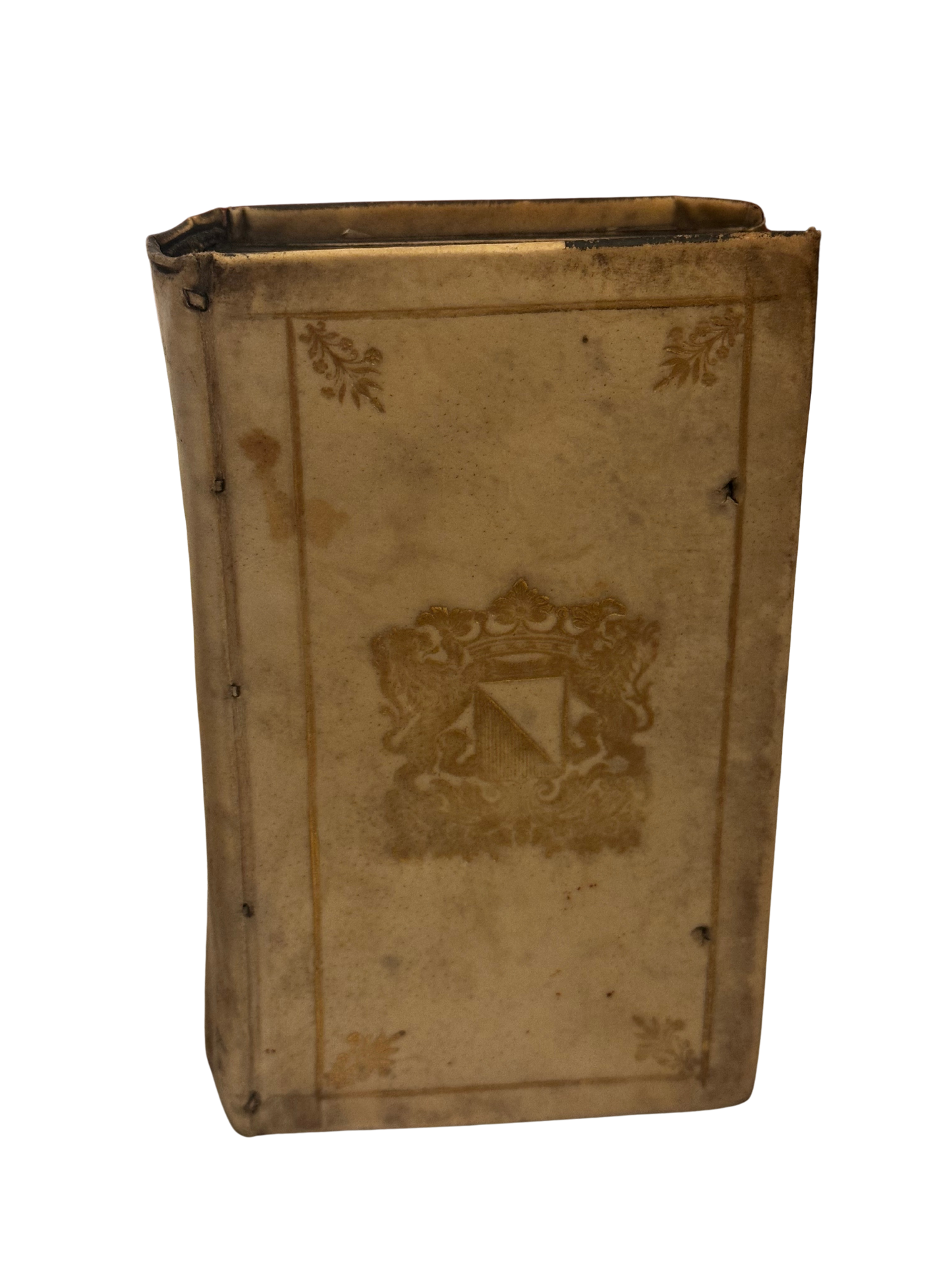
Binding: Contemporary vellum with gilt tooling, including corner flourishes and a central armorial coat of arms (possibly a personal or institutional crest). The text block edges are gilt, a sign of a higher-end academic or theological binding.
Leusden’s Clavis Graeca Novi Testamenti was a lexicon and grammatical reference to help scholars interpret the Greek of the New Testament, with comparative analysis to Hebrew and Aramaic idioms. It was widely used in Reformed universities and theological seminaries in the Dutch Republic and beyond, often as a companion to his other works such as Clavis Hebraica Veteris Testamenti (1669).
The book integrates: Hebrew & Greek word comparisons. Explanations of idiomatic expressions. Philological notes tying Biblical Greek back to Semitic roots. Marginal notations and scholastic diagrams (as seen in your photos). This made it a cornerstone text for early modern biblical linguistics.
Ex Libris Philippe van Heurck — The modern bookplate inside your copy is of Philippe van Heurck (1882–1953), a Belgian physician, collector, and bibliophile from Antwerp, known for his extensive library on botany, natural sciences, and early printing. His ex-libris design shows hands reaching toward divine light over an open book, surrounded by stars and rays — symbolizing enlightenment through knowledge.
Handwritten Latin inscription (Dedication page):
It appears to be a student presentation inscription, typical in the 17th–18th century:
This roughly translates to: “To the talented and well-mannered youth, Cornelius Brink, upon his promotion from the second to the third class, this token, reward, and testimony of good merit is given at Rhenen on the 4th of November, by Samuel Dittlas, Rector of the Hierosynian Gymnasium.” This suggests the book was awarded as a school prize, likely in the late 17th or early 18th century. Such inscriptions were a hallmark of humanist education — combining classical Latin phrasing with moral praise. Books like this, bound finely in vellum with gilt, were customarily gifted by rectors to their most promising students.
Stamp: “J. B. VAN TEMEL / ARCH. SEM. NEERDL. SUP.” — likely a later ownership or seminary library mark, possibly “Archiepiscopal Seminary of the Netherlands (Superior)” or similar.
Engraved Frontispiece: dated Anno 1672 shows two allegorical female figures: Scientia (Knowledge) and Sapientia (Wisdom), flanking a decorative title cartouche with keys and symbols of divine revelation. The imagery emphasizes that wisdom and learning unlock the secrets of Scripture — a literal “clavis” (key).
17th C Clavis Graeca Novi Testamenti (The Greek Key to the New Testament)
Author: Johannes Leusden (1624-1699) – prominent 17th c Dutch Orientalists and Hebraists at the University of Utrecht
Publisher: Georgius à Poolsum (Georgii à Poolsum Bibliopola); Ultrajecti (Utrecht, Netherlands); 1672 (MDCLXXII)
Language: Latin, with Greek and Hebrew text references
Binding: Contemporary vellum with gilt tooling, including corner flourishes and a central armorial coat of arms (possibly a personal or institutional crest). The text block edges are gilt, a sign of a higher-end academic or theological binding.
Leusden’s Clavis Graeca Novi Testamenti was a lexicon and grammatical reference to help scholars interpret the Greek of the New Testament, with comparative analysis to Hebrew and Aramaic idioms. It was widely used in Reformed universities and theological seminaries in the Dutch Republic and beyond, often as a companion to his other works such as Clavis Hebraica Veteris Testamenti (1669).
The book integrates: Hebrew & Greek word comparisons. Explanations of idiomatic expressions. Philological notes tying Biblical Greek back to Semitic roots. Marginal notations and scholastic diagrams (as seen in your photos). This made it a cornerstone text for early modern biblical linguistics.
Ex Libris Philippe van Heurck — The modern bookplate inside your copy is of Philippe van Heurck (1882–1953), a Belgian physician, collector, and bibliophile from Antwerp, known for his extensive library on botany, natural sciences, and early printing. His ex-libris design shows hands reaching toward divine light over an open book, surrounded by stars and rays — symbolizing enlightenment through knowledge.
Handwritten Latin inscription (Dedication page):
It appears to be a student presentation inscription, typical in the 17th–18th century:
This roughly translates to: “To the talented and well-mannered youth, Cornelius Brink, upon his promotion from the second to the third class, this token, reward, and testimony of good merit is given at Rhenen on the 4th of November, by Samuel Dittlas, Rector of the Hierosynian Gymnasium.” This suggests the book was awarded as a school prize, likely in the late 17th or early 18th century. Such inscriptions were a hallmark of humanist education — combining classical Latin phrasing with moral praise. Books like this, bound finely in vellum with gilt, were customarily gifted by rectors to their most promising students.
Stamp: “J. B. VAN TEMEL / ARCH. SEM. NEERDL. SUP.” — likely a later ownership or seminary library mark, possibly “Archiepiscopal Seminary of the Netherlands (Superior)” or similar.
Engraved Frontispiece: dated Anno 1672 shows two allegorical female figures: Scientia (Knowledge) and Sapientia (Wisdom), flanking a decorative title cartouche with keys and symbols of divine revelation. The imagery emphasizes that wisdom and learning unlock the secrets of Scripture — a literal “clavis” (key).