

1818 French Schoolgirl Silk Embroidery by Aimé Prux, Montauban – Maison d’Éducation of Dames Dubois and Elisabeth
1818 French Schoolgirl Silk Embroidery by Aimé Prux, Montauban – Maison d’Éducation of Dames Dubois and Elisabeth
Impossible de charger la disponibilité du service de retrait
Partager
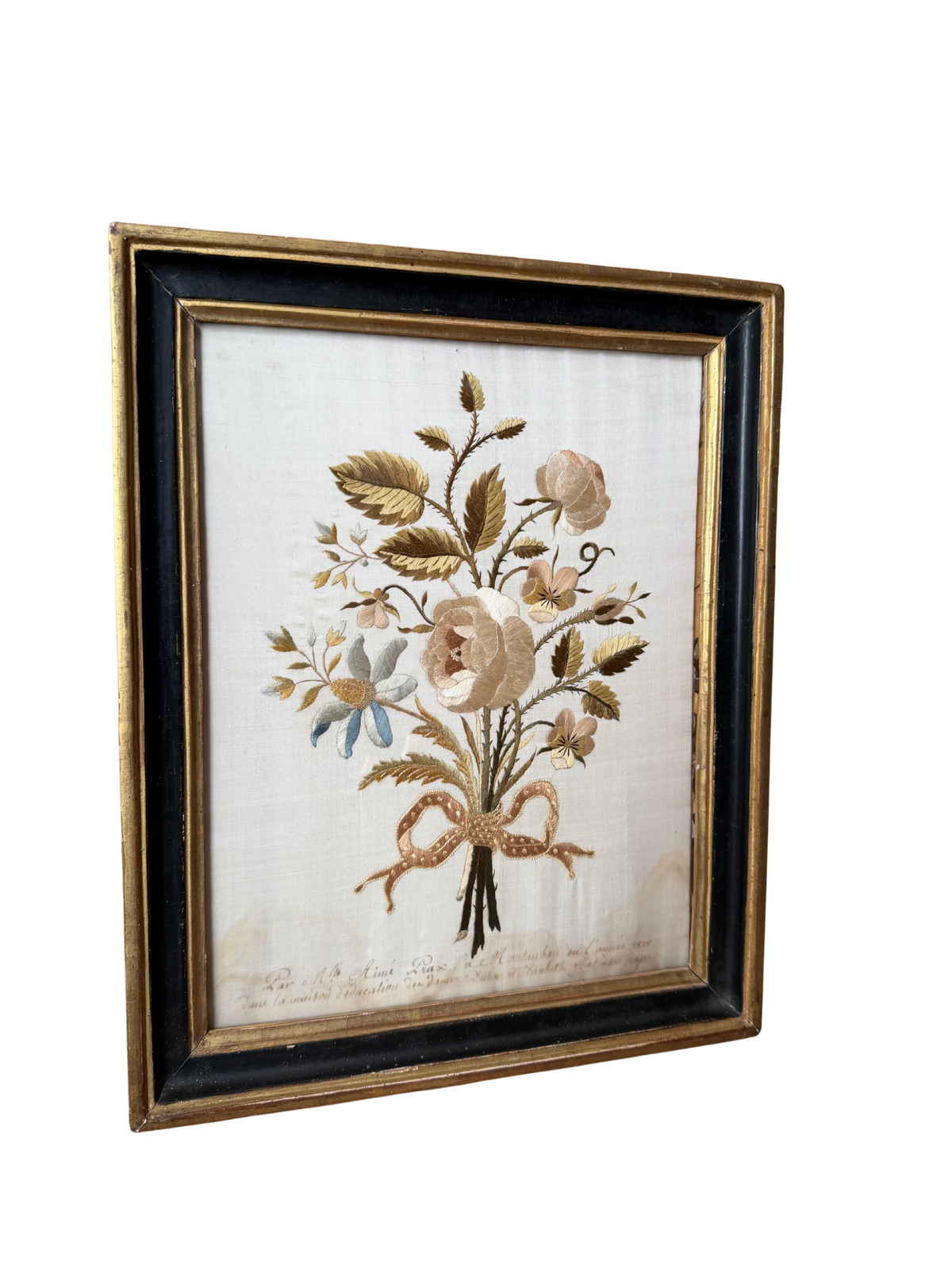
An exceptionally charming and unusually well-documented French schoolgirl needlework dating to 1818, worked by Mlle Aimé Prux in Montauban, France.
Executed in delicately shaded silk threads on a pale silk ground, the composition features a finely worked floral arrangement gathered with an elaborate looping ribbon. The ribbon is embroidered in soft blush-pink silk with cream spotted decoration and carefully articulated edging, while the stems and foliage are rendered in muted greens and browns. The refined workmanship reflects the needlework instruction traditionally included in the education of young ladies during the early 19th century.
Most importantly, the lower portion retains an extensive handwritten inscription identifying the young maker, the location and date, and the educational establishment in which the work was completed.
The inscription reads approximately:
“Par Mlle Aimé Prux à Montauban en l’année 1818, dans la maison d’éducation des dames Dubois et Elisabeth. Offert à son papa.”
Translated:
“By Miss Aimé Prux, at Montauban in the year 1818, in the educational establishment of Mesdames Dubois and Elisabeth. Presented to her father.”
The final dedication gives the textile an especially personal character: rather than simply being an anonymous decorative embroidery, it survives as a documented accomplishment by a young woman and a gift made for her father more than two centuries ago.
Era
French Restoration Period / Early 19th Century
Dated 1818
History
Needlework formed an important component of female education in late-18th- and early-19th-century France. Private maisons d’éducation and pensionnats for young ladies taught subjects such as reading, writing and arithmetic alongside drawing, music and ornamental needlework.
Works of this type functioned both as demonstrations of accomplishment and as personal keepsakes. Many were completed while a pupil was attending school and subsequently presented to a parent or family member.
This example is particularly desirable because its surviving inscription provides unusually specific historical context: the maker, Aimé Prux; Montauban; the year 1818; the maison d’éducation operated by Dames Dubois and Elisabeth; and its intended recipient, the maker’s father.
Research has not yet securely identified the formal name or address of the Dubois and Elisabeth establishment. It may have been a privately operated girls’ boarding or finishing school rather than an institution known by a separate formal title. The inscription itself nevertheless provides compelling primary evidence of the school and Aimé Prux’s attendance there in 1818.
Provenance
Montauban, Tarn-et-Garonne, France
Worked by Mlle Aimé Prux at the maison d’éducation of Dames Dubois and Elisabeth, 1818.
Inscribed as having been presented to her father.
Sourced in France.
Materials
Silk embroidery threads
Fine woven silk textile ground
Handwritten ink inscription
Period textile work
Existing mounting materials
Dimensions
Please add exact dimensions from physical measurement.
Disclaimers / Condition
Over 200 years old and showing condition consistent with its age.
The silk ground exhibits scattered age-related discoloration, staining, small marks and areas of tonal variation. Some wear and losses are visible along the lower edge, particularly around the historic mounting area. Minor age-related wear may also be present within the embroidery and silk threads.
The handwritten inscription remains remarkably legible considering its age, although portions are faint and certain words remain subject to interpretation.
Existing mounting appears historic but has not been removed for examination, so the reverse and concealed areas have not been fully inspected.
Please review all photographs closely as they form an important part of the condition description. Antique textiles inherently exhibit variations, fading and wear consistent with their age and history.
An exceptionally charming and unusually well-documented French schoolgirl needlework dating to 1818, worked by Mlle Aimé Prux in Montauban, France.
Executed in delicately shaded silk threads on a pale silk ground, the composition features a finely worked floral arrangement gathered with an elaborate looping ribbon. The ribbon is embroidered in soft blush-pink silk with cream spotted decoration and carefully articulated edging, while the stems and foliage are rendered in muted greens and browns. The refined workmanship reflects the needlework instruction traditionally included in the education of young ladies during the early 19th century.
Most importantly, the lower portion retains an extensive handwritten inscription identifying the young maker, the location and date, and the educational establishment in which the work was completed.
The inscription reads approximately:
“Par Mlle Aimé Prux à Montauban en l’année 1818, dans la maison d’éducation des dames Dubois et Elisabeth. Offert à son papa.”
Translated:
“By Miss Aimé Prux, at Montauban in the year 1818, in the educational establishment of Mesdames Dubois and Elisabeth. Presented to her father.”
The final dedication gives the textile an especially personal character: rather than simply being an anonymous decorative embroidery, it survives as a documented accomplishment by a young woman and a gift made for her father more than two centuries ago.
Era
French Restoration Period / Early 19th Century
Dated 1818
History
Needlework formed an important component of female education in late-18th- and early-19th-century France. Private maisons d’éducation and pensionnats for young ladies taught subjects such as reading, writing and arithmetic alongside drawing, music and ornamental needlework.
Works of this type functioned both as demonstrations of accomplishment and as personal keepsakes. Many were completed while a pupil was attending school and subsequently presented to a parent or family member.
This example is particularly desirable because its surviving inscription provides unusually specific historical context: the maker, Aimé Prux; Montauban; the year 1818; the maison d’éducation operated by Dames Dubois and Elisabeth; and its intended recipient, the maker’s father.
Research has not yet securely identified the formal name or address of the Dubois and Elisabeth establishment. It may have been a privately operated girls’ boarding or finishing school rather than an institution known by a separate formal title. The inscription itself nevertheless provides compelling primary evidence of the school and Aimé Prux’s attendance there in 1818.
Provenance
Montauban, Tarn-et-Garonne, France
Worked by Mlle Aimé Prux at the maison d’éducation of Dames Dubois and Elisabeth, 1818.
Inscribed as having been presented to her father.
Sourced in France.
Materials
Silk embroidery threads
Fine woven silk textile ground
Handwritten ink inscription
Period textile work
Existing mounting materials
Dimensions
Please add exact dimensions from physical measurement.
Disclaimers / Condition
Over 200 years old and showing condition consistent with its age.
The silk ground exhibits scattered age-related discoloration, staining, small marks and areas of tonal variation. Some wear and losses are visible along the lower edge, particularly around the historic mounting area. Minor age-related wear may also be present within the embroidery and silk threads.
The handwritten inscription remains remarkably legible considering its age, although portions are faint and certain words remain subject to interpretation.
Existing mounting appears historic but has not been removed for examination, so the reverse and concealed areas have not been fully inspected.
Please review all photographs closely as they form an important part of the condition description. Antique textiles inherently exhibit variations, fading and wear consistent with their age and history.