


18th-Century Paestum Archaeological Engraving — Plate XLII
18th-Century Paestum Archaeological Engraving — Plate XLII
Impossible de charger la disponibilité du service de retrait
Partager


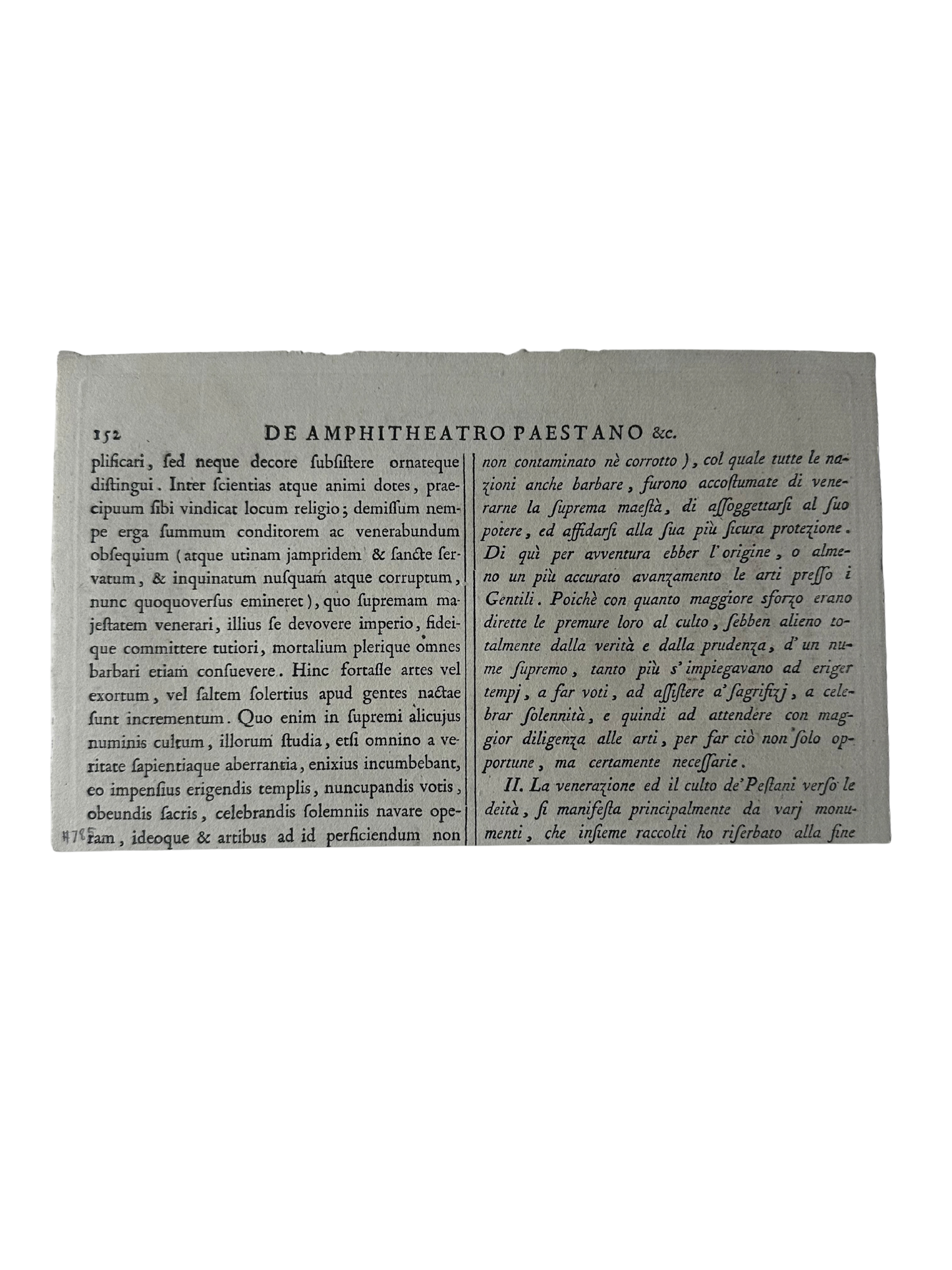
An original late-18th-century copperplate engraving depicting classical ruins at Paestum, identified on the reverse as “De Amphitheatro Paestano.” The composition shows classical figures, antiquities, and a landscape with ruins in the distance, rendered in the refined archaeological illustration style of the Enlightenment period.
The engraving is signed in the plate by the designer/engravers:
C. F. Née inc. - Charles-François Nee - Designed/Draftsman
Ant. Baratti inc. - Antonio Baratti - Engraver
Printed on handmade laid paper with a visible plate impression and deckled edges. The reverse retains original Latin text from the publication, confirming it as an authentic book plate (Plate XLII).
This engraving most likely originates from the celebrated Grand Tour publication:
Voyage pittoresque, ou Description des Royaumes de Naples et de Sicile
by the Abbé de Saint-Non, published in Paris between 1781 and 1786.
Engravings from this work helped introduce the ruins of Paestum to a wider European audience and contributed to the rise of Neoclassical architectural taste in the late 18th century.
An original late-18th-century copperplate engraving depicting classical ruins at Paestum, identified on the reverse as “De Amphitheatro Paestano.” The composition shows classical figures, antiquities, and a landscape with ruins in the distance, rendered in the refined archaeological illustration style of the Enlightenment period.
The engraving is signed in the plate by the designer/engravers:
C. F. Née inc. - Charles-François Nee - Designed/Draftsman
Ant. Baratti inc. - Antonio Baratti - Engraver
Printed on handmade laid paper with a visible plate impression and deckled edges. The reverse retains original Latin text from the publication, confirming it as an authentic book plate (Plate XLII).
This engraving most likely originates from the celebrated Grand Tour publication:
Voyage pittoresque, ou Description des Royaumes de Naples et de Sicile
by the Abbé de Saint-Non, published in Paris between 1781 and 1786.
Engravings from this work helped introduce the ruins of Paestum to a wider European audience and contributed to the rise of Neoclassical architectural taste in the late 18th century.
10"w x 6"h
10"w x 6"h
Charles-François Nee (active 18th c.) was the designer or draftsman. Antonio Baratti (1724–1787) was a prolific Italian engraver based in Venice, known for classical and archaeological subjects.
Paestum, originally the Greek city of Poseidonia in southern Italy, became a major archaeological fascination during the Enlightenment. Illustrated travel books documenting classical ruins were produced for scholars, artists, and Grand Tour travelers.
The Abbé de Saint-Non’s Voyage pittoresque is one of the most important illustrated travel publications of the period, combining archaeology, landscape imagery, and classical subject matter. Plates were engraved by multiple artists working collaboratively, including Charles-François Née and Antonio Baratti.
Charles-François Nee (active 18th c.) was the designer or draftsman. Antonio Baratti (1724–1787) was a prolific Italian engraver based in Venice, known for classical and archaeological subjects.
Paestum, originally the Greek city of Poseidonia in southern Italy, became a major archaeological fascination during the Enlightenment. Illustrated travel books documenting classical ruins were produced for scholars, artists, and Grand Tour travelers.
The Abbé de Saint-Non’s Voyage pittoresque is one of the most important illustrated travel publications of the period, combining archaeology, landscape imagery, and classical subject matter. Plates were engraved by multiple artists working collaboratively, including Charles-François Née and Antonio Baratti.
Late 18th century (circa 1780s)
Late 18th century (circa 1780s)
Copperplate engraving
Handmade laid paper
Copperplate engraving
Handmade laid paper
Removed from an 18th-century antiquarian publication printed in Paris documenting southern Italian ruins.
Removed from an 18th-century antiquarian publication printed in Paris documenting southern Italian ruins.
Removed from bound volume
Minor toning consistent with age
Light edge irregularities and handling wear
Unframed
Removed from bound volume
Minor toning consistent with age
Light edge irregularities and handling wear
Unframed