
19th Century French Blue Wax Heraldic Alliance Seal on Handwritten Correspondence in Gilt Rococo-Revival Frame
19th Century French Blue Wax Heraldic Alliance Seal on Handwritten Correspondence in Gilt Rococo-Revival Frame
Impossible de charger la disponibilité du service de retrait
Partager
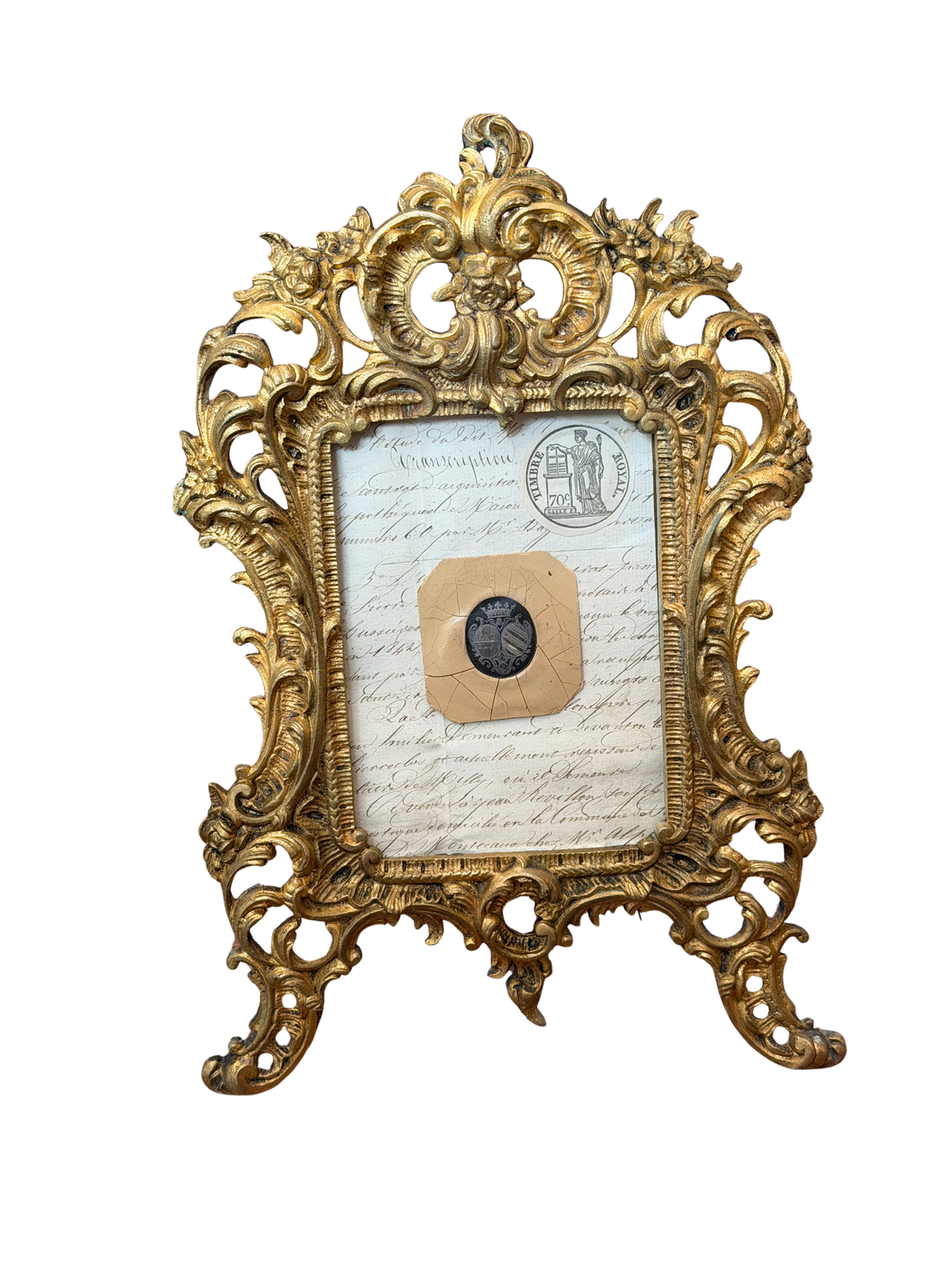
A striking 19th-century French heraldic wax seal preserved on its original handwritten correspondence and displayed within an elaborate gilt Rococo-Revival frame.
At the center is a large blue wax seal impression bearing a finely engraved pair of conjoined heraldic shields beneath a coronet, surrounded by scrolling foliate ornament. The paired shields indicate an alliance or marriage coat of arms, combining the arms of two families.
The dexter shield at left appears quartered or divided horizontally, with architectural or tower-like devices in the upper field and additional heraldic charges below. The sinister shield at right is composed of a series of diagonal bands or bends, several apparently containing small repeated charges. Above the shields is a noble coronet with visible pearls or points, indicating an armorial connection to the titled nobility, although the precise rank and family attribution would require further heraldic research.
The impression remains remarkably crisp, with the coronet, shield divisions and ornamental scrollwork clearly legible.
The seal is mounted over antique French manuscript correspondence with a visible period postal or fiscal marking above, creating a layered presentation combining heraldry, calligraphy and documentary history.
Presented in a highly decorative pierced gilt-metal or composition frame in the Rococo Revival taste, with exuberant C-scrolls, floral ornament and a scrolling easel support.
Era
Mid-19th century, circa 1840–1870
The correspondence and seal appear consistent with this period, while the decorative frame may be contemporary or slightly later in the 19th century.
History
Wax seals were used throughout the 18th and 19th centuries to authenticate private correspondence, legal documents and official papers. For members of noble or armigerous families, a personal seal matrix was engraved with the owner’s coat of arms.
A seal displaying two shields beneath a single coronet is generally associated with an armorial alliance, most often representing a married couple and the joining of two family lineages.
Blue sealing wax was one of several colored waxes employed in 19th-century Europe. Although wax color could sometimes carry social or contextual associations, its significance was not completely standardized, and blue should not be interpreted as identifying a particular noble rank by itself.
The unusually large and detailed heraldic impression makes this example particularly decorative and collectible.
Heraldic Detail
The seal appears to show:
Two juxtaposed or accollé shields, characteristic of alliance arms.
A noble coronet above the shields.
Dexter arms: divided field incorporating architectural/tower-like charges and additional devices beneath.
Sinister arms: multiple diagonal bands or bends containing repeated small charges.
Elaborate Rococo-style mantling or scrollwork surrounding the shields.
I would describe these as “unidentified French noble alliance arms” rather than assign a family until the blazon can be matched securely.
Provenance
Sourced in France.
Retains its original 19th-century handwritten French correspondence and blue heraldic wax impression.
Materials
Blue sealing wax; handwritten paper correspondence; gilt metal and/or gilt composition frame; glass.
Dimensions
Add measured dimensions.
Condition
Good antique condition with age-related wear throughout. The blue wax impression retains strong detail with expected minor surface wear and small imperfections.
The manuscript paper shows age-related toning, creasing and scattered marks appropriate to its age. The ornate gilt frame displays rubbing, oxidation, small areas of finish loss and general wear consistent with 19th-century decorative metalwork.
Please review photographs closely as they form an important part of the condition description.
Disclaimers
Heraldic interpretation is based on the visible seal impression. The specific families represented by the arms have not yet been conclusively identified, and no title or noble attribution should be considered definitive without documentary or genealogical confirmation.
Wax seal / alliance arms: likely a marquis-level marriage alliance, with two shields beneath a marquis coronet.
Dexter shield: clearly coupé (horizontally divided). The upper half shows a two-towered crenellated castle/gateway joined by a wall; the lower half shows a running or leaping dog/greyhound. The exact family is still unidentified.
Sinister shield: appears to show three diagonal bends, creating seven visible diagonal zones. Based on the latest close reading, the background looks speckled/dotted and the three bends look cross-hatched, which would most likely read Or with three bends Sable — gold with three black bends — though the tiny seal makes the hatching difficult to confirm absolutely. A Norman L’Évêque coat is a possible visual candidate, but not yet proven.
So the best current description is:
Armes d’alliance beneath a marquis coronet; dexter: coupé, château à deux tours above a running greyhound; sinister: probably d’or à trois bandes de sable. Family identification pending.
A striking 19th-century French heraldic wax seal preserved on its original handwritten correspondence and displayed within an elaborate gilt Rococo-Revival frame.
At the center is a large blue wax seal impression bearing a finely engraved pair of conjoined heraldic shields beneath a coronet, surrounded by scrolling foliate ornament. The paired shields indicate an alliance or marriage coat of arms, combining the arms of two families.
The dexter shield at left appears quartered or divided horizontally, with architectural or tower-like devices in the upper field and additional heraldic charges below. The sinister shield at right is composed of a series of diagonal bands or bends, several apparently containing small repeated charges. Above the shields is a noble coronet with visible pearls or points, indicating an armorial connection to the titled nobility, although the precise rank and family attribution would require further heraldic research.
The impression remains remarkably crisp, with the coronet, shield divisions and ornamental scrollwork clearly legible.
The seal is mounted over antique French manuscript correspondence with a visible period postal or fiscal marking above, creating a layered presentation combining heraldry, calligraphy and documentary history.
Presented in a highly decorative pierced gilt-metal or composition frame in the Rococo Revival taste, with exuberant C-scrolls, floral ornament and a scrolling easel support.
Era
Mid-19th century, circa 1840–1870
The correspondence and seal appear consistent with this period, while the decorative frame may be contemporary or slightly later in the 19th century.
History
Wax seals were used throughout the 18th and 19th centuries to authenticate private correspondence, legal documents and official papers. For members of noble or armigerous families, a personal seal matrix was engraved with the owner’s coat of arms.
A seal displaying two shields beneath a single coronet is generally associated with an armorial alliance, most often representing a married couple and the joining of two family lineages.
Blue sealing wax was one of several colored waxes employed in 19th-century Europe. Although wax color could sometimes carry social or contextual associations, its significance was not completely standardized, and blue should not be interpreted as identifying a particular noble rank by itself.
The unusually large and detailed heraldic impression makes this example particularly decorative and collectible.
Heraldic Detail
The seal appears to show:
Two juxtaposed or accollé shields, characteristic of alliance arms.
A noble coronet above the shields.
Dexter arms: divided field incorporating architectural/tower-like charges and additional devices beneath.
Sinister arms: multiple diagonal bands or bends containing repeated small charges.
Elaborate Rococo-style mantling or scrollwork surrounding the shields.
I would describe these as “unidentified French noble alliance arms” rather than assign a family until the blazon can be matched securely.
Provenance
Sourced in France.
Retains its original 19th-century handwritten French correspondence and blue heraldic wax impression.
Materials
Blue sealing wax; handwritten paper correspondence; gilt metal and/or gilt composition frame; glass.
Dimensions
Add measured dimensions.
Condition
Good antique condition with age-related wear throughout. The blue wax impression retains strong detail with expected minor surface wear and small imperfections.
The manuscript paper shows age-related toning, creasing and scattered marks appropriate to its age. The ornate gilt frame displays rubbing, oxidation, small areas of finish loss and general wear consistent with 19th-century decorative metalwork.
Please review photographs closely as they form an important part of the condition description.
Disclaimers
Heraldic interpretation is based on the visible seal impression. The specific families represented by the arms have not yet been conclusively identified, and no title or noble attribution should be considered definitive without documentary or genealogical confirmation.
Wax seal / alliance arms: likely a marquis-level marriage alliance, with two shields beneath a marquis coronet.
Dexter shield: clearly coupé (horizontally divided). The upper half shows a two-towered crenellated castle/gateway joined by a wall; the lower half shows a running or leaping dog/greyhound. The exact family is still unidentified.
Sinister shield: appears to show three diagonal bends, creating seven visible diagonal zones. Based on the latest close reading, the background looks speckled/dotted and the three bends look cross-hatched, which would most likely read Or with three bends Sable — gold with three black bends — though the tiny seal makes the hatching difficult to confirm absolutely. A Norman L’Évêque coat is a possible visual candidate, but not yet proven.
So the best current description is:
Armes d’alliance beneath a marquis coronet; dexter: coupé, château à deux tours above a running greyhound; sinister: probably d’or à trois bandes de sable. Family identification pending.