


19th Century French Palais Royal Style Tessellated Bone and Tortoiseshell Inlaid Trinket Box
19th Century French Palais Royal Style Tessellated Bone and Tortoiseshell Inlaid Trinket Box
Impossible de charger la disponibilité du service de retrait
Partager


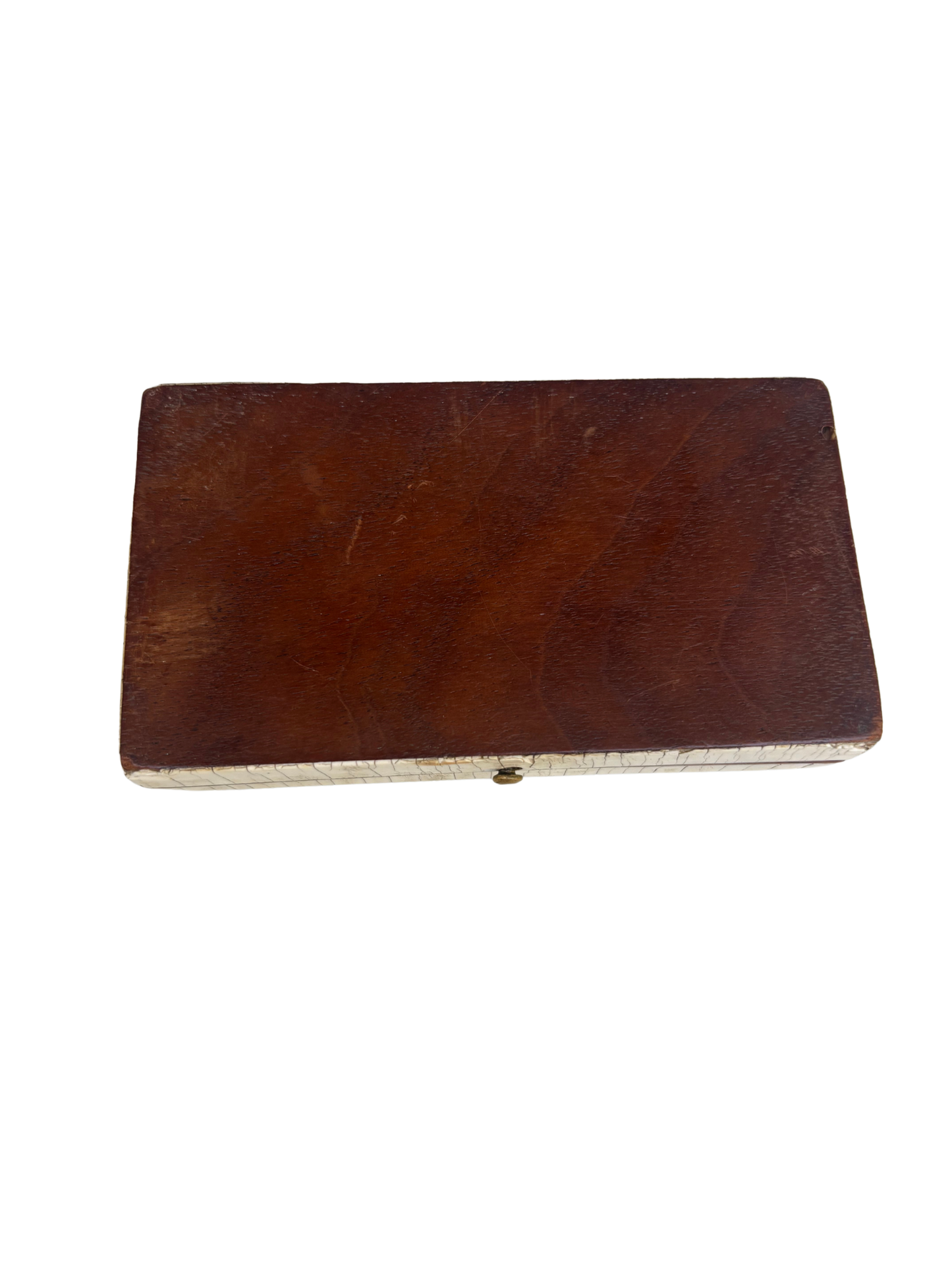
A finely detailed rectangular trinket or jewelry box in the French Palais Royal taste, featuring an elaborate tessallated bone top with intricate tortoiseshell and gilt brass inlay. The surface is richly decorated with scrolling foliate and strapwork motifs, framing panels of deep cobalt blue, ruby red, and ivory tones. The characteristic craquelure throughout the surface is consistent with age and the natural aging of lacquer or composition finishes, adding visual depth and authenticity.
A central engraved brass cartouche displays a delicate monogram, likely original to the piece. The box opens via a small brass push-button to reveal a fitted interior lined in dark velvet, designed for jewelry or small personal objects. The case is constructed of wood beneath the decorative exterior.
A finely detailed rectangular trinket or jewelry box in the French Palais Royal taste, featuring an elaborate tessallated bone top with intricate tortoiseshell and gilt brass inlay. The surface is richly decorated with scrolling foliate and strapwork motifs, framing panels of deep cobalt blue, ruby red, and ivory tones. The characteristic craquelure throughout the surface is consistent with age and the natural aging of lacquer or composition finishes, adding visual depth and authenticity.
A central engraved brass cartouche displays a delicate monogram, likely original to the piece. The box opens via a small brass push-button to reveal a fitted interior lined in dark velvet, designed for jewelry or small personal objects. The case is constructed of wood beneath the decorative exterior.
2.5"h x 4.5"w x 1"d
2.5"h x 4.5"w x 1"d
Boxes in this style are inspired by the luxury objects produced for and around the Palais Royal in Paris, which became synonymous with finely crafted decorative goods in the 18th and 19th centuries. By the mid-19th century, this aesthetic—combining exotic veneers, brass inlay, and richly colored surfaces—was widely adopted by Parisian workshops catering to an affluent clientele.
Rather than true Boulle marquetry or glass églomisé, many later examples utilized lacquered or composition surfaces to achieve similar visual richness in a more compact and accessible form. These boxes were prized as personal luxury items, used to store jewelry, keepsakes, or calling cards.
Boxes in this style are inspired by the luxury objects produced for and around the Palais Royal in Paris, which became synonymous with finely crafted decorative goods in the 18th and 19th centuries. By the mid-19th century, this aesthetic—combining exotic veneers, brass inlay, and richly colored surfaces—was widely adopted by Parisian workshops catering to an affluent clientele.
Rather than true Boulle marquetry or glass églomisé, many later examples utilized lacquered or composition surfaces to achieve similar visual richness in a more compact and accessible form. These boxes were prized as personal luxury items, used to store jewelry, keepsakes, or calling cards.
Mid to late 19th century
Mid to late 19th century
Wood body, bone veneer (or bone-like material), gilt brass inlay, lacquered/composition polychrome surface, brass hardware, velvet interior lining
Wood body, bone veneer (or bone-like material), gilt brass inlay, lacquered/composition polychrome surface, brass hardware, velvet interior lining
French, likely Parisian workshop
French, likely Parisian workshop
Good antique condition with age-appropriate wear. Surface shows widespread craquelure consistent with aged lacquer/composition. Minor losses and chips to bone veneer, especially along edges and corners. Light wear and minor lifting to inlay in areas. Interior lining shows wear and compression. Brass hardware with light patina. Structurally sound and displays beautifully.
Good antique condition with age-appropriate wear. Surface shows widespread craquelure consistent with aged lacquer/composition. Minor losses and chips to bone veneer, especially along edges and corners. Light wear and minor lifting to inlay in areas. Interior lining shows wear and compression. Brass hardware with light patina. Structurally sound and displays beautifully.