

19th-Century French Renaissance Revival Brass/Bronze Six-Light Chandelier with Griffins
19th-Century French Renaissance Revival Brass/Bronze Six-Light Chandelier with Griffins
Impossible de charger la disponibilité du service de retrait
Partager
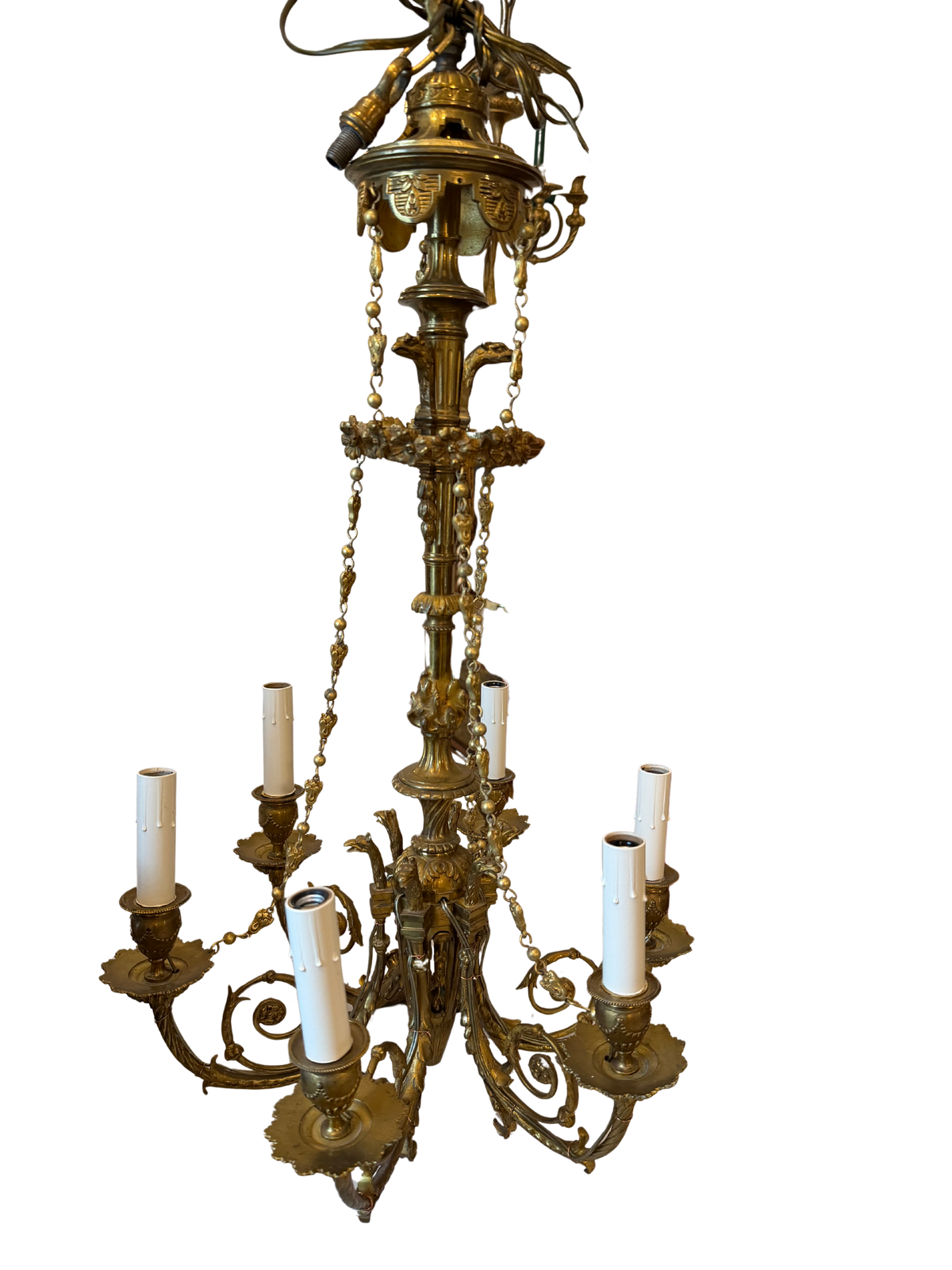
A spectacular and unusually elaborate French Renaissance Revival brass chandelier, dating to the late 19th century and richly ornamented with fantastical beasts, heraldic motifs, scrolling foliage, floral garlands, and architectural detailing.
The chandelier is constructed around a tall, heavily modeled central standard with fluted and spirally twisted sections, acanthus leaves, gadrooned moldings, and multiple decorative tiers. At the lower hub, a dramatic grouping of six projecting griffin or dragon heads emerges from block-form mounts, each corresponding with one of the scrolling chandelier arms.
The six lights extend on sinuous foliate arms terminating in broad, serrated drip pans and urn-form candle cups decorated with delicate swags. The arms incorporate additional scrolling tendrils, floral bosses, and small classical mask or medallion ornaments.
Particularly striking are the long decorative chains descending from the upper body to the individual arms. Each chain alternates cast foliate links with spherical beads, giving the chandelier an almost jewel-like quality while visually connecting the upper and lower sections.
Above, a circular corona is encircled by a dense garland of cast flowers and leaves. The uppermost tier is embellished with a series of heraldic-style shields or escutcheons, continuing the historicist Renaissance vocabulary found throughout the fixture.
The profusion of griffins, heraldic shields, acanthus, architectural moldings, and scrolling ornament places the chandelier firmly within the French late-19th-century fascination with Renaissance and Gothic decorative arts.
Now electrified with six candle-form sockets.
Era
Late 19th century, circa 1870–1900
French, Renaissance Revival / Neo-Renaissance, with Gothic Revival influences.
History
During the second half of the 19th century, French decorative arts frequently revived historical styles associated with the Renaissance, medieval period, and François I era. Chandeliers of this type were intended for richly furnished interiors and often incorporated heraldic ornament, mythical creatures, architectural forms, and dense naturalistic decoration.
The use of griffins or dragon-like creatures is particularly characteristic of Renaissance Revival metalwork. Such beasts drew upon medieval and Renaissance grotesques while also providing sculptural transition points between the chandelier's central body and projecting arms.
The present fixture appears to have been converted or rewired for electricity at a later date. Its elaborate cast construction and decorative candle cups are substantially earlier than the visible modern electrical components.
Provenance
Private collection.
Maker presently unidentified; no maker's mark is visible in the photographs provided.
Materials
Cast and worked brass
Patinated brass
Metal chain links and decorative castings
Modern electrical wiring
Modern candle sleeves
Dimensions
Please add physical measurements:
Overall height: ___"
Overall diameter: ___"
Approximate chandelier body height excluding wiring/canopy: ___"
Condition
Good antique condition consistent with age and use. The brass retains an attractive aged golden patina with areas of oxidation, discoloration, rubbing, and surface wear.
Several components show the slight irregularities and age-related movement expected from a large assembled antique chandelier. Visible wiring and small securing wires indicate later electrification and/or subsequent stabilization or repair. Modern white candle sleeves are present.
The chandelier should be professionally inspected and installed by a qualified electrician before use. Electrical functionality and compliance with current electrical codes are not guaranteed.
Please review all photographs closely, as they form an important part of the condition description.
Disclaimers
The chandelier is attributed to France and the late 19th century based on its construction, materials, ornament, and Renaissance Revival design vocabulary. No manufacturer's mark has yet been identified.
The griffin/dragon terminology describes the fantastical cast creatures ornamenting the central body; they may combine characteristics of several historic grotesque forms rather than represent one specific heraldic beast.
Electrical components are later.
A spectacular and unusually elaborate French Renaissance Revival brass chandelier, dating to the late 19th century and richly ornamented with fantastical beasts, heraldic motifs, scrolling foliage, floral garlands, and architectural detailing.
The chandelier is constructed around a tall, heavily modeled central standard with fluted and spirally twisted sections, acanthus leaves, gadrooned moldings, and multiple decorative tiers. At the lower hub, a dramatic grouping of six projecting griffin or dragon heads emerges from block-form mounts, each corresponding with one of the scrolling chandelier arms.
The six lights extend on sinuous foliate arms terminating in broad, serrated drip pans and urn-form candle cups decorated with delicate swags. The arms incorporate additional scrolling tendrils, floral bosses, and small classical mask or medallion ornaments.
Particularly striking are the long decorative chains descending from the upper body to the individual arms. Each chain alternates cast foliate links with spherical beads, giving the chandelier an almost jewel-like quality while visually connecting the upper and lower sections.
Above, a circular corona is encircled by a dense garland of cast flowers and leaves. The uppermost tier is embellished with a series of heraldic-style shields or escutcheons, continuing the historicist Renaissance vocabulary found throughout the fixture.
The profusion of griffins, heraldic shields, acanthus, architectural moldings, and scrolling ornament places the chandelier firmly within the French late-19th-century fascination with Renaissance and Gothic decorative arts.
Now electrified with six candle-form sockets.
Era
Late 19th century, circa 1870–1900
French, Renaissance Revival / Neo-Renaissance, with Gothic Revival influences.
History
During the second half of the 19th century, French decorative arts frequently revived historical styles associated with the Renaissance, medieval period, and François I era. Chandeliers of this type were intended for richly furnished interiors and often incorporated heraldic ornament, mythical creatures, architectural forms, and dense naturalistic decoration.
The use of griffins or dragon-like creatures is particularly characteristic of Renaissance Revival metalwork. Such beasts drew upon medieval and Renaissance grotesques while also providing sculptural transition points between the chandelier's central body and projecting arms.
The present fixture appears to have been converted or rewired for electricity at a later date. Its elaborate cast construction and decorative candle cups are substantially earlier than the visible modern electrical components.
Provenance
Private collection.
Maker presently unidentified; no maker's mark is visible in the photographs provided.
Materials
Cast and worked brass
Patinated brass
Metal chain links and decorative castings
Modern electrical wiring
Modern candle sleeves
Dimensions
Please add physical measurements:
Overall height: ___"
Overall diameter: ___"
Approximate chandelier body height excluding wiring/canopy: ___"
Condition
Good antique condition consistent with age and use. The brass retains an attractive aged golden patina with areas of oxidation, discoloration, rubbing, and surface wear.
Several components show the slight irregularities and age-related movement expected from a large assembled antique chandelier. Visible wiring and small securing wires indicate later electrification and/or subsequent stabilization or repair. Modern white candle sleeves are present.
The chandelier should be professionally inspected and installed by a qualified electrician before use. Electrical functionality and compliance with current electrical codes are not guaranteed.
Please review all photographs closely, as they form an important part of the condition description.
Disclaimers
The chandelier is attributed to France and the late 19th century based on its construction, materials, ornament, and Renaissance Revival design vocabulary. No manufacturer's mark has yet been identified.
The griffin/dragon terminology describes the fantastical cast creatures ornamenting the central body; they may combine characteristics of several historic grotesque forms rather than represent one specific heraldic beast.
Electrical components are later.