


Antique Baroque Engraved Portrait of George Melville, Earl of Melville
Antique Baroque Engraved Portrait of George Melville, Earl of Melville
Impossible de charger la disponibilité du service de retrait
Partager


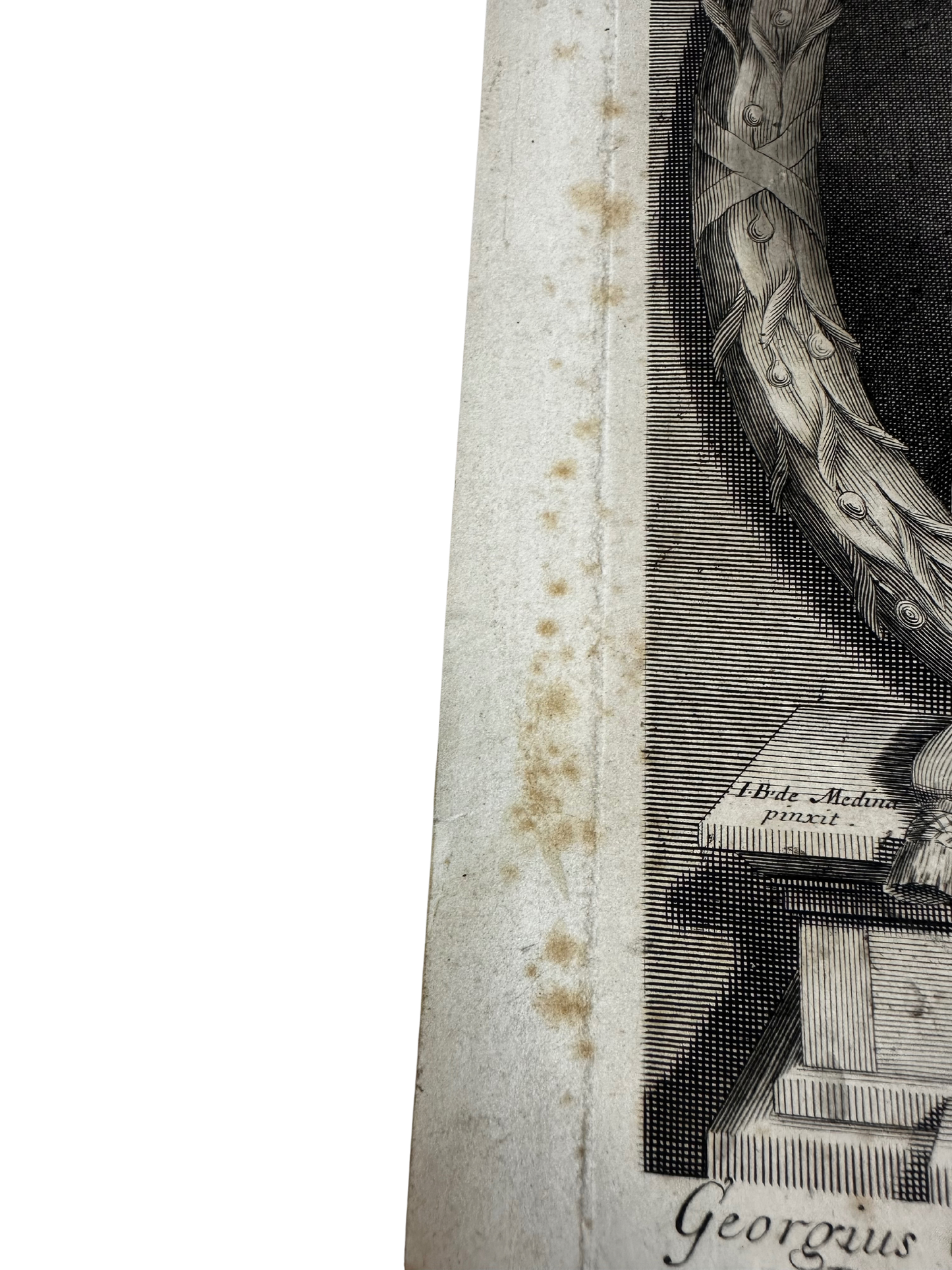
This is a finely executed late 17th-century copperplate engraving depicting George Melville, 1st Earl of Melville, shown in three-quarter view with long curled periwig and lace cravat, rendered in dense, highly controlled line work. The portrait is enclosed within an elaborate laurel wreath cartouche, topped by a crowned monogram and flanked by ribboned banners.
Below the portrait sits a sculptural architectural plinth supporting a quartered heraldic coat of arms, surmounted by a crown and supported by a falcon (dexter) and hound (sinister)—a classic aristocratic heraldic pairing. The motto “DENIQUE CÆLUM” appears on a scroll beneath the shield.
The engraving is signed in the plate:
“I. de Medina pinxit” (after a painting by Juan de Medina)
“R. White sculpsit” (engraved by Robert White)
Additional inscriptions appear on ribbon banners in the upper corners, including the clearly legible date “Anno Dom. 1690”. The Latin dedication beneath the image identifies Melville’s titles and his service as Secretary of State for Scotland under William III and Mary II.
“George, Earl of Melville, Viscount of Kirkcaldy,
Lord of Raith, Monimail, and Ballwearie;
to the most serene princes William III, King of Great Britain,
France and Ireland, and to Queen Mary,
Viceroy (Lord Lieutenant) for the ancient Kingdom of Scotland;
and sole Secretary of State.”
The print is executed on laid paper with visible chain lines and shows natural age-related toning, foxing, and light staining consistent with a 17th-century impression. Plate mark remains visible.
This is a finely executed late 17th-century copperplate engraving depicting George Melville, 1st Earl of Melville, shown in three-quarter view with long curled periwig and lace cravat, rendered in dense, highly controlled line work. The portrait is enclosed within an elaborate laurel wreath cartouche, topped by a crowned monogram and flanked by ribboned banners.
Below the portrait sits a sculptural architectural plinth supporting a quartered heraldic coat of arms, surmounted by a crown and supported by a falcon (dexter) and hound (sinister)—a classic aristocratic heraldic pairing. The motto “DENIQUE CÆLUM” appears on a scroll beneath the shield.
The engraving is signed in the plate:
“I. de Medina pinxit” (after a painting by Juan de Medina)
“R. White sculpsit” (engraved by Robert White)
Additional inscriptions appear on ribbon banners in the upper corners, including the clearly legible date “Anno Dom. 1690”. The Latin dedication beneath the image identifies Melville’s titles and his service as Secretary of State for Scotland under William III and Mary II.
“George, Earl of Melville, Viscount of Kirkcaldy,
Lord of Raith, Monimail, and Ballwearie;
to the most serene princes William III, King of Great Britain,
France and Ireland, and to Queen Mary,
Viceroy (Lord Lieutenant) for the ancient Kingdom of Scotland;
and sole Secretary of State.”
The print is executed on laid paper with visible chain lines and shows natural age-related toning, foxing, and light staining consistent with a 17th-century impression. Plate mark remains visible.
12.75" x 9.25"
12.75" x 9.25"
George Melville (1634–1707) was a prominent Scottish statesman and nobleman during the reign of William III and Mary II. He was a supporter of William of Orange during the Glorious Revolution and served as Secretary of State for Scotland, making him one of the most influential political figures of his era. He became the 1st Earl of Melville in 1690. This portrait would have been commissioned or published to honor his political service.
The original painted portrait was executed by John Baptist de Medina (1659–1710), a Flemish-born painter active in Scotland and known for aristocratic and official portraiture. This engraving was produced by Robert White (1645–1703), one of the most important English engravers of the late 17th century, whose work included portraits of monarchs, nobles, and church figures.
Such engravings were produced for circulation among political, academic, and aristocratic audiences and were often bound into books or kept as standalone commemorative prints.
The family Coat of Arms & Motto "DENIQUE CÆLUM" translates to "Heaven at last", fitting for a noble portrait.
George Melville (1634–1707) was a prominent Scottish statesman and nobleman during the reign of William III and Mary II. He was a supporter of William of Orange during the Glorious Revolution and served as Secretary of State for Scotland, making him one of the most influential political figures of his era. He became the 1st Earl of Melville in 1690. This portrait would have been commissioned or published to honor his political service.
The original painted portrait was executed by John Baptist de Medina (1659–1710), a Flemish-born painter active in Scotland and known for aristocratic and official portraiture. This engraving was produced by Robert White (1645–1703), one of the most important English engravers of the late 17th century, whose work included portraits of monarchs, nobles, and church figures.
Such engravings were produced for circulation among political, academic, and aristocratic audiences and were often bound into books or kept as standalone commemorative prints.
The family Coat of Arms & Motto "DENIQUE CÆLUM" translates to "Heaven at last", fitting for a noble portrait.
Late 17th century Circa 1690
Late 17th century Circa 1690
Paper, Ink
Paper, Ink
Likely British (England/Scotland)
Printed from a copperplate engraving after a painted portrait by John Baptist de Medina; engraved by Robert White.
Likely British (England/Scotland)
Printed from a copperplate engraving after a painted portrait by John Baptist de Medina; engraved by Robert White.
Age-related foxing and scattered staining throughout the sheet
Margins intact with plate mark present
No evidence of later reproduction or modern printing
Overall condition is consistent with an authentic 17th-century engraved portrait
Age-related foxing and scattered staining throughout the sheet
Margins intact with plate mark present
No evidence of later reproduction or modern printing
Overall condition is consistent with an authentic 17th-century engraved portrait