

Antique Bible Box with Key
Antique Bible Box with Key
Impossible de charger la disponibilité du service de retrait
Partager
Bible Box - Ornate Multi-Colored wood with Ormolu Mounts
France or Northern Italy, circa 1840–1860
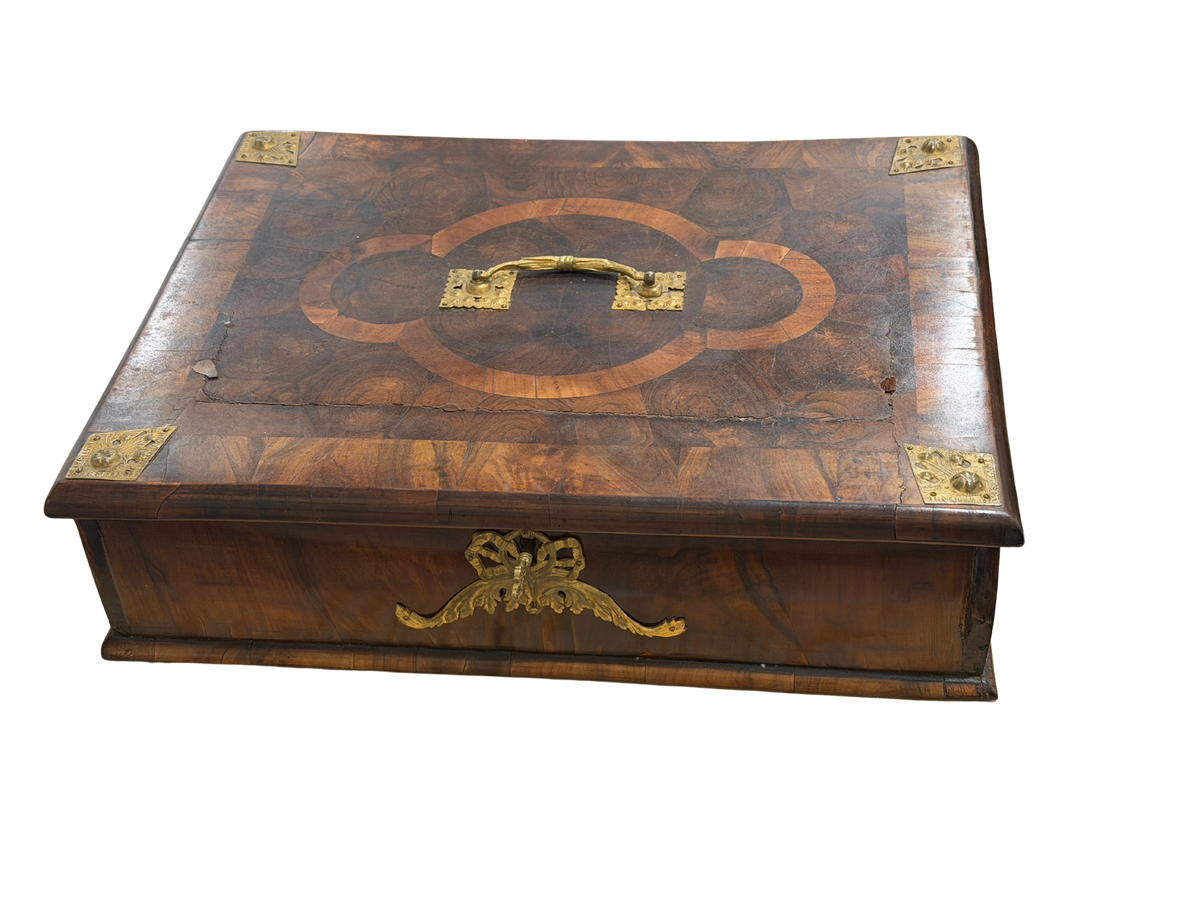
A large-scale devotional or presentation coffer, richly veneered in radial-cut walnut and rosewood with a striking geometric marquetry medallion across the lid. The monumental presence, fine materials, and ornate brass fittings point to an aristocratic or ecclesiastical commission, likely intended to hold a family Bible, liturgical volumes, or sacred correspondence.
Walnut and rosewood in concentric circular and ring-patterned marquetry, exhibiting excellent depth and figuring.
Cast and chased ormolu (gilt bronze) fittings including:
Four corner mounts with repoussé floral and fruit motifs.
A scrolling Rococo escutcheon with ribbon-tied acanthus decoration.
A gilt brass handle of naturalistic foliate design.
Deep crimson velvet lining, beautifully preserved, intended to cradle large-format books or documents.
Retains fully working key
This chest exemplifies the transition from the restrained elegance of the Louis-Philippe era (1830–1848) to the more decorative Second Empire style (1850s–1860s).
The combination of geometric veneer (echoing Biedermeier influence) with exuberant Rococo mounts is characteristic of high-end Parisian or Lyonnais cabinetmaking of the period.
Comparable monumental boxes were made for:
Altars or domestic chapels, to hold missals and ceremonial linens.
Presentation Bibles or papal gifts, particularly in France and Northern Italy.
Writing coffers or document chests used in the salons of the bourgeois elite.
Bible Box - Ornate Multi-Colored wood with Ormolu Mounts
France or Northern Italy, circa 1840–1860
A large-scale devotional or presentation coffer, richly veneered in radial-cut walnut and rosewood with a striking geometric marquetry medallion across the lid. The monumental presence, fine materials, and ornate brass fittings point to an aristocratic or ecclesiastical commission, likely intended to hold a family Bible, liturgical volumes, or sacred correspondence.
Walnut and rosewood in concentric circular and ring-patterned marquetry, exhibiting excellent depth and figuring.
Cast and chased ormolu (gilt bronze) fittings including:
Four corner mounts with repoussé floral and fruit motifs.
A scrolling Rococo escutcheon with ribbon-tied acanthus decoration.
A gilt brass handle of naturalistic foliate design.
Deep crimson velvet lining, beautifully preserved, intended to cradle large-format books or documents.
Retains fully working key
This chest exemplifies the transition from the restrained elegance of the Louis-Philippe era (1830–1848) to the more decorative Second Empire style (1850s–1860s).
The combination of geometric veneer (echoing Biedermeier influence) with exuberant Rococo mounts is characteristic of high-end Parisian or Lyonnais cabinetmaking of the period.
Comparable monumental boxes were made for:
Altars or domestic chapels, to hold missals and ceremonial linens.
Presentation Bibles or papal gifts, particularly in France and Northern Italy.
Writing coffers or document chests used in the salons of the bourgeois elite.