



Antique Continental Two-Air Cylinder Music Box Case with Rosewood Veneer and Original Tune Sheet
Antique Continental Two-Air Cylinder Music Box Case with Rosewood Veneer and Original Tune Sheet
Impossible de charger la disponibilité du service de retrait
Partager


A small antique Continental musical box housed in a rectangular wooden case with richly figured rosewood or simulated rosewood veneer, contrasting edge banding, and a central brass shield-shaped cartouche.
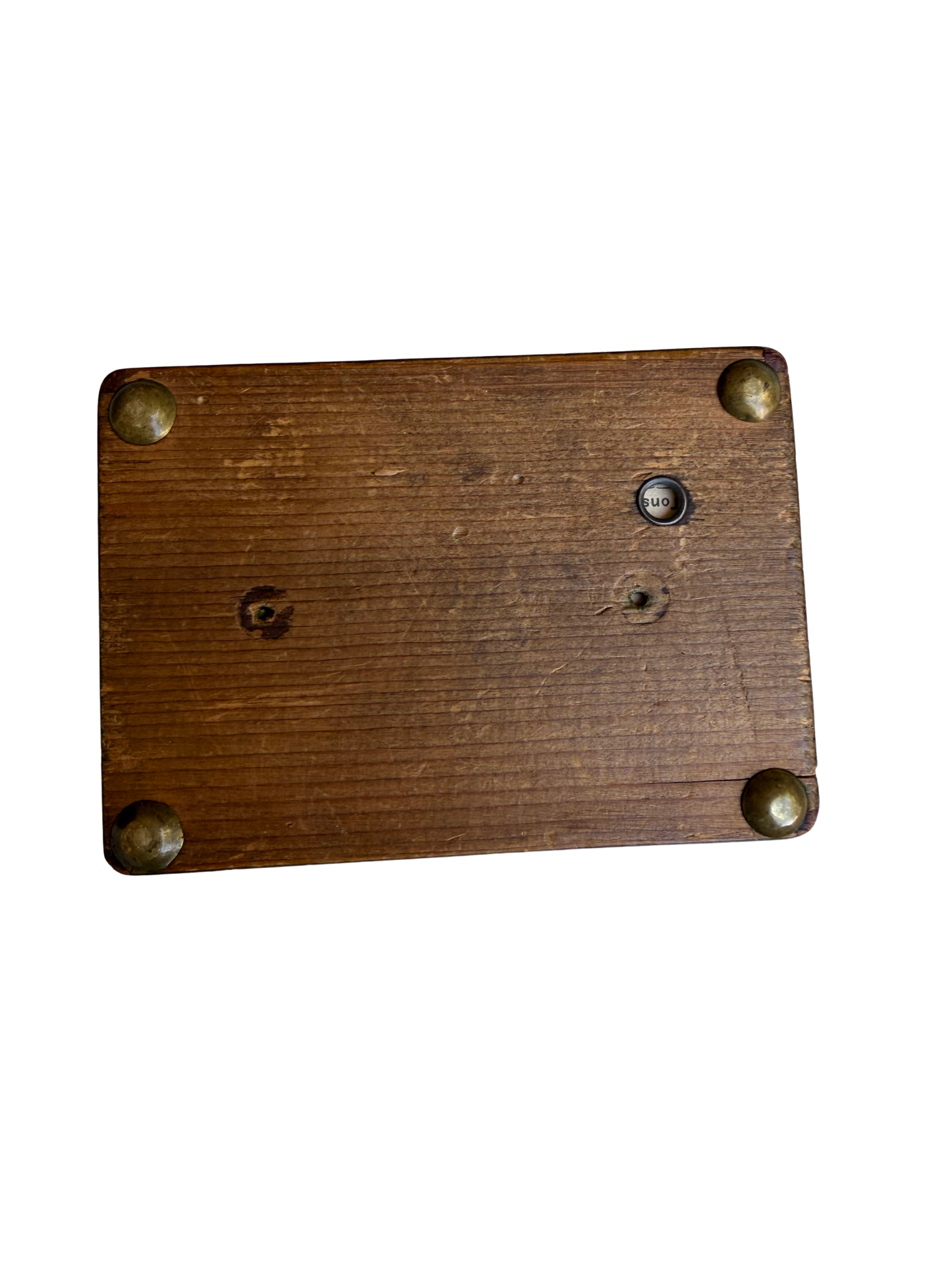
The case is raised on four domed brass feet and fitted with a hinged lid, front release button, and brass hardware. The underside retains several openings associated with the original operating or winding mechanism.
Affixed beneath the lid is an original lithographed tune sheet headed “2 Airs,” bearing handwritten German titles. One appears to reference a waltz associated with Strauss, while the second begins “Wir winden dir den Jungfernkranz,” the bridal chorus from Carl Maria von Weber’s opera Der Freischütz. The handwriting is difficult to decipher fully, so the titles should not be presented as definitive without additional research.
The original musical movement, cylinder, comb, and internal bedplate are no longer present. The surviving piece is therefore best offered as an antique music-box case, decorative keepsake box, or restoration project rather than as a functioning musical instrument.
A small antique Continental musical box housed in a rectangular wooden case with richly figured rosewood or simulated rosewood veneer, contrasting edge banding, and a central brass shield-shaped cartouche.
The case is raised on four domed brass feet and fitted with a hinged lid, front release button, and brass hardware. The underside retains several openings associated with the original operating or winding mechanism.
Affixed beneath the lid is an original lithographed tune sheet headed “2 Airs,” bearing handwritten German titles. One appears to reference a waltz associated with Strauss, while the second begins “Wir winden dir den Jungfernkranz,” the bridal chorus from Carl Maria von Weber’s opera Der Freischütz. The handwriting is difficult to decipher fully, so the titles should not be presented as definitive without additional research.
The original musical movement, cylinder, comb, and internal bedplate are no longer present. The surviving piece is therefore best offered as an antique music-box case, decorative keepsake box, or restoration project rather than as a functioning musical instrument.
1.75"h x 4.5"w x 3"d
1.75"h x 4.5"w x 3"d
Small cylinder music boxes were widely manufactured in Switzerland during the 19th century and exported throughout Europe. Many were fitted into veneered cases and supplied with printed tune sheets identifying the melodies played by the pinned cylinder.
The designation “2 Airs” indicates that the original movement was arranged to play two melodies. The handwritten German-language selections suggest that the box was intended for a German-speaking market, even though the movement itself may originally have been Swiss.
The empty screw holes, interior mounting traces, operating apertures, and absence of a cylinder or comb indicate that the musical mechanism was removed at some point in the box’s history.
Small cylinder music boxes were widely manufactured in Switzerland during the 19th century and exported throughout Europe. Many were fitted into veneered cases and supplied with printed tune sheets identifying the melodies played by the pinned cylinder.
The designation “2 Airs” indicates that the original movement was arranged to play two melodies. The handwritten German-language selections suggest that the box was intended for a German-speaking market, even though the movement itself may originally have been Swiss.
The empty screw holes, interior mounting traces, operating apertures, and absence of a cylinder or comb indicate that the musical mechanism was removed at some point in the box’s history.
Continental European, likely Swiss, German, or Austrian, circa 1870–1900
Continental European, likely Swiss, German, or Austrian, circa 1870–1900
Rosewood or rosewood-veneered wood, contrasting wood stringing, brass hardware and feet, paper tune sheet, and dark-painted interior.
Rosewood or rosewood-veneered wood, contrasting wood stringing, brass hardware and feet, paper tune sheet, and dark-painted interior.
Acquired through the antiques and decorative arts trade in upstate New York. Earlier ownership and the circumstances surrounding the loss of the movement are unknown.
Acquired through the antiques and decorative arts trade in upstate New York. Earlier ownership and the circumstances surrounding the loss of the movement are unknown.
Antique condition with significant alterations and losses. The entire original musical movement, including the cylinder, comb, bedplate, winding system, and controls, is absent. Several empty mounting and operating holes remain on the front, underside, and interior.
The wooden case shows scratches, scuffs, finish wear, discoloration, edge losses, small veneer separations, dents, and age-related marks. The central brass cartouche is worn, scratched, and slightly irregular. Brass fittings show tarnish and oxidation. The interior is dusty and worn, with residue, empty screw holes, and surface losses. The original tune sheet is toned, stained, creased, abraded, and partially difficult to read.
Antique condition with significant alterations and losses. The entire original musical movement, including the cylinder, comb, bedplate, winding system, and controls, is absent. Several empty mounting and operating holes remain on the front, underside, and interior.
The wooden case shows scratches, scuffs, finish wear, discoloration, edge losses, small veneer separations, dents, and age-related marks. The central brass cartouche is worn, scratched, and slightly irregular. Brass fittings show tarnish and oxidation. The interior is dusty and worn, with residue, empty screw holes, and surface losses. The original tune sheet is toned, stained, creased, abraded, and partially difficult to read.