

Antique French Napoleon III Ebonized Wood and Brass Inlay Box
Antique French Napoleon III Ebonized Wood and Brass Inlay Box
Impossible de charger la disponibilité du service de retrait
Partager
Additional Description
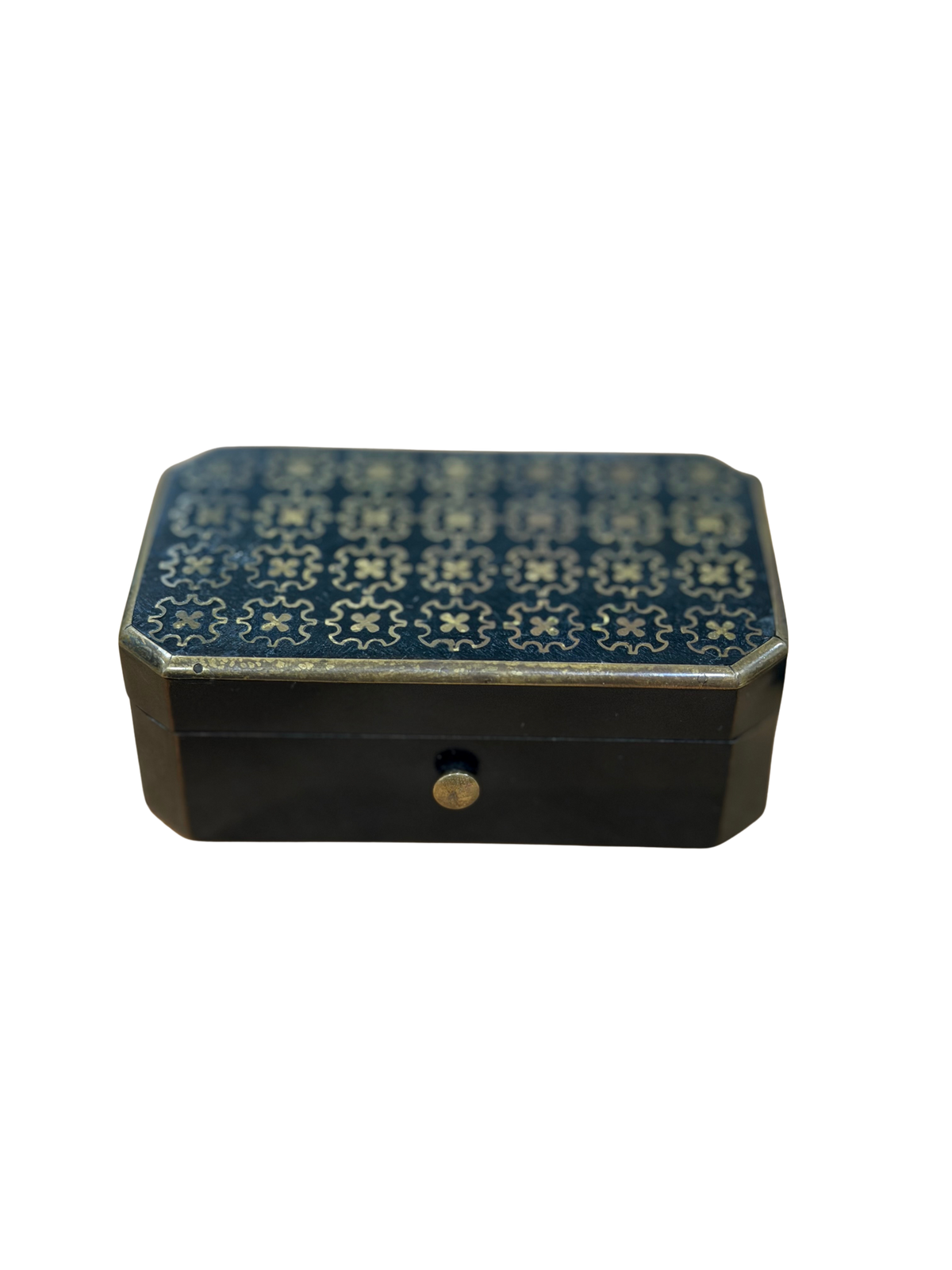
A handsome small antique French box dating to the Napoleon III period, crafted in dark ebonized wood and decorated with finely worked brass inlay.
The chamfered rectangular lid is ornamented with a repeating geometric pattern of stylized quatrefoil and cross motifs, all executed in brass against the nearly black ground. A narrow brass border follows the perimeter of the lid, creating a striking contrast with the dark surface.
The box opens on a substantial brass hinge to reveal a warm reddish-brown wood interior. A small push-button closure is positioned at the front, with corresponding brass fittings mounted along the interior edges.
Its diminutive size suggests it was intended as a personal accessory box, possibly for snuff, tobacco, small jewelry, seals, or other personal effects. Without fitted compartments or an inscription, I would avoid assigning one specific original use.
The combination of ebonized wood, brass ornament, clipped corners, and geometric decoration is especially characteristic of mid- to late-19th-century French decorative arts.
Era
French, Napoleon III period, circa 1860–1880
History
During the reign of Napoleon III, French decorative arts embraced richly contrasting materials and historical revival styles. Dark woods such as ebony and ebonized fruitwood were frequently paired with brass, gilt metal, mother-of-pearl, and tortoiseshell-inspired decoration.
Small personal boxes were produced in a wide variety of forms for use on dressing tables, writing desks, and in pockets or traveling cases. Geometric brass inlay such as that seen here provided the luxurious appearance associated with larger Boulle-inspired furnishings, but on a much more intimate scale.
Although reminiscent of Boulle work, this piece is more accurately described as brass-inlaid ebonized wood rather than true Boulle marquetry, as there is no tortoiseshell component visible.
Provenance
France; sourced in France
Materials
Ebonized wood
Brass inlay and edging
Brass hinge and push-button closure
Wood interior
Dimensions
Dimensions to be added
I would record:
Width
Depth
Height
Condition
Good antique condition with wear commensurate with age and use.
The exterior shows scattered surface scratches, small abrasions, and age-related wear to the dark finish. The brass inlay and edging show oxidation, rubbing, and mellowing consistent with age.
The interior retains its warm reddish-brown wood surface with expected scratches and minor wear. The hinge and front closure remain present. Minor separation or movement may be visible around some metal fittings.
Please review photographs carefully for the most accurate representation of condition.
Disclaimers
The precise original purpose of the box is unknown. It may have been used for snuff, tobacco, small jewelry, seals, or other personal effects and is therefore catalogued simply as a small personal box.
The dark wood is described as ebonized wood rather than solid ebony unless confirmed through direct examination.
As with all antique objects, signs of age, previous use, repairs, surface variation, and minor losses should be expected.