


Antique French Paul-Louis Courier Lettres écrites de France et d’Italie — Bibliothèque Larousse, Decorative Gilt Binding
Antique French Paul-Louis Courier Lettres écrites de France et d’Italie — Bibliothèque Larousse, Decorative Gilt Binding
Impossible de charger la disponibilité du service de retrait
Partager


An attractive antique French literary volume of Paul-Louis Courier’s Lettres écrites de France et d’Italie, with notices and annotations by Louis Coquelin, published in Paris by Bibliothèque Larousse.
The volume is particularly appealing as a decorative object, retaining a handsome quarter-leather binding with marbled paper boards, gilt ornamentation to the spine, patterned endpapers, and illustrated plates. Its warm brown leather, muted marbling, and aged paper make it a lovely addition to a collected library, French-inspired interior, or layered antique book display.
The title page reads:
Paul-Louis Courier
Lettres écrites de France et d’Italie
Notices et Annotations par Louis Coquelin
Quatre Gravures Hors Texte
Bibliothèque Larousse — Paris
Bibliographic records for this Larousse edition describe the work as containing approximately 255–268 pages and four plates, consistent with the title page’s indication of quatre gravures hors texte.
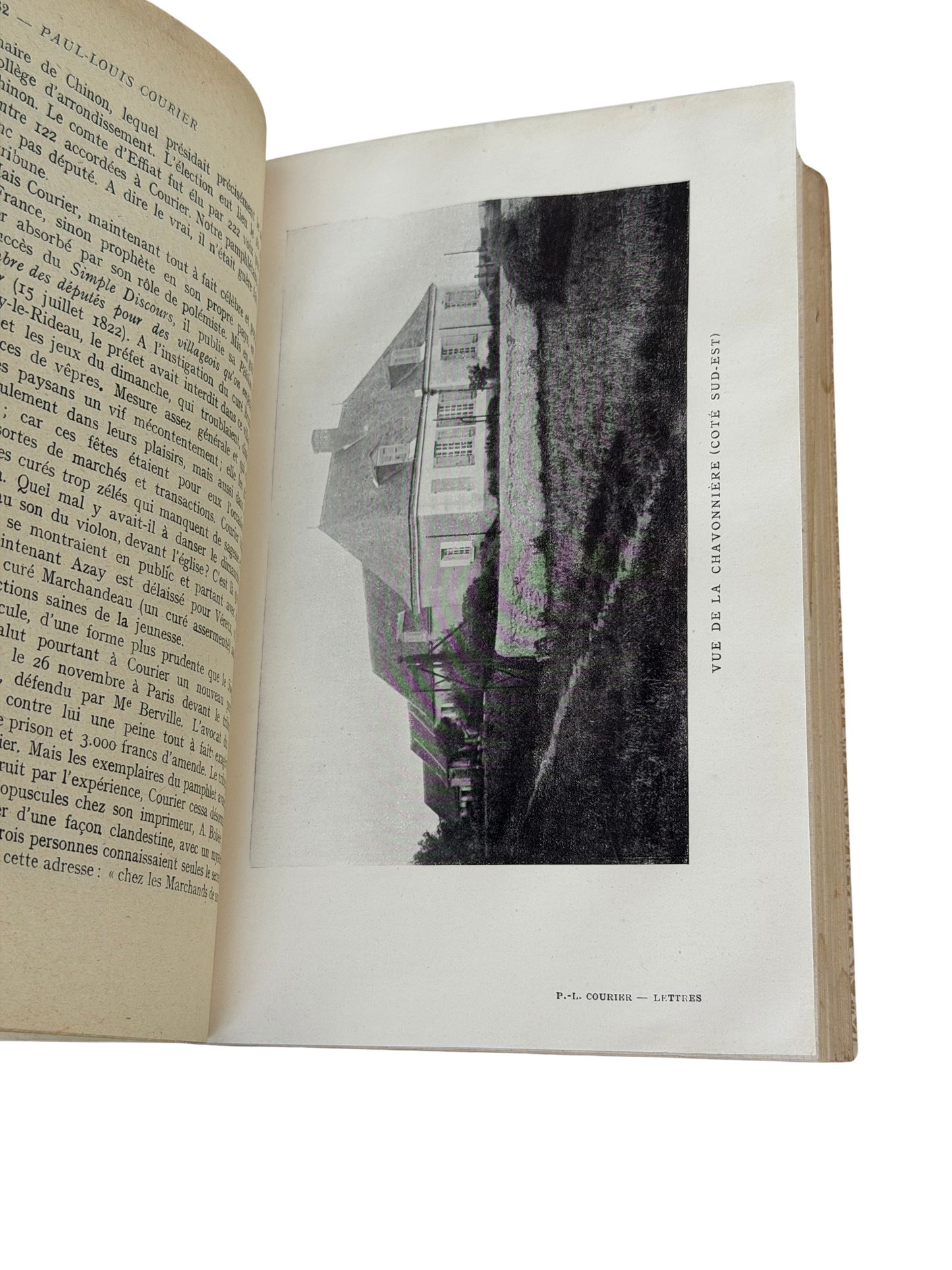
This example retains its engraved frontispiece portrait of Courier as well as at least one of the illustrated plates, including a view captioned “Vue de la Chavonnière (Courrier)”.
The binding combines a brown leather spine and corners with richly marbled paper-covered boards. The spine is decorated in gilt with floral ornament, linear tooling, and a small decorative device near the foot, with the author and title lettered in gilt.
The interior features charming repeating floral-patterned endpapers in a warm neutral palette.
An attractive antique French literary volume of Paul-Louis Courier’s Lettres écrites de France et d’Italie, with notices and annotations by Louis Coquelin, published in Paris by Bibliothèque Larousse.
The volume is particularly appealing as a decorative object, retaining a handsome quarter-leather binding with marbled paper boards, gilt ornamentation to the spine, patterned endpapers, and illustrated plates. Its warm brown leather, muted marbling, and aged paper make it a lovely addition to a collected library, French-inspired interior, or layered antique book display.
The title page reads:
Paul-Louis Courier
Lettres écrites de France et d’Italie
Notices et Annotations par Louis Coquelin
Quatre Gravures Hors Texte
Bibliothèque Larousse — Paris
Bibliographic records for this Larousse edition describe the work as containing approximately 255–268 pages and four plates, consistent with the title page’s indication of quatre gravures hors texte.
This example retains its engraved frontispiece portrait of Courier as well as at least one of the illustrated plates, including a view captioned “Vue de la Chavonnière (Courrier)”.
The binding combines a brown leather spine and corners with richly marbled paper-covered boards. The spine is decorated in gilt with floral ornament, linear tooling, and a small decorative device near the foot, with the author and title lettered in gilt.
The interior features charming repeating floral-patterned endpapers in a warm neutral palette.
8"h x 5.5"w x 1"d
8"h x 5.5"w x 1"d
Paul-Louis Courier (1772–1825) was a French writer, classical scholar, translator, and political pamphleteer known for his elegant prose and biting criticism of political and institutional authority.
Although trained as an artillery officer, Courier was deeply devoted to Greek literature and became an accomplished Hellenist. He translated ancient authors and spent significant periods traveling through France and Italy, experiences that shaped the correspondence gathered in this volume.
His Lettres écrites de France et d’Italie were published posthumously and have long been admired for their wit, stylistic precision, vivid observations, and unusually modern-feeling voice. Larousse notes that Courier’s humor is particularly evident in these letters, while his broader reputation rests on both his classical scholarship and his sharp political pamphleteering.
The correspondence follows Courier through military life, literary study, travel, and intellectual circles in France and Italy. Surviving letters span the late 18th and early 19th centuries and include discussions of classical manuscripts, scholarly acquaintances, politics, military service, and everyday life abroad.
The location illustrated in this copy, La Chavonnière, was Courier’s estate in Touraine and later became closely associated with his life and writing. Larousse describes the estate as a base from which Courier produced some of his most famous attacks on the political establishment.
Paul-Louis Courier (1772–1825) was a French writer, classical scholar, translator, and political pamphleteer known for his elegant prose and biting criticism of political and institutional authority.
Although trained as an artillery officer, Courier was deeply devoted to Greek literature and became an accomplished Hellenist. He translated ancient authors and spent significant periods traveling through France and Italy, experiences that shaped the correspondence gathered in this volume.
His Lettres écrites de France et d’Italie were published posthumously and have long been admired for their wit, stylistic precision, vivid observations, and unusually modern-feeling voice. Larousse notes that Courier’s humor is particularly evident in these letters, while his broader reputation rests on both his classical scholarship and his sharp political pamphleteering.
The correspondence follows Courier through military life, literary study, travel, and intellectual circles in France and Italy. Surviving letters span the late 18th and early 19th centuries and include discussions of classical manuscripts, scholarly acquaintances, politics, military service, and everyday life abroad.
The location illustrated in this copy, La Chavonnière, was Courier’s estate in Touraine and later became closely associated with his life and writing. Larousse describes the estate as a base from which Courier produced some of his most famous attacks on the political establishment.
Late 19th / Early 20th Century France, circa 1900 The title page itself does not display a clearly visible publication year in the supplied photographs, and bibliographic references to this Larousse issue do not consistently provide a precise date. For retail purposes, I would conservatively describe the volume as circa 1900–1920 unless a dated colophon or copyright page is present elsewhere in the book.
Late 19th / Early 20th Century France, circa 1900 The title page itself does not display a clearly visible publication year in the supplied photographs, and bibliographic references to this Larousse issue do not consistently provide a precise date. For retail purposes, I would conservatively describe the volume as circa 1900–1920 unless a dated colophon or copyright page is present elsewhere in the book.
Printed paper
Brown leather spine and corners
Marbled paper-covered boards
Gilt spine lettering and decoration
Printed decorative endpapers
Engraved / printed illustration plates
Sewn text block
Printed paper
Brown leather spine and corners
Marbled paper-covered boards
Gilt spine lettering and decoration
Printed decorative endpapers
Engraved / printed illustration plates
Sewn text block
No specific previous ownership has been identified from the photographs provided.
The decorative binding appears consistent with French commercial or private-library bindings of the late 19th to early 20th century. No visible bookplate or named ownership inscription is apparent in the supplied images.
No specific previous ownership has been identified from the photographs provided.
The decorative binding appears consistent with French commercial or private-library bindings of the late 19th to early 20th century. No visible bookplate or named ownership inscription is apparent in the supplied images.
Antique condition with wear consistent with age and use.
Visible condition includes rubbing and surface wear to the leather spine and corners; losses and fading to portions of the gilt decoration; wear and minor losses at the spine head and tail; rubbing and edge wear to the marbled boards; bumped and worn corners; and general shelf wear.
The page edges show toning and age-related discoloration. Interior pages display scattered foxing, spotting, toning, and occasional staining consistent with age. The illustrated plates and surrounding pages may show similar age-related variation.
The patterned endpapers show some separation and wear along the inner hinge area, and the binding should be handled with appropriate care.
No page-by-page collation has been completed. The title page specifies four plates, but completeness of all plates and leaves should be independently confirmed before representing the book as complete.
As with all antique books, additional minor imperfections, historic repairs, inscriptions, stains, handling marks, or binding weaknesses may be present but not individually noted.
Antique condition with wear consistent with age and use.
Visible condition includes rubbing and surface wear to the leather spine and corners; losses and fading to portions of the gilt decoration; wear and minor losses at the spine head and tail; rubbing and edge wear to the marbled boards; bumped and worn corners; and general shelf wear.
The page edges show toning and age-related discoloration. Interior pages display scattered foxing, spotting, toning, and occasional staining consistent with age. The illustrated plates and surrounding pages may show similar age-related variation.
The patterned endpapers show some separation and wear along the inner hinge area, and the binding should be handled with appropriate care.
No page-by-page collation has been completed. The title page specifies four plates, but completeness of all plates and leaves should be independently confirmed before representing the book as complete.
As with all antique books, additional minor imperfections, historic repairs, inscriptions, stains, handling marks, or binding weaknesses may be present but not individually noted.