


Antique Religious/Rosary Chatelaine Hook with Miraculous Medal Motif
Antique Religious/Rosary Chatelaine Hook with Miraculous Medal Motif
Impossible de charger la disponibilité du service de retrait
Partager


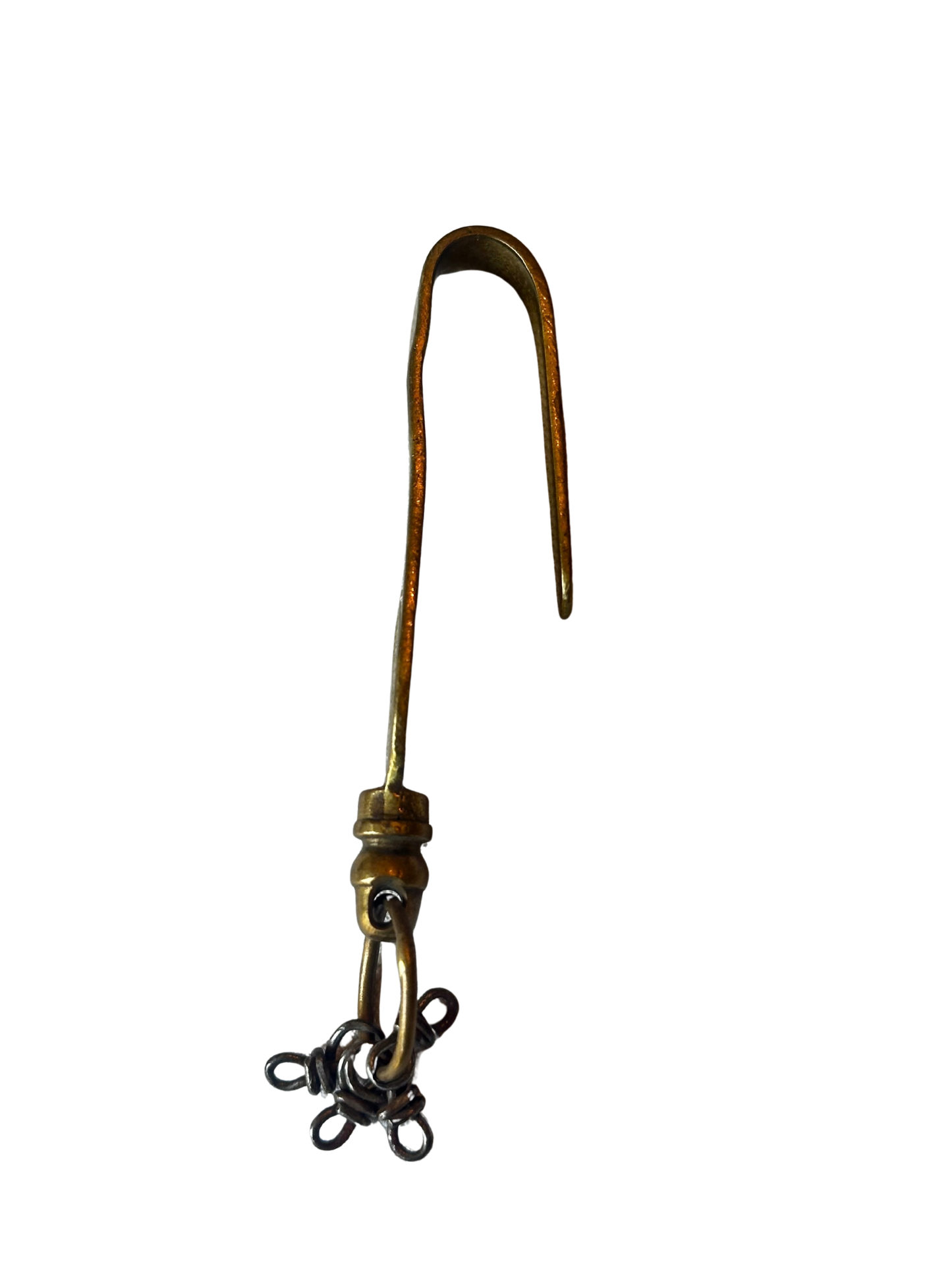
A small antique devotional chatelaine-style hook, formed of brass or gilt brass, featuring an oval medallion depicting the Virgin Mary in the classic Miraculous Medal pose, surrounded by a partially legible French devotional inscription. The flattened upper section terminates in a curved hook designed to slip over a belt, sash, or pocket edge. The lower section features a circular ring fitted with several small iron or steel suspension loops, likely intended for attaching devotional objects such as keys, rosaries, prayer medals, or small reliquaries. The piece shows hand-finished characteristics, soft casting details, and wear consistent with personal, daily use.
A small antique devotional chatelaine-style hook, formed of brass or gilt brass, featuring an oval medallion depicting the Virgin Mary in the classic Miraculous Medal pose, surrounded by a partially legible French devotional inscription. The flattened upper section terminates in a curved hook designed to slip over a belt, sash, or pocket edge. The lower section features a circular ring fitted with several small iron or steel suspension loops, likely intended for attaching devotional objects such as keys, rosaries, prayer medals, or small reliquaries. The piece shows hand-finished characteristics, soft casting details, and wear consistent with personal, daily use.
3.75"h x 0.5"w x 0.5"d
3.75"h x 0.5"w x 0.5"d
Chatelaine hooks and clips were widely used in 19th-century Europe as practical and symbolic accessories, worn at the waist or bodice. Religious examples such as this were especially common among Catholic women and clergy, serving both a functional role and a visible expression of faith. The Miraculous Medal imagery originates from the Marian apparitions reported by Saint Catherine Labouré in Paris in 1830, after which medals and related devotional objects spread rapidly throughout France and Catholic Europe. Items like this were often sold near churches, pilgrimage sites, and religious shops.
Chatelaine hooks and clips were widely used in 19th-century Europe as practical and symbolic accessories, worn at the waist or bodice. Religious examples such as this were especially common among Catholic women and clergy, serving both a functional role and a visible expression of faith. The Miraculous Medal imagery originates from the Marian apparitions reported by Saint Catherine Labouré in Paris in 1830, after which medals and related devotional objects spread rapidly throughout France and Catholic Europe. Items like this were often sold near churches, pilgrimage sites, and religious shops.
Mid–late 19th century (circa 1850–1900)
Mid–late 19th century (circa 1850–1900)
Brass or gilt brass body; iron or steel suspension loops
Brass or gilt brass body; iron or steel suspension loops
Continental Europe (likely French)
Continental Europe (likely French)
Surface wear, patina, and oxidation consistent with age and devotional use; some softening of details; mixed metals present; no maker’s mark observed.
Surface wear, patina, and oxidation consistent with age and devotional use; some softening of details; mixed metals present; no maker’s mark observed.