


Antique Tapestry Border Fragments with Acanthus Motifs (Seamed)
Antique Tapestry Border Fragments with Acanthus Motifs (Seamed)
Impossible de charger la disponibilité du service de retrait
Partager
Additional Description:
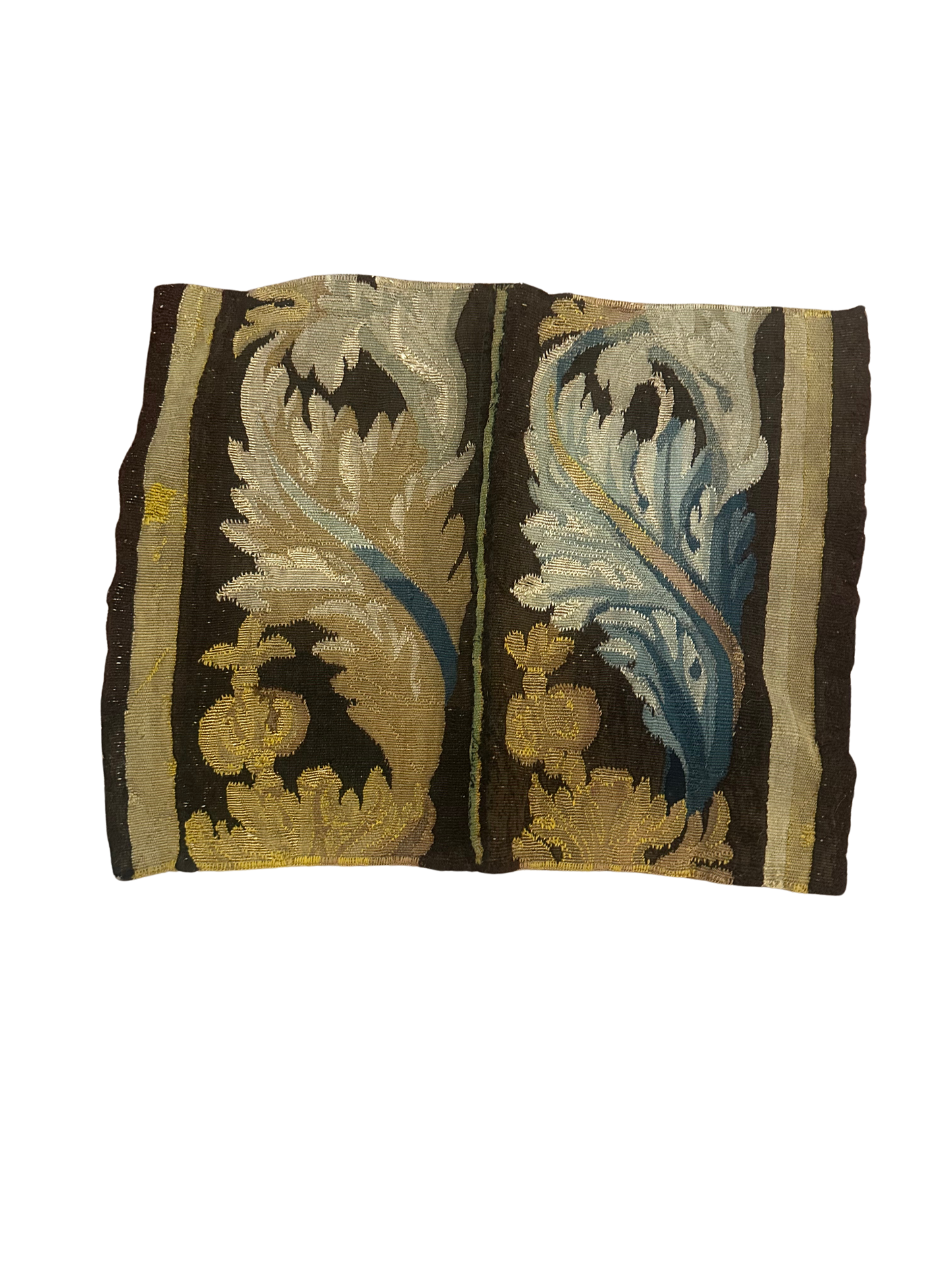
A pair of antique tapestry border fragments, now sewn together vertically, forming a wider decorative panel. The borders feature repeated stylized acanthus leaves, woven in earthy browns, muted golds, soft blues, celadon green, and ochre against a dark ground. The weave structure is consistent with tapestry (weft-faced), not brocade or damask, with wool predominating.
The visible central seam indicates these were originally two separate border lengths, likely trimmed from a larger wall tapestry, upholstery panel, or architectural textile and later joined—possibly for reuse, display, or stabilization. Edge irregularities, directional wear, and pattern truncation all support their origin as border elements rather than a central field design.
Era:
18th century (late Baroque to early Neoclassical taste)
History:
Tapestry borders were woven separately or as integral margins to frame larger narrative or ornamental tapestry panels. In the 18th century, such borders commonly featured repeating vegetal scrolls, crowns, urns, or cartouches to visually “contain” the central scene. As interiors evolved and large tapestries were cut down or repurposed in the 19th century, borders were often salvaged, reused, or stitched together to create new decorative textiles. Surviving border fragments like these are valued today for their graphic rhythm, age, and suitability for framing or shadow-box presentation.
Provenance:
Continental Europe (likely French or Flemish)
Materials:
Primarily wool tapestry weave; later thread used for seaming
Dimensions:
15.25"h x 19.25"w
Disclaimers:
Fragmentary textile; visible central seam joining two borders; wear consistent with age including thinning, small losses, fraying edges, and scattered repairs; color softening and uneven surface texture; no workshop attribution; recommended for decorative display or framing rather than functional textile use.
Additional Description:
A pair of antique tapestry border fragments, now sewn together vertically, forming a wider decorative panel. The borders feature repeated stylized acanthus leaves, woven in earthy browns, muted golds, soft blues, celadon green, and ochre against a dark ground. The weave structure is consistent with tapestry (weft-faced), not brocade or damask, with wool predominating.
The visible central seam indicates these were originally two separate border lengths, likely trimmed from a larger wall tapestry, upholstery panel, or architectural textile and later joined—possibly for reuse, display, or stabilization. Edge irregularities, directional wear, and pattern truncation all support their origin as border elements rather than a central field design.
Era:
18th century (late Baroque to early Neoclassical taste)
History:
Tapestry borders were woven separately or as integral margins to frame larger narrative or ornamental tapestry panels. In the 18th century, such borders commonly featured repeating vegetal scrolls, crowns, urns, or cartouches to visually “contain” the central scene. As interiors evolved and large tapestries were cut down or repurposed in the 19th century, borders were often salvaged, reused, or stitched together to create new decorative textiles. Surviving border fragments like these are valued today for their graphic rhythm, age, and suitability for framing or shadow-box presentation.
Provenance:
Continental Europe (likely French or Flemish)
Materials:
Primarily wool tapestry weave; later thread used for seaming
Dimensions:
15.25"h x 19.25"w
Disclaimers:
Fragmentary textile; visible central seam joining two borders; wear consistent with age including thinning, small losses, fraying edges, and scattered repairs; color softening and uneven surface texture; no workshop attribution; recommended for decorative display or framing rather than functional textile use.