


Black Forest–Style Carved Wooden Crucifix with Silverplate Corpus
Black Forest–Style Carved Wooden Crucifix with Silverplate Corpus
Impossible de charger la disponibilité du service de retrait
Partager


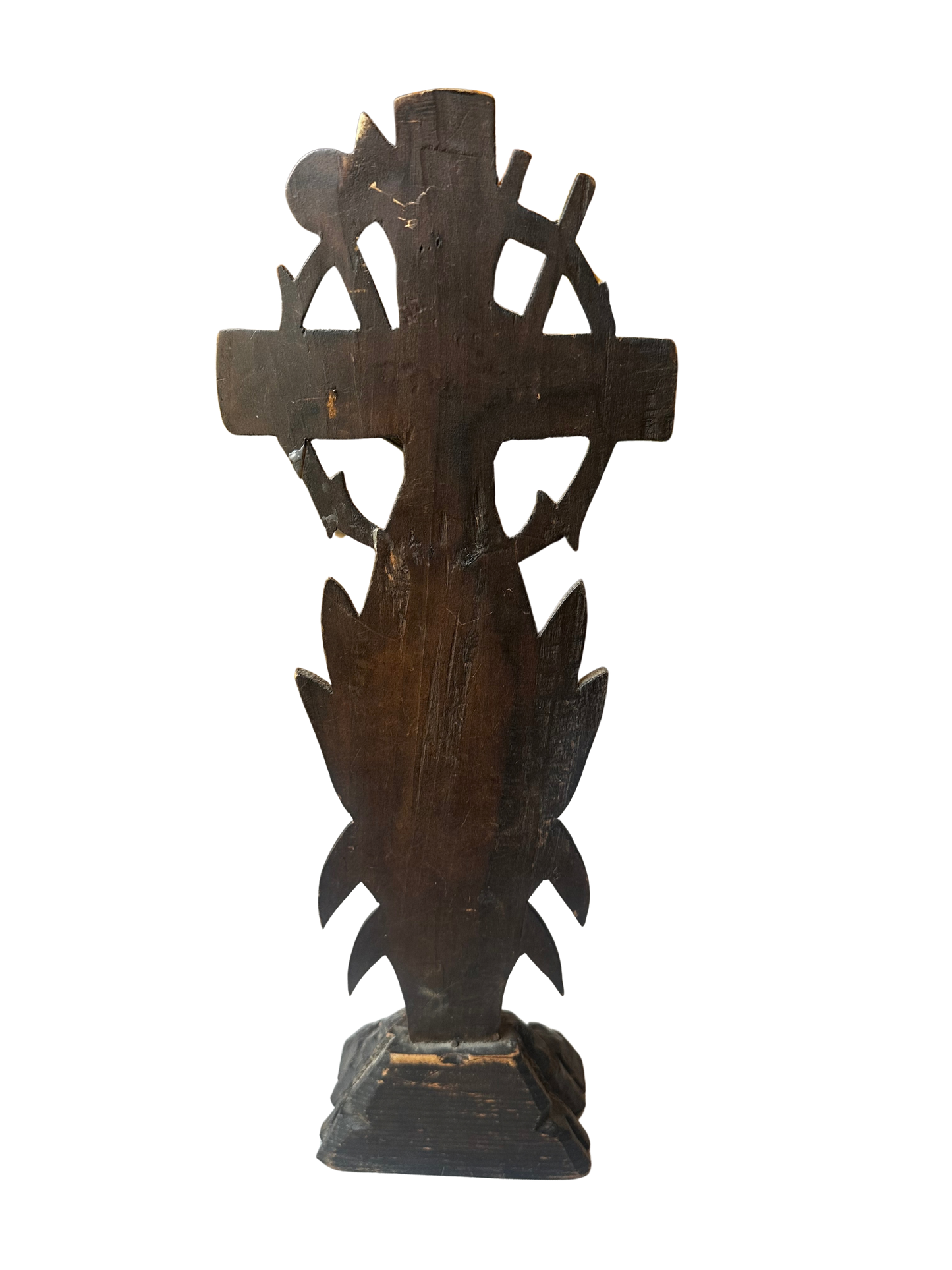
A carved wooden devotional crucifix in the Black Forest taste, featuring a lightweight, dark-stained wood cross with stylized foliate contours and symbolic Passion elements (Arma Christi) arranged behind the arms of the cross. The figure of Christ (corpus) and radiant halo are executed in light silverplate metal rather than bronze or spelter, lending the piece a noticeably lighter overall weight. The carving style, construction, and materials suggest production intended for domestic devotion rather than ecclesiastical use. The base is integrally carved and simplified, consistent with souvenir or regional devotional workshops active in the late 19th to early 20th century.
A carved wooden devotional crucifix in the Black Forest taste, featuring a lightweight, dark-stained wood cross with stylized foliate contours and symbolic Passion elements (Arma Christi) arranged behind the arms of the cross. The figure of Christ (corpus) and radiant halo are executed in light silverplate metal rather than bronze or spelter, lending the piece a noticeably lighter overall weight. The carving style, construction, and materials suggest production intended for domestic devotion rather than ecclesiastical use. The base is integrally carved and simplified, consistent with souvenir or regional devotional workshops active in the late 19th to early 20th century.
14.5"h x 5.5"w x 3.5"d
14.5"h x 5.5"w x 3.5"d
In the Black Forest region of Germany and surrounding Alpine areas, carved devotional objects were widely produced for private homes, pilgrimage sites, and export markets during the late 19th century. These objects emphasized expressive carving and symbolic richness while remaining affordable and portable. Silverplate corpora were commonly used in place of bronze to reduce cost and weight, making such crucifixes accessible to a broader middle-class devotional audience. Many examples entered international markets through religious shops, pilgrimage routes, and later antiques trade.
In the Black Forest region of Germany and surrounding Alpine areas, carved devotional objects were widely produced for private homes, pilgrimage sites, and export markets during the late 19th century. These objects emphasized expressive carving and symbolic richness while remaining affordable and portable. Silverplate corpora were commonly used in place of bronze to reduce cost and weight, making such crucifixes accessible to a broader middle-class devotional audience. Many examples entered international markets through religious shops, pilgrimage routes, and later antiques trade.
Late 19th to early 20th century (circa 1890–1915)
Late 19th to early 20th century (circa 1890–1915)
Lightweight carved wood; silverplate metal corpus and halo
Lightweight carved wood; silverplate metal corpus and halo
Central Europe (likely German / Black Forest region)
Central Europe (likely German / Black Forest region)
Wear consistent with age and devotional use; surface abrasions to wood; plate wear and patina to metal elements; no maker’s mark; lightweight construction indicative of regional devotional production rather than ecclesiastical commission.
Wear consistent with age and devotional use; surface abrasions to wood; plate wear and patina to metal elements; no maker’s mark; lightweight construction indicative of regional devotional production rather than ecclesiastical commission.