

Blue Opaline Glass Centerpiece Bowl in Gilt Brass Foliate Stand
Blue Opaline Glass Centerpiece Bowl in Gilt Brass Foliate Stand
Impossible de charger la disponibilité du service de retrait
Partager
Additional Description:
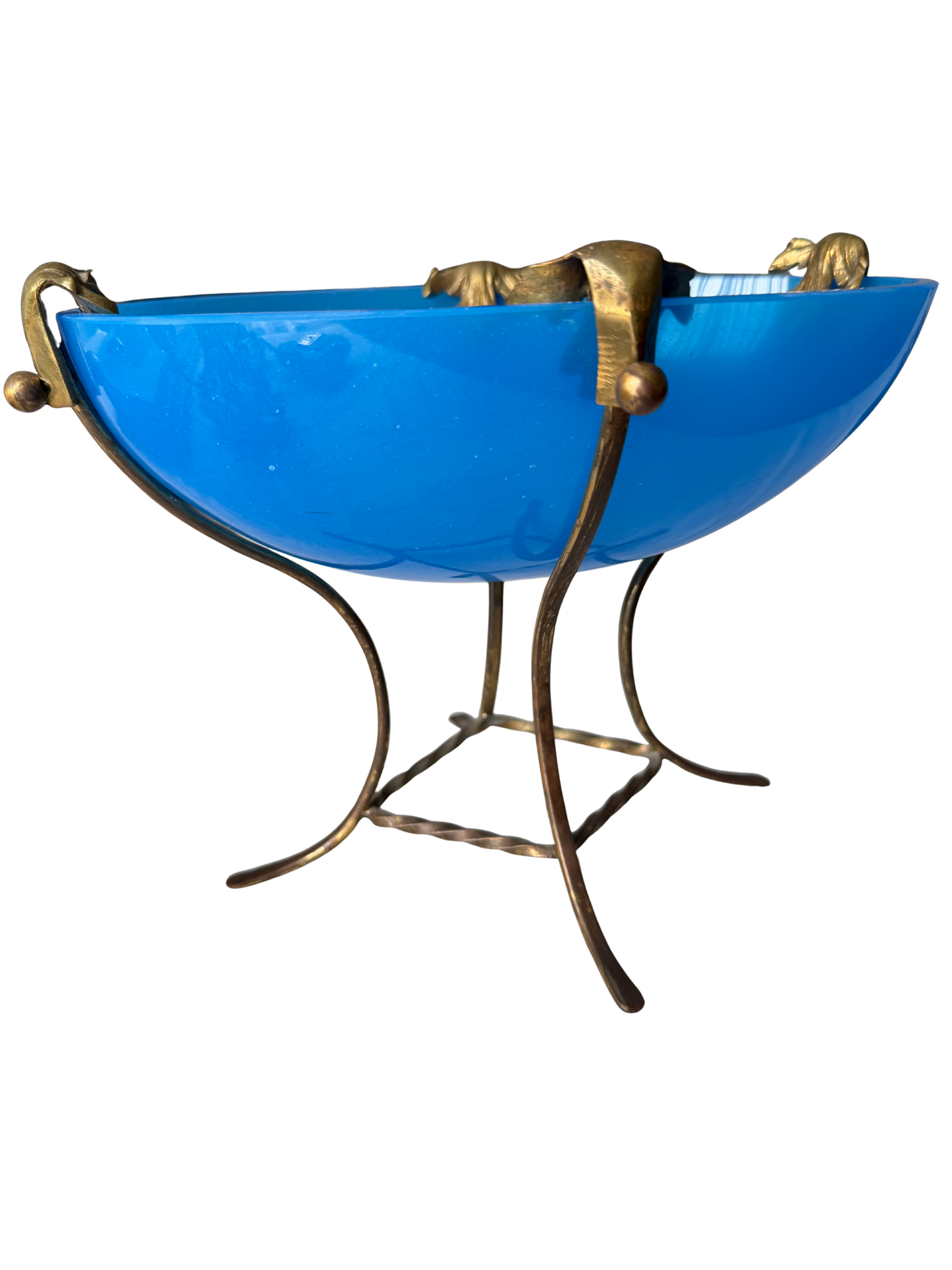
A striking decorative centerpiece comprising a vivid turquoise-blue opaline glass bowl supported within an elegant gilt-metal stand. The shallow oval bowl has a smooth, softly rounded profile and luminous translucent color, creating a dramatic contrast with the warm aged brass finish of the mount.
The hand-worked stand is formed from four curving supports joined by a twisted rectangular stretcher beneath the bowl. Each support terminates in a sculpted foliate mount that folds gently over the rim, with small spherical accents completing the design. The combination of saturated blue glass and botanical metalwork gives the piece a glamorous Continental character suited to both traditional and eclectic interiors.
Ideal as a table centerpiece, fruit bowl, floral vessel, or sculptural decorative object.
Era:
Continental European, likely mid-20th century, circa 1950–1970.
History:
Colored opaline and cased glass enjoyed renewed popularity in European decorative arts during the mid-20th century, particularly in France and Italy. Bowls and vessels were frequently paired with gilt-brass or wrought-metal mounts inspired by earlier neoclassical and Art Nouveau forms.
The stylized leaf clips, slender curved legs, and twisted lower frame suggest a decorative workshop production rather than a factory-standard tableware design. Without a visible signature or manufacturer’s mark, a specific French or Italian attribution cannot be confirmed.
Provenance:
Acquired through the antiques and decorative arts trade. Earlier ownership and maker are unknown.
Materials:
Blue opaline or cased glass and gilt brass or brass-finished metal.
Dimensions:
Please provide the overall length, width, and height, as well as the bowl dimensions, for the completed listing.
Condition:
Vintage condition with wear consistent with age and use. The glass bowl shows scattered surface marks, light scratches, dust, and minor interior spotting. No obvious major cracks or large chips are visible in the provided photographs, though the rim and underside should be inspected closely before listing.
The metal stand shows tarnish, oxidation, uneven patination, surface rubbing, and small areas of verdigris, particularly to the feet. The supports may have slight irregularities or minor bends associated with handmade construction and age. The bowl appears removable from the stand and should be handled carefully when moved.
Disclaimers:
The precise glass type, maker, country of manufacture, and date are unconfirmed. “Opaline” is used descriptively for the bowl’s saturated translucent appearance and should not be interpreted as an attribution to a particular glasshouse. The metal has not been tested and may be brass, bronze, or brass-finished alloy. No claim is made that the bowl and stand were originally manufactured together, although they appear visually and structurally compatible. Not recommended for food use unless the materials and surface condition are independently assessed.
Additional Description:
A striking decorative centerpiece comprising a vivid turquoise-blue opaline glass bowl supported within an elegant gilt-metal stand. The shallow oval bowl has a smooth, softly rounded profile and luminous translucent color, creating a dramatic contrast with the warm aged brass finish of the mount.
The hand-worked stand is formed from four curving supports joined by a twisted rectangular stretcher beneath the bowl. Each support terminates in a sculpted foliate mount that folds gently over the rim, with small spherical accents completing the design. The combination of saturated blue glass and botanical metalwork gives the piece a glamorous Continental character suited to both traditional and eclectic interiors.
Ideal as a table centerpiece, fruit bowl, floral vessel, or sculptural decorative object.
Era:
Continental European, likely mid-20th century, circa 1950–1970.
History:
Colored opaline and cased glass enjoyed renewed popularity in European decorative arts during the mid-20th century, particularly in France and Italy. Bowls and vessels were frequently paired with gilt-brass or wrought-metal mounts inspired by earlier neoclassical and Art Nouveau forms.
The stylized leaf clips, slender curved legs, and twisted lower frame suggest a decorative workshop production rather than a factory-standard tableware design. Without a visible signature or manufacturer’s mark, a specific French or Italian attribution cannot be confirmed.
Provenance:
Acquired through the antiques and decorative arts trade. Earlier ownership and maker are unknown.
Materials:
Blue opaline or cased glass and gilt brass or brass-finished metal.
Dimensions:
Please provide the overall length, width, and height, as well as the bowl dimensions, for the completed listing.
Condition:
Vintage condition with wear consistent with age and use. The glass bowl shows scattered surface marks, light scratches, dust, and minor interior spotting. No obvious major cracks or large chips are visible in the provided photographs, though the rim and underside should be inspected closely before listing.
The metal stand shows tarnish, oxidation, uneven patination, surface rubbing, and small areas of verdigris, particularly to the feet. The supports may have slight irregularities or minor bends associated with handmade construction and age. The bowl appears removable from the stand and should be handled carefully when moved.
Disclaimers:
The precise glass type, maker, country of manufacture, and date are unconfirmed. “Opaline” is used descriptively for the bowl’s saturated translucent appearance and should not be interpreted as an attribution to a particular glasshouse. The metal has not been tested and may be brass, bronze, or brass-finished alloy. No claim is made that the bowl and stand were originally manufactured together, although they appear visually and structurally compatible. Not recommended for food use unless the materials and surface condition are independently assessed.