

Carved Winged Griffin / Gryphon Architectural Furniture Fragment
Carved Winged Griffin / Gryphon Architectural Furniture Fragment
Impossible de charger la disponibilité du service de retrait
Partager
Additional Description:
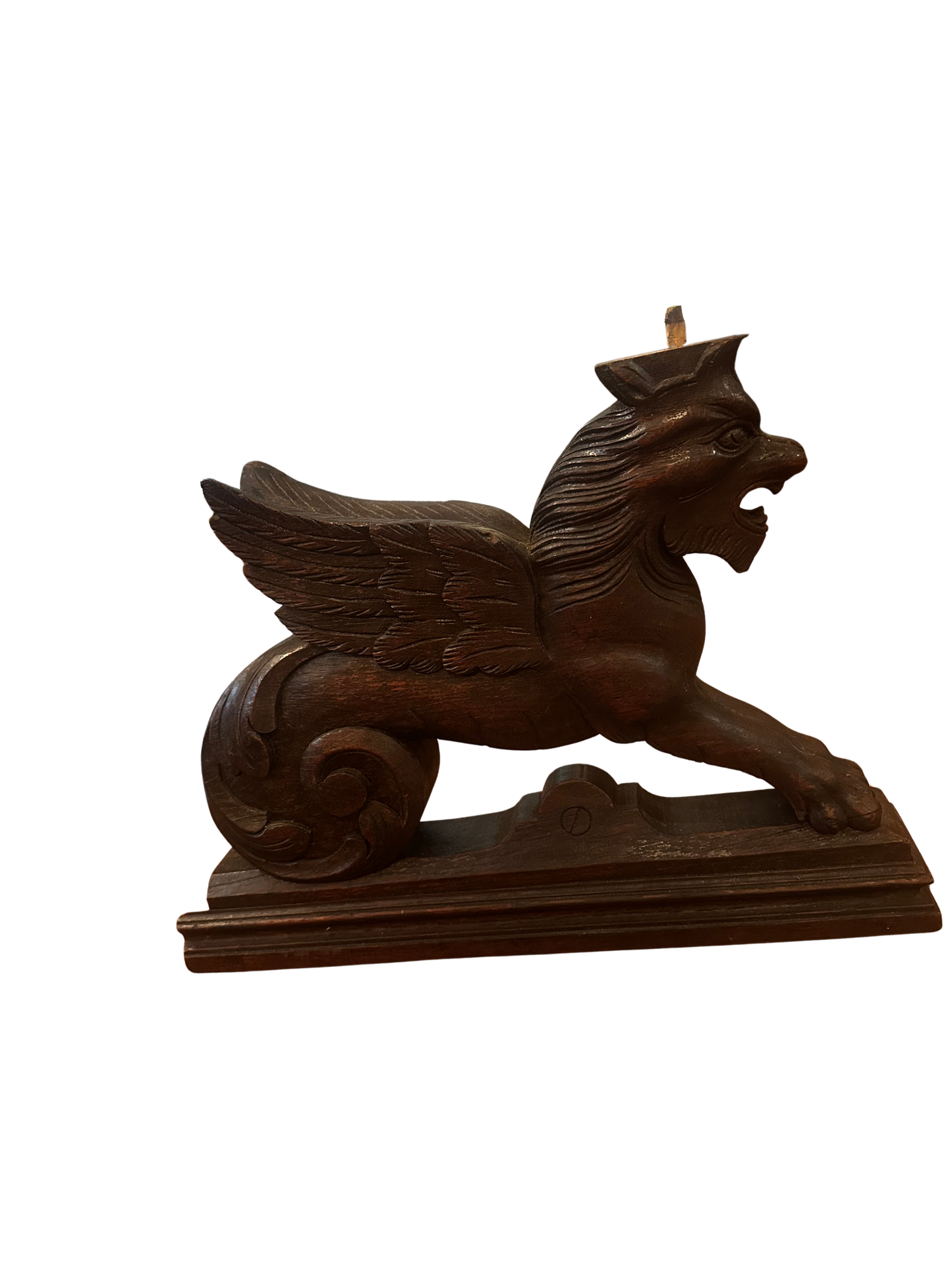
A wonderfully sculptural carved wooden griffin or gryphon fragment, likely originating as an architectural ornament or decorative furniture mount from the late 19th to early 20th century. The piece depicts a fantastical winged creature with leonine paws, scrolling rear haunches, feathered wings, and an expressive open-mouthed face. The stylized carving blends Gothic Revival and Renaissance Revival influences, with bold hand-carved lines and exaggerated foliate scrollwork.
The underside and rear construction strongly suggest it was originally mounted to a larger structure — likely serving as a decorative bracket, corbel, overmantel ornament, pediment element, or furniture applique. The protruding dowel and old nail construction indicate attachment to cabinetry or architectural woodwork rather than being conceived as a freestanding sculpture.
The deep dark stain or ebonized finish gives the piece a dramatic, almost medieval character, while the visible hand-tool marks and softened contours speak to age and craftsmanship. Particularly attractive are the feather carving on the wings, the scrolling rear quarter motif, and the alert forward stance that gives the creature movement and presence.
This type of decorative carving was popular in Gothic Revival interiors, Renaissance Revival furniture, and ecclesiastical-inspired decorative arts of the late Victorian period. It would display beautifully atop a stack of antique books, incorporated into a gallery wall, or styled within a maximalist European interior.
Era:
Late 19th to Early 20th Century
(ca. 1880–1920)
History:
Griffins and gryphons have long symbolized guardianship, strength, and nobility in European decorative arts. During the Gothic Revival and Renaissance Revival movements of the 19th century, fantastical creatures such as griffins, gargoyles, dragons, and winged lions became especially fashionable in furniture making and architectural ornamentation.
Pieces like this were often carved as embellishments for sideboards, overmantels, hall benches, staircases, ecclesiastical furnishings, or large cabinets. The dramatic silhouette and medieval inspiration aligned perfectly with Victorian tastes for romantic historicism and castle-inspired interiors.
Provenance:
Likely Continental European or English in influence. Acquired from the secondary antiques market.
Materials:
Hand-carved wood with dark stained or ebonized finish
Dimensions:
[Please Add]
Disclaimers:
Age-related wear throughout including surface scratches, finish loss, scuffs, small edge chips, construction separations, and losses consistent with architectural salvage or removal from a larger object. Visible old mounting hardware, nails, and dowel remnants present. One wing tip and portions of the base show wear and small losses. Displays beautifully with rich patina and strong decorative presence. Attribution and exact original use remain speculative.
Additional Description:
A wonderfully sculptural carved wooden griffin or gryphon fragment, likely originating as an architectural ornament or decorative furniture mount from the late 19th to early 20th century. The piece depicts a fantastical winged creature with leonine paws, scrolling rear haunches, feathered wings, and an expressive open-mouthed face. The stylized carving blends Gothic Revival and Renaissance Revival influences, with bold hand-carved lines and exaggerated foliate scrollwork.
The underside and rear construction strongly suggest it was originally mounted to a larger structure — likely serving as a decorative bracket, corbel, overmantel ornament, pediment element, or furniture applique. The protruding dowel and old nail construction indicate attachment to cabinetry or architectural woodwork rather than being conceived as a freestanding sculpture.
The deep dark stain or ebonized finish gives the piece a dramatic, almost medieval character, while the visible hand-tool marks and softened contours speak to age and craftsmanship. Particularly attractive are the feather carving on the wings, the scrolling rear quarter motif, and the alert forward stance that gives the creature movement and presence.
This type of decorative carving was popular in Gothic Revival interiors, Renaissance Revival furniture, and ecclesiastical-inspired decorative arts of the late Victorian period. It would display beautifully atop a stack of antique books, incorporated into a gallery wall, or styled within a maximalist European interior.
Era:
Late 19th to Early 20th Century
(ca. 1880–1920)
History:
Griffins and gryphons have long symbolized guardianship, strength, and nobility in European decorative arts. During the Gothic Revival and Renaissance Revival movements of the 19th century, fantastical creatures such as griffins, gargoyles, dragons, and winged lions became especially fashionable in furniture making and architectural ornamentation.
Pieces like this were often carved as embellishments for sideboards, overmantels, hall benches, staircases, ecclesiastical furnishings, or large cabinets. The dramatic silhouette and medieval inspiration aligned perfectly with Victorian tastes for romantic historicism and castle-inspired interiors.
Provenance:
Likely Continental European or English in influence. Acquired from the secondary antiques market.
Materials:
Hand-carved wood with dark stained or ebonized finish
Dimensions:
[Please Add]
Disclaimers:
Age-related wear throughout including surface scratches, finish loss, scuffs, small edge chips, construction separations, and losses consistent with architectural salvage or removal from a larger object. Visible old mounting hardware, nails, and dowel remnants present. One wing tip and portions of the base show wear and small losses. Displays beautifully with rich patina and strong decorative presence. Attribution and exact original use remain speculative.