


Classical Acanthus Ornament Study Attributed to Phillip Douglas Creer, Charcoal Architectural Rendering
Classical Acanthus Ornament Study Attributed to Phillip Douglas Creer, Charcoal Architectural Rendering
Impossible de charger la disponibilité du service de retrait
Partager
Additional Description:
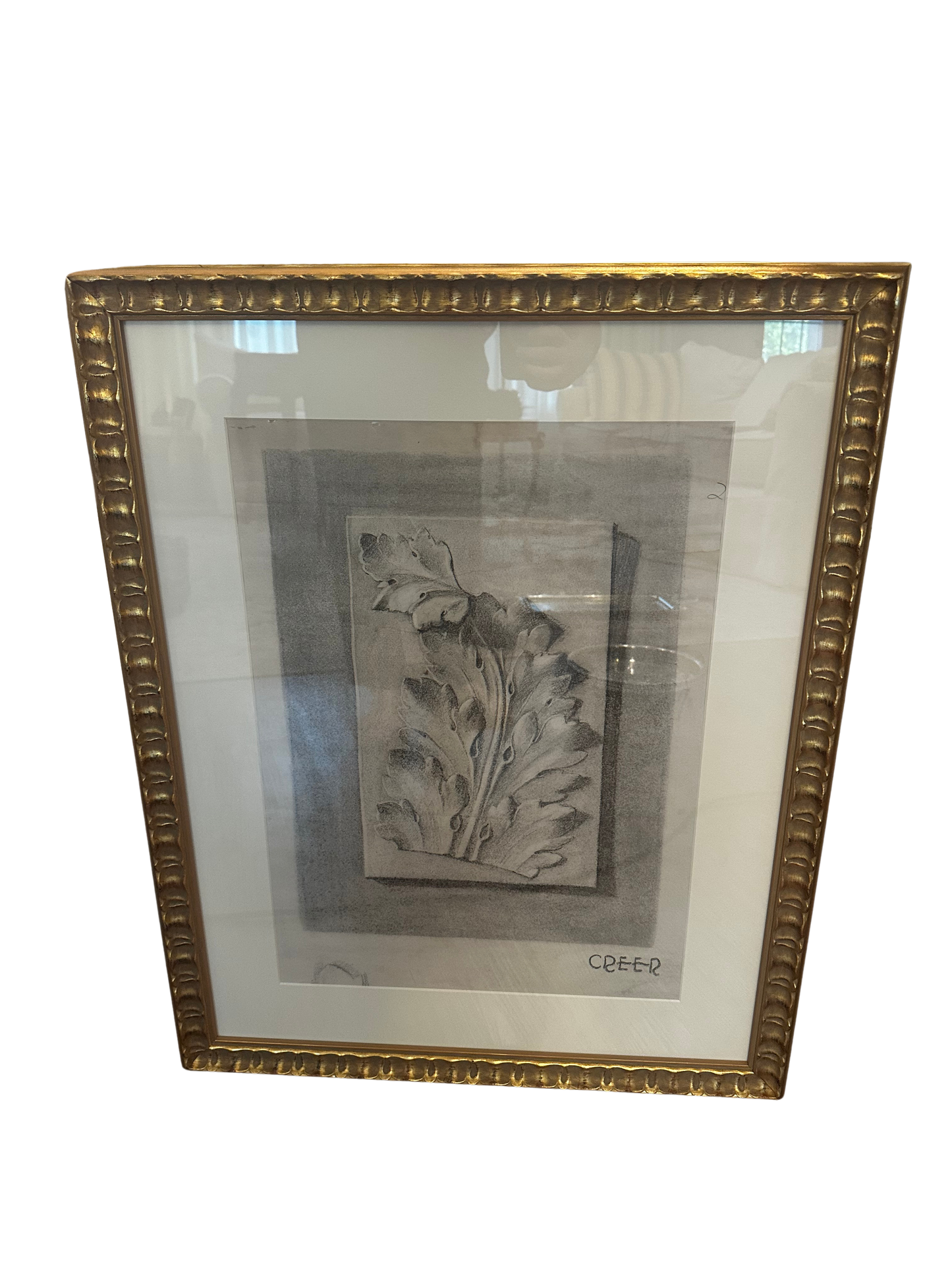
An elegant architectural rendering depicting a classical acanthus leaf ornament study, executed in charcoal or compressed charcoal on paper with exceptional tonal sensitivity and sculptural realism. The composition isolates a carved ornamental fragment within a rectangular framing device, allowing the viewer to focus on the flowing acanthus leaves and deeply modeled shadow work.
The artist rendered the curling foliage with remarkable precision, emphasizing the dimensional folds and organic movement characteristic of classical architectural carving. The soft gradations of charcoal create a convincing illusion of carved stone or plaster relief emerging from darkness, demonstrating strong academic draftsmanship rooted in classical architectural training.
Signed lower right “CREER,” strongly suggesting attribution to Phillip Douglas Creer. The work appears to belong to the same group of architectural studies as the Ionic capital and scrolling ornament renderings, likely produced as educational studies, restoration references, or architectural ornament documentation.
The drawing is housed in a giltwood frame with repeating decorative molding that harmonizes beautifully with the classical subject matter.
Era:
Likely Mid-20th Century
History:
Attributed to Phillip Douglas Creer (1903–1993), an influential architect and architectural educator associated with The University of Texas at Austin. Creer studied architecture at the University of Pennsylvania and later served as dean of the School of Architecture at UT Austin from 1956 to 1967. He was deeply involved in architectural preservation, classical architectural education, and restoration-minded design practices.
Architectural ornament studies such as this were fundamental to Beaux-Arts-inspired architectural education, where students and architects trained by closely analyzing historic decorative forms. Drawings of acanthus ornamentation, capitals, scrollwork, and carved architectural fragments helped develop an understanding of proportion, light, carving depth, and classical decorative vocabulary.
Provenance:
From a Texas estate collection. Attribution based on visible signature; additional provenance research recommended.
Materials:
Charcoal or compressed charcoal on paper; archival matting under glass in giltwood frame.
Dimensions:
[Insert Dimensions]
Disclaimers:
Age-related toning, light spotting, and surface wear visible. Minor discoloration and waviness to paper visible under glass. Frame shows expected wear including abrasions and finish inconsistencies. Attribution remains unconfirmed pending additional documentation or authentication.
Additional Description:
An elegant architectural rendering depicting a classical acanthus leaf ornament study, executed in charcoal or compressed charcoal on paper with exceptional tonal sensitivity and sculptural realism. The composition isolates a carved ornamental fragment within a rectangular framing device, allowing the viewer to focus on the flowing acanthus leaves and deeply modeled shadow work.
The artist rendered the curling foliage with remarkable precision, emphasizing the dimensional folds and organic movement characteristic of classical architectural carving. The soft gradations of charcoal create a convincing illusion of carved stone or plaster relief emerging from darkness, demonstrating strong academic draftsmanship rooted in classical architectural training.
Signed lower right “CREER,” strongly suggesting attribution to Phillip Douglas Creer. The work appears to belong to the same group of architectural studies as the Ionic capital and scrolling ornament renderings, likely produced as educational studies, restoration references, or architectural ornament documentation.
The drawing is housed in a giltwood frame with repeating decorative molding that harmonizes beautifully with the classical subject matter.
Era:
Likely Mid-20th Century
History:
Attributed to Phillip Douglas Creer (1903–1993), an influential architect and architectural educator associated with The University of Texas at Austin. Creer studied architecture at the University of Pennsylvania and later served as dean of the School of Architecture at UT Austin from 1956 to 1967. He was deeply involved in architectural preservation, classical architectural education, and restoration-minded design practices.
Architectural ornament studies such as this were fundamental to Beaux-Arts-inspired architectural education, where students and architects trained by closely analyzing historic decorative forms. Drawings of acanthus ornamentation, capitals, scrollwork, and carved architectural fragments helped develop an understanding of proportion, light, carving depth, and classical decorative vocabulary.
Provenance:
From a Texas estate collection. Attribution based on visible signature; additional provenance research recommended.
Materials:
Charcoal or compressed charcoal on paper; archival matting under glass in giltwood frame.
Dimensions:
[Insert Dimensions]
Disclaimers:
Age-related toning, light spotting, and surface wear visible. Minor discoloration and waviness to paper visible under glass. Frame shows expected wear including abrasions and finish inconsistencies. Attribution remains unconfirmed pending additional documentation or authentication.