

Classical Bronze Wall Appliqué of Apollo / Sun God Mask
Classical Bronze Wall Appliqué of Apollo / Sun God Mask
Impossible de charger la disponibilité du service de retrait
Partager
Additional Description:
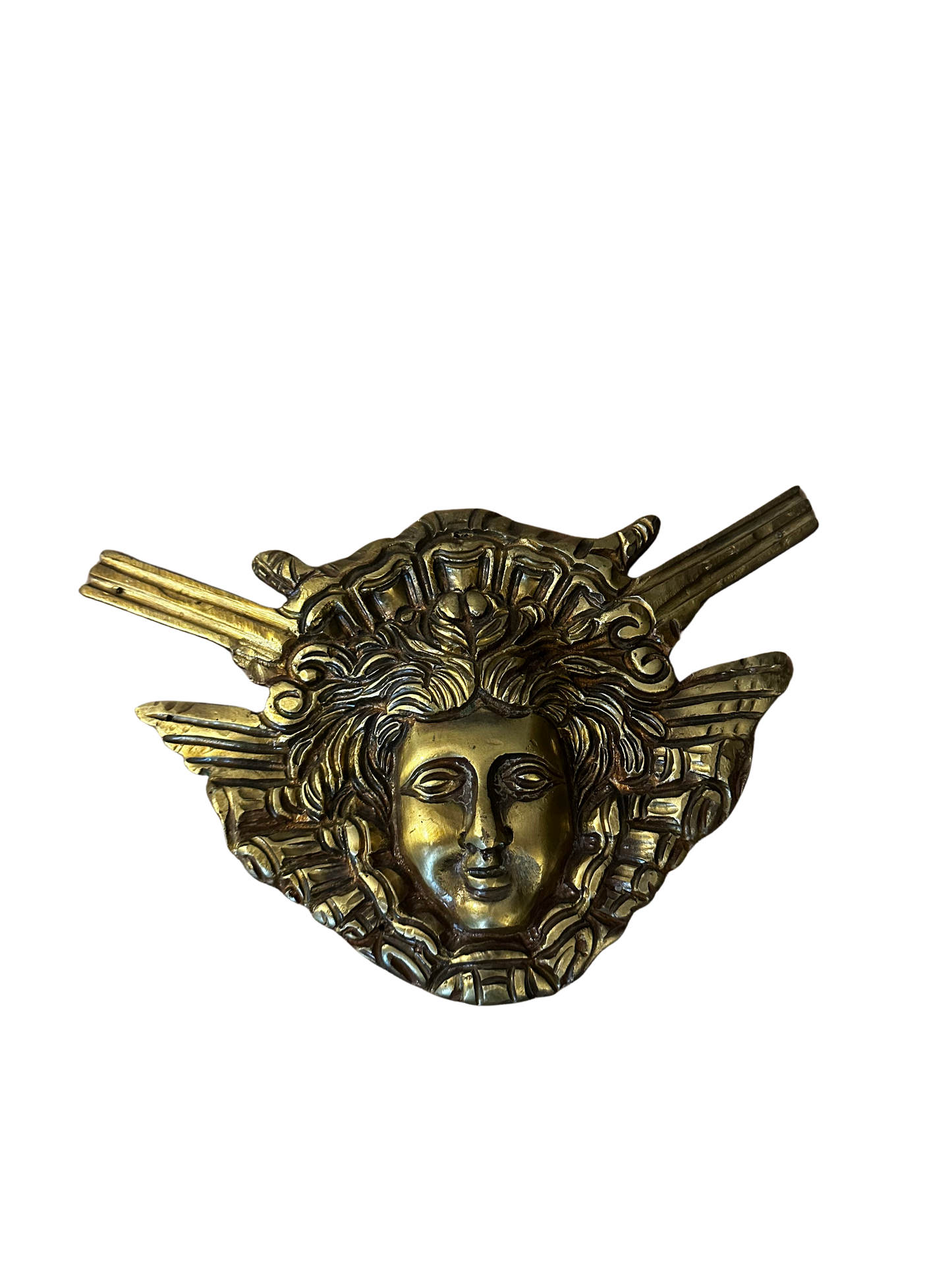
Striking classical bronze wall appliqué depicting a stylized male mask, likely inspired by Apollo, the Greco-Roman god associated with the sun, light, music, and the arts. The sculptural face emerges from deeply cast flowing locks and radiating architectural rays or sunburst elements, creating a powerful composition that blends neoclassical imagery with early 20th-century decorative design sensibilities.
The facial features are serene and idealized in the classical manner, while the surrounding radiating forms evoke solar imagery strongly associated with Apollo and sun-god iconography. Rich sculptural depth throughout the casting enhances the dimensionality of the piece, particularly in the flowing hair, scrolling ornament, and layered radiating elements.
The reverse reveals substantial oxidation and wear consistent with age and metal construction, supporting the possibility of bronze or heavy cast metal rather than carved wood or composition. Likely originally mounted as an architectural ornament, furniture appliqué, overdoor embellishment, or decorative mount within a grand interior scheme.
Era:
Early 20th century, likely circa 1920–1940.
History:
Classical mask motifs remained highly popular in European decorative arts during the late neoclassical revival and Art Deco periods. Apollo, often represented with idealized youthful features and radiating solar imagery, symbolized enlightenment, beauty, culture, and artistic refinement.
Decorative bronze appliqués such as this were used on architectural panels, luxury furniture, overmantels, theater interiors, and grand decorative schemes influenced by both classical antiquity and Beaux-Arts design traditions. The dramatic radiating forms also align with the fascination for sunburst motifs during the Art Deco era.
Provenance:
Likely Continental European or French-inspired architectural or decorative arts fragment; acquired from an estate collection.
Materials:
Cast bronze or heavy cast metal with gilt or patinated finish.
Dimensions:
—
Disclaimers/Condition:
Age-related wear throughout including oxidation, rubbing and losses to gilded or patinated surfaces, scratches, edge wear, and surface inconsistencies. Reverse shows oxidation and wear from previous mounting. Possible old mounting holes or attachment points present.
Additional Description:
Striking classical bronze wall appliqué depicting a stylized male mask, likely inspired by Apollo, the Greco-Roman god associated with the sun, light, music, and the arts. The sculptural face emerges from deeply cast flowing locks and radiating architectural rays or sunburst elements, creating a powerful composition that blends neoclassical imagery with early 20th-century decorative design sensibilities.
The facial features are serene and idealized in the classical manner, while the surrounding radiating forms evoke solar imagery strongly associated with Apollo and sun-god iconography. Rich sculptural depth throughout the casting enhances the dimensionality of the piece, particularly in the flowing hair, scrolling ornament, and layered radiating elements.
The reverse reveals substantial oxidation and wear consistent with age and metal construction, supporting the possibility of bronze or heavy cast metal rather than carved wood or composition. Likely originally mounted as an architectural ornament, furniture appliqué, overdoor embellishment, or decorative mount within a grand interior scheme.
Era:
Early 20th century, likely circa 1920–1940.
History:
Classical mask motifs remained highly popular in European decorative arts during the late neoclassical revival and Art Deco periods. Apollo, often represented with idealized youthful features and radiating solar imagery, symbolized enlightenment, beauty, culture, and artistic refinement.
Decorative bronze appliqués such as this were used on architectural panels, luxury furniture, overmantels, theater interiors, and grand decorative schemes influenced by both classical antiquity and Beaux-Arts design traditions. The dramatic radiating forms also align with the fascination for sunburst motifs during the Art Deco era.
Provenance:
Likely Continental European or French-inspired architectural or decorative arts fragment; acquired from an estate collection.
Materials:
Cast bronze or heavy cast metal with gilt or patinated finish.
Dimensions:
—
Disclaimers/Condition:
Age-related wear throughout including oxidation, rubbing and losses to gilded or patinated surfaces, scratches, edge wear, and surface inconsistencies. Reverse shows oxidation and wear from previous mounting. Possible old mounting holes or attachment points present.