


Classical Scroll Ornament Study Attributed to Phillip Douglas Creer, Charcoal Architectural Rendering
Classical Scroll Ornament Study Attributed to Phillip Douglas Creer, Charcoal Architectural Rendering
Impossible de charger la disponibilité du service de retrait
Partager
Additional Description:
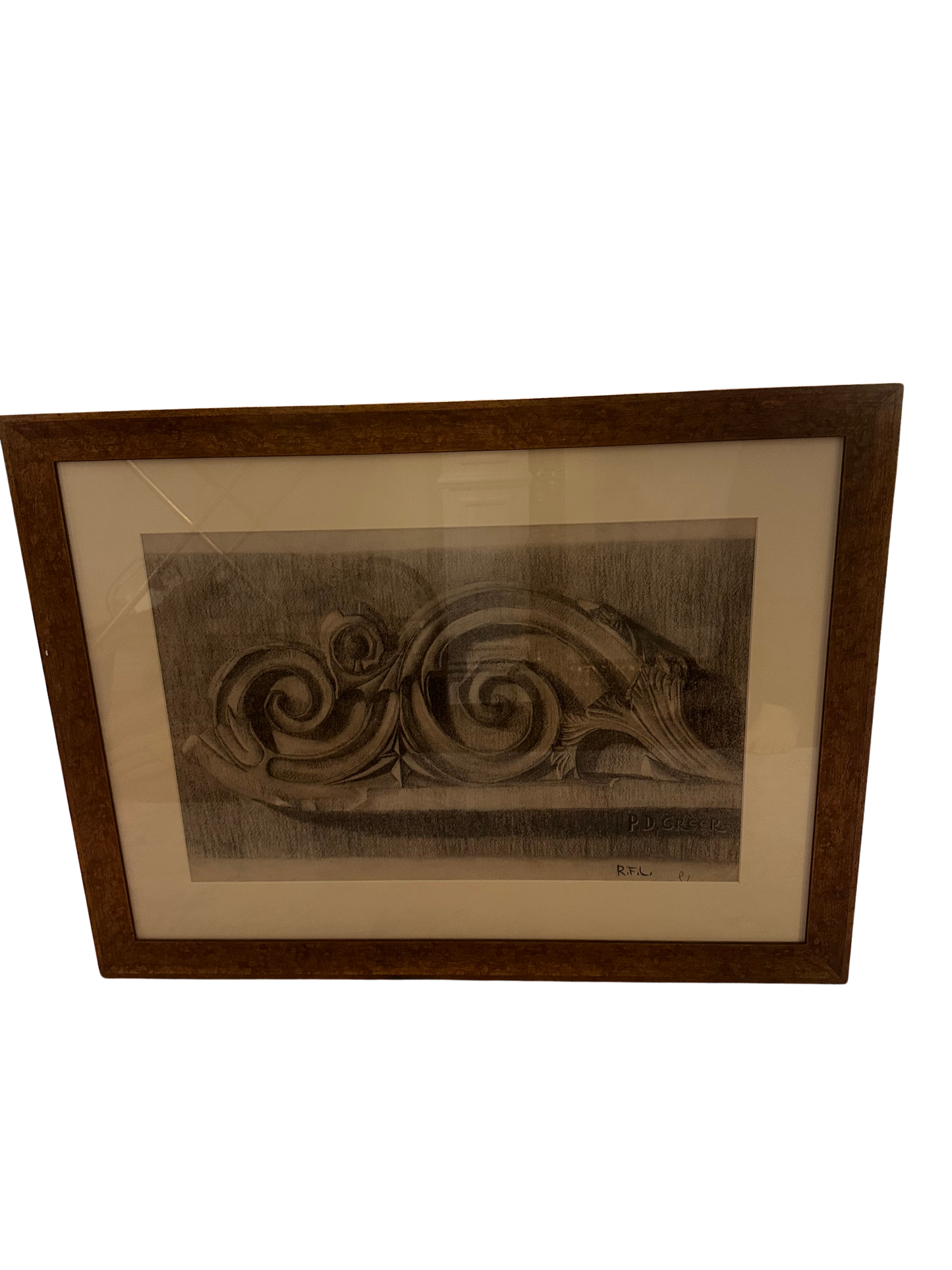
A refined monochromatic architectural study depicting an elaborate scrolling neoclassical ornament rendered with exceptional tonal control and sculptural depth. Executed in charcoal or compressed charcoal on paper, the composition focuses on intertwined volutes, acanthus-inspired carving, and flowing ornamental forms suggestive of classical friezes, pediments, or architectural cresting.
The drawing demonstrates sophisticated academic draftsmanship through its nuanced handling of light and shadow. The artist carefully modeled the curling volutes and carved transitions to emphasize dimensionality, creating the illusion of carved stone or wood ornament emerging from darkness. The background shading further heightens the sculptural drama of the composition.
Signed lower right “P.D. Creer,” strongly suggesting attribution to Phillip Douglas Creer. Additional initials and notation appear beneath the signature, reinforcing the impression of a formal architectural or atelier study.
This work pairs beautifully with the accompanying Ionic capital study and likely formed part of a larger series examining classical architectural ornamentation and decorative vocabulary.
Presented in an elegant giltwood frame with delicate scrolling ornamentation that complements the classical subject matter.
Era:
Likely Mid-20th Century
History:
Architectural ornament studies such as this were foundational exercises in Beaux-Arts and classical architectural education. Architects, draftsmen, and restoration designers regularly produced detailed renderings of historic ornamental forms to better understand proportion, carving depth, shadow, and decorative rhythm.
If correctly attributed to Phillip Douglas Creer, this drawing may relate to his architectural studies, restoration interests, or classical design work. Such renderings occupy an appealing intersection between fine art and architectural scholarship.
History:
Attributed to Phillip Douglas Creer (1903–1993), an influential American architect, educator, and preservation advocate associated with The University of Texas at Austin. Creer received his architectural education at the University of Pennsylvania and later became head of the Department of Architecture at the Rhode Island School of Design before serving as dean of the School of Architecture at UT Austin from 1956 to 1967. He was deeply involved in architectural education, historic preservation, and professional architectural organizations throughout Texas and the United States.
Beyond academia, Creer was active professionally through the firm Creer & Roessner Architects and served as executive director of the Texas Board of Architectural Examiners. He was also the first chairman of the Austin Historic Landmark Commission and was widely respected for his contributions to architectural preservation and education in Texas. In recognition of his influence, the Heritage Society of Austin established the Philip Creer Fellowship in Historic Preservation at UT Austin
Provenance:
From a Texas estate collection. Attribution based on visible “P.D. Creer” signature; further authentication and provenance research recommended.
Materials:
Charcoal or compressed charcoal on paper; archival matting under glass in giltwood frame.
Dimensions:
[Insert Dimensions]
Disclaimers:
Age-related toning, light surface wear, and minor spotting visible. Reflections visible under glass. Frame shows expected age wear including surface abrasions and minor finish inconsistencies. Attribution remains tentative pending additional provenance or scholarly verification.
Additional Description:
A refined monochromatic architectural study depicting an elaborate scrolling neoclassical ornament rendered with exceptional tonal control and sculptural depth. Executed in charcoal or compressed charcoal on paper, the composition focuses on intertwined volutes, acanthus-inspired carving, and flowing ornamental forms suggestive of classical friezes, pediments, or architectural cresting.
The drawing demonstrates sophisticated academic draftsmanship through its nuanced handling of light and shadow. The artist carefully modeled the curling volutes and carved transitions to emphasize dimensionality, creating the illusion of carved stone or wood ornament emerging from darkness. The background shading further heightens the sculptural drama of the composition.
Signed lower right “P.D. Creer,” strongly suggesting attribution to Phillip Douglas Creer. Additional initials and notation appear beneath the signature, reinforcing the impression of a formal architectural or atelier study.
This work pairs beautifully with the accompanying Ionic capital study and likely formed part of a larger series examining classical architectural ornamentation and decorative vocabulary.
Presented in an elegant giltwood frame with delicate scrolling ornamentation that complements the classical subject matter.
Era:
Likely Mid-20th Century
History:
Architectural ornament studies such as this were foundational exercises in Beaux-Arts and classical architectural education. Architects, draftsmen, and restoration designers regularly produced detailed renderings of historic ornamental forms to better understand proportion, carving depth, shadow, and decorative rhythm.
If correctly attributed to Phillip Douglas Creer, this drawing may relate to his architectural studies, restoration interests, or classical design work. Such renderings occupy an appealing intersection between fine art and architectural scholarship.
History:
Attributed to Phillip Douglas Creer (1903–1993), an influential American architect, educator, and preservation advocate associated with The University of Texas at Austin. Creer received his architectural education at the University of Pennsylvania and later became head of the Department of Architecture at the Rhode Island School of Design before serving as dean of the School of Architecture at UT Austin from 1956 to 1967. He was deeply involved in architectural education, historic preservation, and professional architectural organizations throughout Texas and the United States.
Beyond academia, Creer was active professionally through the firm Creer & Roessner Architects and served as executive director of the Texas Board of Architectural Examiners. He was also the first chairman of the Austin Historic Landmark Commission and was widely respected for his contributions to architectural preservation and education in Texas. In recognition of his influence, the Heritage Society of Austin established the Philip Creer Fellowship in Historic Preservation at UT Austin
Provenance:
From a Texas estate collection. Attribution based on visible “P.D. Creer” signature; further authentication and provenance research recommended.
Materials:
Charcoal or compressed charcoal on paper; archival matting under glass in giltwood frame.
Dimensions:
[Insert Dimensions]
Disclaimers:
Age-related toning, light surface wear, and minor spotting visible. Reflections visible under glass. Frame shows expected age wear including surface abrasions and minor finish inconsistencies. Attribution remains tentative pending additional provenance or scholarly verification.