

Curated Set of Three French Literary Volumes with Emphera Wrappers
Curated Set of Three French Literary Volumes with Emphera Wrappers
Impossible de charger la disponibilité du service de retrait
Partager
Additional Description:
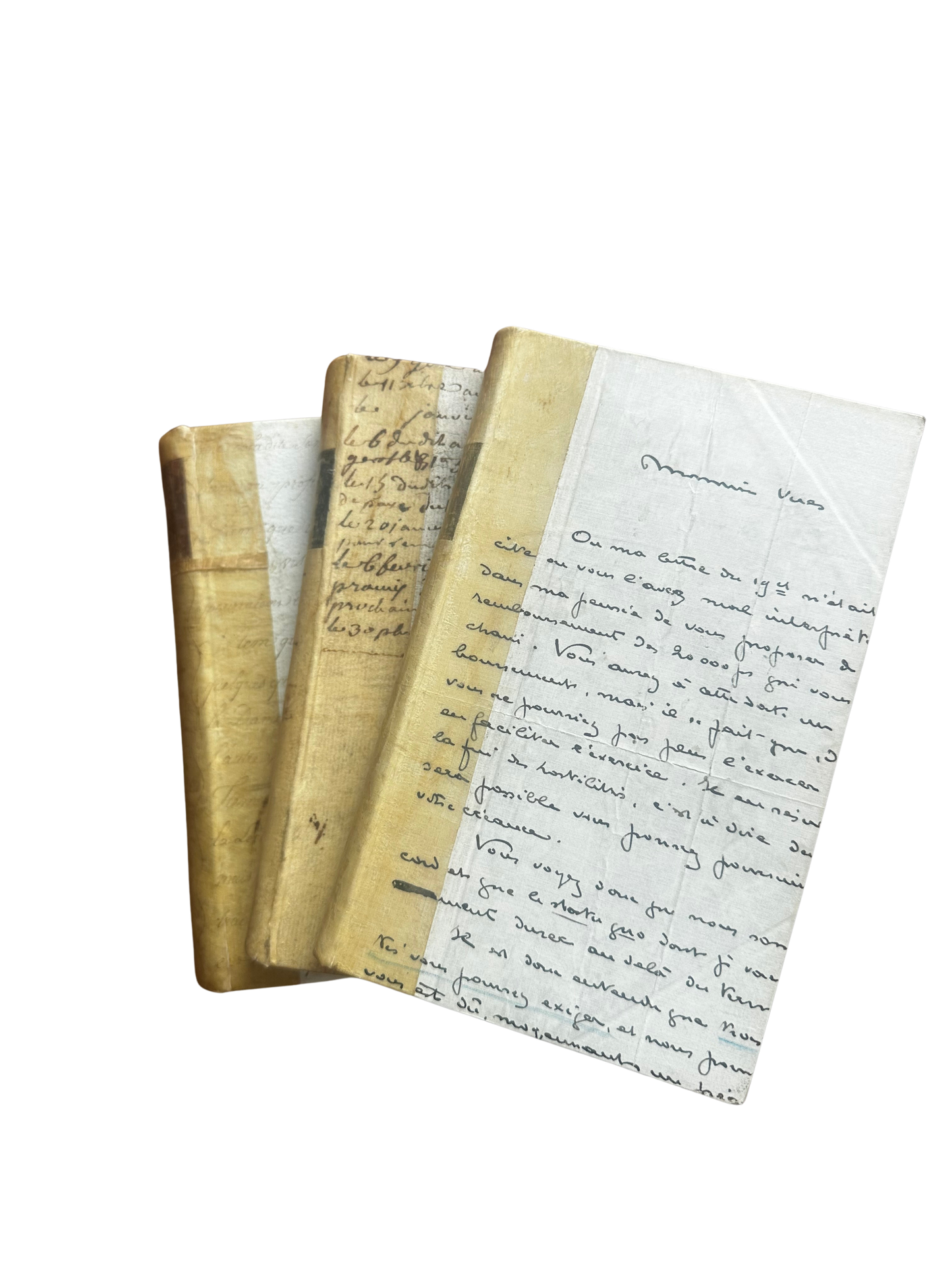
An evocative and intellectually rich grouping of three French literary volumes, each bearing the quiet romance of manuscript-wrapped bindings and layered histories. This set is unified not only by language and period, but by its deeply atmospheric presentation—original printed texts housed within hand-inscribed or manuscript-style paper wrappers, creating a striking interplay between printed literature and handwritten archival material.
The first volume, Pour Gagner aux Courses by Raoul Leguy (Éditions Montaigne, Paris), reflects early 20th-century French culture surrounding leisure and sport, its modest format elevated by its manuscript-style exterior. The second, La Chanson de Ma Vie (Mes Mémoires) by Yvette Guilbert (Bernard Grasset, Paris, 1927), carries particular significance, as Guilbert was an iconic performer of the Belle Époque, closely associated with Parisian cabaret culture and immortalized by artists such as Toulouse-Lautrec. The third volume, La Rôtisserie de la Reine Pédauque by Anatole France (Calmann-Lévy, Paris), represents one of the great literary voices of France, a Nobel Prize–winning author whose works bridge satire, philosophy, and historical narrative.
What distinguishes this set most profoundly is the use of manuscript leaves or handwritten-style paper as outer wrappers—suggestive of either period rebinding practices, personal library customization, or atelier-style presentation. The visible handwriting, varied scripts, and aged patina create a tactile and visual depth that elevates these volumes from simple books to objects of aesthetic and historical intrigue. Together, they read as a curated vignette of French intellectual life—literature, memoir, and cultural commentary—wrapped in the visual language of the archive.
Era:
Late 19th to early 20th century (primarily circa 1890–1930)
History:
France has long held a deep reverence for literary culture, and the late 19th to early 20th centuries represent a particularly vibrant period of intellectual and artistic production. Authors such as Anatole France contributed to the philosophical and literary canon, while figures like Yvette Guilbert embodied the cultural energy of Parisian performance and modernity. During this period, it was not uncommon for books to be rebound, customized, or protected with paper wrappers—sometimes incorporating manuscript leaves, recycled documents, or decorative papers—particularly within personal libraries or by smaller ateliers.
Such bindings, while modest in material, often carry a distinct charm and individuality, reflecting the owner’s taste and the era’s appreciation for both text and object. This set exemplifies that tradition, blending printed works with the visual poetry of handwritten script.
Provenance:
French, acquired as a curated group on the secondary market.
Materials:
Paper, printed text blocks; manuscript or manuscript-style paper wrappers; cloth or paper spine labels; ink inscriptions; natural paper patina.
Dimensions:
Leave blank
Disclaimers:
Condition consistent with age and use. Visible wear, toning, staining, and edge wear to wrappers and pages throughout. Manuscript wrappers show handling wear, creasing, and discoloration. Some spine labels are worn or partially faded. Pages may exhibit foxing, minor spotting, or age-related toning. Bindings appear stable but should be handled with care due to age and materials. Attribution of manuscript wrappers as period-applied or later customization is based on visual assessment and not definitively documented.
Additional Description:
An evocative and intellectually rich grouping of three French literary volumes, each bearing the quiet romance of manuscript-wrapped bindings and layered histories. This set is unified not only by language and period, but by its deeply atmospheric presentation—original printed texts housed within hand-inscribed or manuscript-style paper wrappers, creating a striking interplay between printed literature and handwritten archival material.
The first volume, Pour Gagner aux Courses by Raoul Leguy (Éditions Montaigne, Paris), reflects early 20th-century French culture surrounding leisure and sport, its modest format elevated by its manuscript-style exterior. The second, La Chanson de Ma Vie (Mes Mémoires) by Yvette Guilbert (Bernard Grasset, Paris, 1927), carries particular significance, as Guilbert was an iconic performer of the Belle Époque, closely associated with Parisian cabaret culture and immortalized by artists such as Toulouse-Lautrec. The third volume, La Rôtisserie de la Reine Pédauque by Anatole France (Calmann-Lévy, Paris), represents one of the great literary voices of France, a Nobel Prize–winning author whose works bridge satire, philosophy, and historical narrative.
What distinguishes this set most profoundly is the use of manuscript leaves or handwritten-style paper as outer wrappers—suggestive of either period rebinding practices, personal library customization, or atelier-style presentation. The visible handwriting, varied scripts, and aged patina create a tactile and visual depth that elevates these volumes from simple books to objects of aesthetic and historical intrigue. Together, they read as a curated vignette of French intellectual life—literature, memoir, and cultural commentary—wrapped in the visual language of the archive.
Era:
Late 19th to early 20th century (primarily circa 1890–1930)
History:
France has long held a deep reverence for literary culture, and the late 19th to early 20th centuries represent a particularly vibrant period of intellectual and artistic production. Authors such as Anatole France contributed to the philosophical and literary canon, while figures like Yvette Guilbert embodied the cultural energy of Parisian performance and modernity. During this period, it was not uncommon for books to be rebound, customized, or protected with paper wrappers—sometimes incorporating manuscript leaves, recycled documents, or decorative papers—particularly within personal libraries or by smaller ateliers.
Such bindings, while modest in material, often carry a distinct charm and individuality, reflecting the owner’s taste and the era’s appreciation for both text and object. This set exemplifies that tradition, blending printed works with the visual poetry of handwritten script.
Provenance:
French, acquired as a curated group on the secondary market.
Materials:
Paper, printed text blocks; manuscript or manuscript-style paper wrappers; cloth or paper spine labels; ink inscriptions; natural paper patina.
Dimensions:
Leave blank
Disclaimers:
Condition consistent with age and use. Visible wear, toning, staining, and edge wear to wrappers and pages throughout. Manuscript wrappers show handling wear, creasing, and discoloration. Some spine labels are worn or partially faded. Pages may exhibit foxing, minor spotting, or age-related toning. Bindings appear stable but should be handled with care due to age and materials. Attribution of manuscript wrappers as period-applied or later customization is based on visual assessment and not definitively documented.