


English Regency Figured Mahogany and Mother-of-Pearl Sarcophagus Tea Caddy with Cut Crystal Mixing Bowl
English Regency Figured Mahogany and Mother-of-Pearl Sarcophagus Tea Caddy with Cut Crystal Mixing Bowl
Impossible de charger la disponibilité du service de retrait
Partager


A handsome English Regency tea caddy of sarcophagus form, crafted in richly figured mahogany and retaining its traditional fitted interior.
The hinged lid is designed with broad sloping shoulders and a raised rectangular central panel edged in carved gadrooned molding. A rectangular mother-of-pearl cartouche is inset at the center, providing a refined contrast against the warm mahogany grain.
The case is similarly finished with gadrooned molding along the lower edge and raised on four small bun feet. Each side retains a circular ring carrying handle, while the front is fitted with a brass lock and ring-form key.
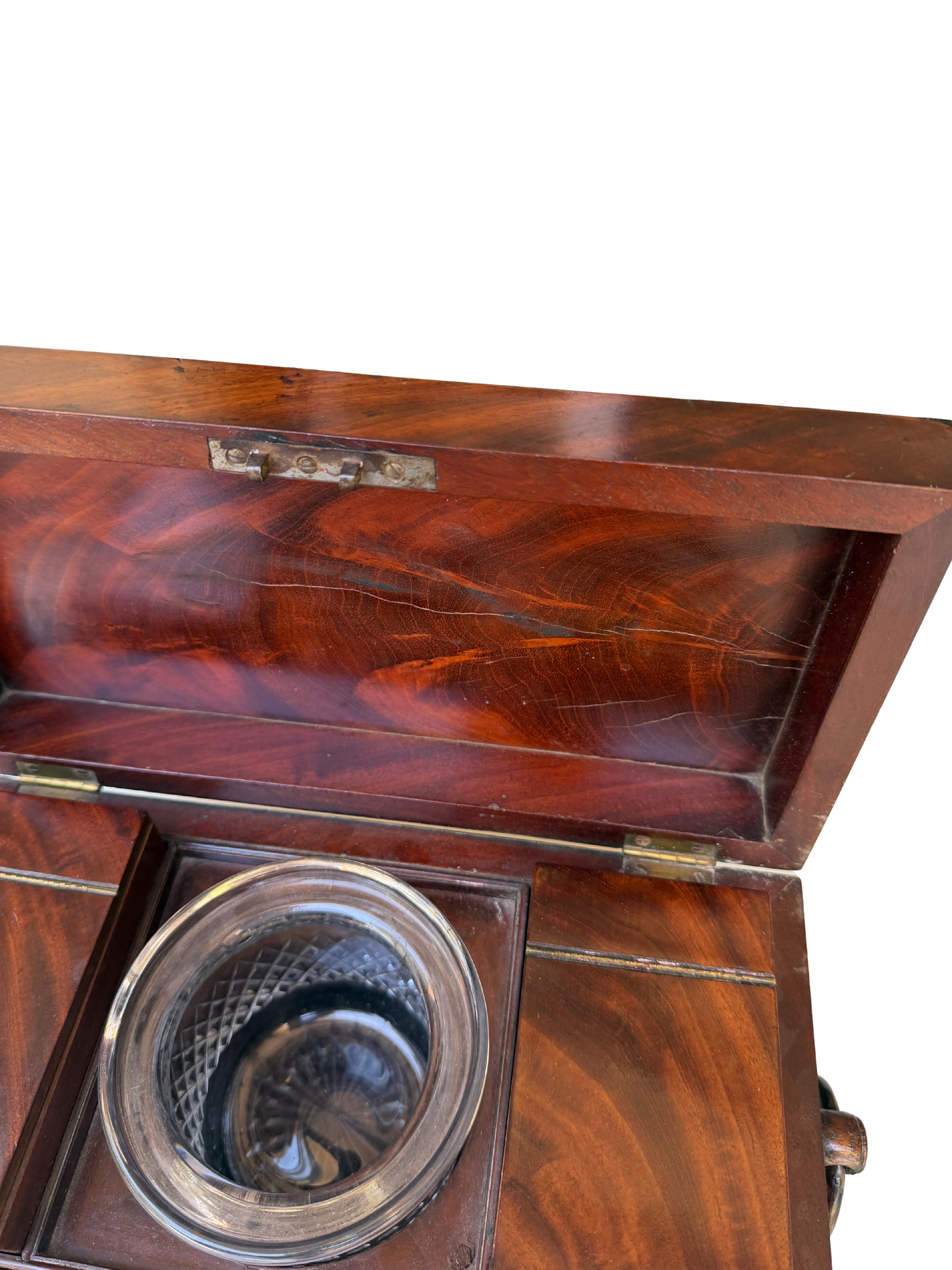
Opening the lid reveals a fitted interior with two individually hinged tea compartments flanking a central well. The compartments would originally have held separate varieties of tea, while the central cut crystal bowl was intended as a mixing bowl for combining tea leaves prior to brewing.
The included crystal bowl features a broad flared rim and diamond-cut decoration to the body, giving the interior an especially decorative presentation. The two tea compartments retain their mahogany lids with narrow contrasting inlaid bands.
An elegant and highly displayable example of the refined tea culture of Regency England.
A handsome English Regency tea caddy of sarcophagus form, crafted in richly figured mahogany and retaining its traditional fitted interior.
The hinged lid is designed with broad sloping shoulders and a raised rectangular central panel edged in carved gadrooned molding. A rectangular mother-of-pearl cartouche is inset at the center, providing a refined contrast against the warm mahogany grain.
The case is similarly finished with gadrooned molding along the lower edge and raised on four small bun feet. Each side retains a circular ring carrying handle, while the front is fitted with a brass lock and ring-form key.
Opening the lid reveals a fitted interior with two individually hinged tea compartments flanking a central well. The compartments would originally have held separate varieties of tea, while the central cut crystal bowl was intended as a mixing bowl for combining tea leaves prior to brewing.
The included crystal bowl features a broad flared rim and diamond-cut decoration to the body, giving the interior an especially decorative presentation. The two tea compartments retain their mahogany lids with narrow contrasting inlaid bands.
An elegant and highly displayable example of the refined tea culture of Regency England.
7” H x 13.5” W x 6.5” D
7” H x 13.5” W x 6.5” D
Tea remained an expensive and socially important commodity in Britain during the late Georgian and Regency periods. Tea caddies therefore served both a practical and decorative function, often being displayed prominently within drawing rooms and dining interiors.
By the early 19th century, the sarcophagus-form tea caddy became particularly fashionable. Inspired by the renewed European interest in Classical and Egyptian antiquity, these caddies frequently featured sloping architectural lids, richly figured veneers, carved gadrooned borders, bun feet, and decorative side handles.
Fitted examples were commonly arranged with two separate tea canisters, traditionally allowing different teas such as black and green tea to be stored independently. A central glass bowl, often referred to today as a mixing bowl, allowed the household to blend leaves according to taste before brewing.
Mother-of-pearl plaques and escutcheons were also fashionable embellishments during the period, lending contrast and refinement to otherwise restrained mahogany cases.
Tea remained an expensive and socially important commodity in Britain during the late Georgian and Regency periods. Tea caddies therefore served both a practical and decorative function, often being displayed prominently within drawing rooms and dining interiors.
By the early 19th century, the sarcophagus-form tea caddy became particularly fashionable. Inspired by the renewed European interest in Classical and Egyptian antiquity, these caddies frequently featured sloping architectural lids, richly figured veneers, carved gadrooned borders, bun feet, and decorative side handles.
Fitted examples were commonly arranged with two separate tea canisters, traditionally allowing different teas such as black and green tea to be stored independently. A central glass bowl, often referred to today as a mixing bowl, allowed the household to blend leaves according to taste before brewing.
Mother-of-pearl plaques and escutcheons were also fashionable embellishments during the period, lending contrast and refinement to otherwise restrained mahogany cases.
English Regency, circa 1810–1830
English Regency, circa 1810–1830
Figured mahogany and mahogany veneer; secondary woods; mother-of-pearl cartouche; brass hardware; carved wood gadrooning; cut crystal mixing bowl
Figured mahogany and mahogany veneer; secondary woods; mother-of-pearl cartouche; brass hardware; carved wood gadrooning; cut crystal mixing bowl
English/Continental Europe; acquired from Austin auction house
English/Continental Europe; acquired from Austin auction house
Antique condition consistent with age and use. The mahogany retains a warm, naturally aged surface with scattered scratches, marks, finish variation, small areas of discoloration, and minor age-related wear throughout.
The mother-of-pearl cartouche remains present. The brass lock, ring-form key, hinges, and side carrying rings are retained. Interior tea compartments are present with their hinged lids, showing age-related wear and losses to portions of the original lining or interior surface. Evidence of previous restoration or finish work may be present.
The cut crystal mixing bowl is included and appears to be in good overall antique condition from the photographs, though minor surface wear or small imperfections may be present.
Please review all photographs carefully as they form an important part of the condition description.
Antique condition consistent with age and use. The mahogany retains a warm, naturally aged surface with scattered scratches, marks, finish variation, small areas of discoloration, and minor age-related wear throughout.
The mother-of-pearl cartouche remains present. The brass lock, ring-form key, hinges, and side carrying rings are retained. Interior tea compartments are present with their hinged lids, showing age-related wear and losses to portions of the original lining or interior surface. Evidence of previous restoration or finish work may be present.
The cut crystal mixing bowl is included and appears to be in good overall antique condition from the photographs, though minor surface wear or small imperfections may be present.
Please review all photographs carefully as they form an important part of the condition description.