


Grand Neoclassical Alabaster Tazza with Pegasus Figure
Grand Neoclassical Alabaster Tazza with Pegasus Figure
Impossible de charger la disponibilité du service de retrait
Partager
Additional Description:
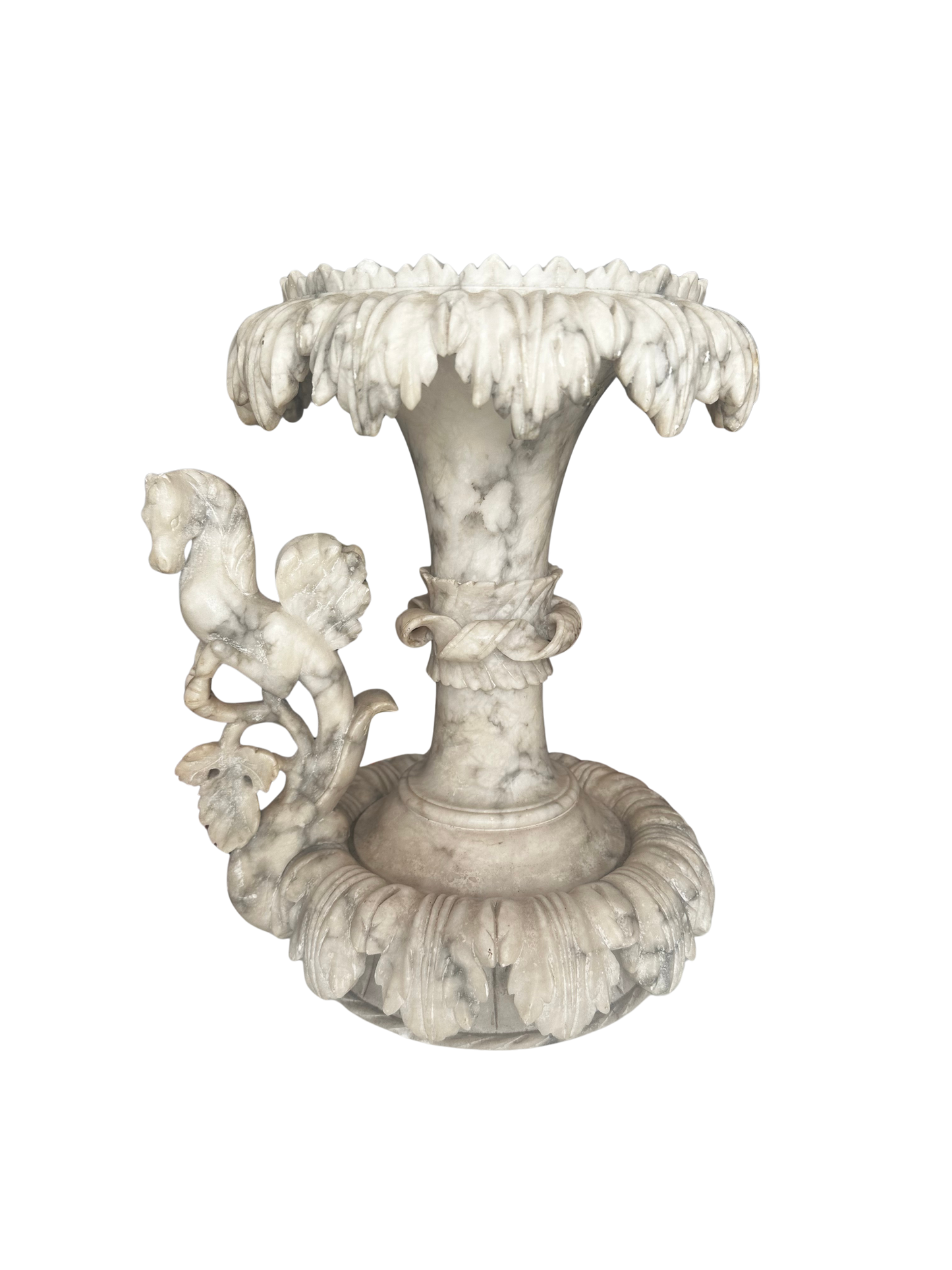
A striking neoclassical carved alabaster tazza, executed in softly veined stone with a luminous, almost ethereal quality characteristic of fine alabaster. The flared bowl is richly adorned with carved acanthus and foliate motifs, rising from a baluster-form stem encircled by a twisting ribbon and leaf-carved band. The base is boldly gadrooned, giving the piece strong architectural presence.
Emerging dynamically from one side is a sculptural Pegasus rendered in high relief, its wings extended and form animated with classical movement. The opposing side shows evidence of a missing counterpart figure, suggesting the tazza was originally conceived as part of a symmetrical composition or larger garniture.
The stone itself displays beautiful natural veining throughout, with a softness and translucency that distinguishes alabaster from marble. The interior drilling indicates the piece may have served as a functional decorative object—such as a compote, jardinière, or adapted centerpiece—at various points in its life.
Era:
Late 19th to early 20th century (Neoclassical / Grand Tour Revival)
History:
Carved alabaster objects of this type were widely produced in Italy and across Continental Europe during the 19th century, inspired by classical antiquity and the tastes of Grand Tour collectors. Alabaster, prized for its workability and luminous surface, allowed artisans to create richly detailed decorative objects intended for refined interiors. Motifs such as Pegasus, acanthus leaves, and architectural bases reflect a continued fascination with Greco-Roman mythology and design.
Provenance: Italy or Continental Europe
Materials: Carved alabaster
Dimensions:
TBD
Disclaimers:
Loss to one Pegasus figure; asymmetry indicates the piece was likely originally part of a pair or larger decorative composition. Minor chips, surface wear, and interior staining consistent with age and material. Evidence of drilling suggests possible historical adaptation. Alabaster is a softer stone and naturally exhibits wear over time.
Additional Description:
A striking neoclassical carved alabaster tazza, executed in softly veined stone with a luminous, almost ethereal quality characteristic of fine alabaster. The flared bowl is richly adorned with carved acanthus and foliate motifs, rising from a baluster-form stem encircled by a twisting ribbon and leaf-carved band. The base is boldly gadrooned, giving the piece strong architectural presence.
Emerging dynamically from one side is a sculptural Pegasus rendered in high relief, its wings extended and form animated with classical movement. The opposing side shows evidence of a missing counterpart figure, suggesting the tazza was originally conceived as part of a symmetrical composition or larger garniture.
The stone itself displays beautiful natural veining throughout, with a softness and translucency that distinguishes alabaster from marble. The interior drilling indicates the piece may have served as a functional decorative object—such as a compote, jardinière, or adapted centerpiece—at various points in its life.
Era:
Late 19th to early 20th century (Neoclassical / Grand Tour Revival)
History:
Carved alabaster objects of this type were widely produced in Italy and across Continental Europe during the 19th century, inspired by classical antiquity and the tastes of Grand Tour collectors. Alabaster, prized for its workability and luminous surface, allowed artisans to create richly detailed decorative objects intended for refined interiors. Motifs such as Pegasus, acanthus leaves, and architectural bases reflect a continued fascination with Greco-Roman mythology and design.
Provenance: Italy or Continental Europe
Materials: Carved alabaster
Dimensions:
TBD
Disclaimers:
Loss to one Pegasus figure; asymmetry indicates the piece was likely originally part of a pair or larger decorative composition. Minor chips, surface wear, and interior staining consistent with age and material. Evidence of drilling suggests possible historical adaptation. Alabaster is a softer stone and naturally exhibits wear over time.