



Hand-Painted Translucent Celluloid Portrait Plaque of a Renaissance Lady with Lute in 18K Gold Bezel, Signed "Dimarc"
Hand-Painted Translucent Celluloid Portrait Plaque of a Renaissance Lady with Lute in 18K Gold Bezel, Signed "Dimarc"
Impossible de charger la disponibilité du service de retrait
Partager


After "Mary Magdalene Playing a Lute" by 16th century Flemish Master of Half-Lengths
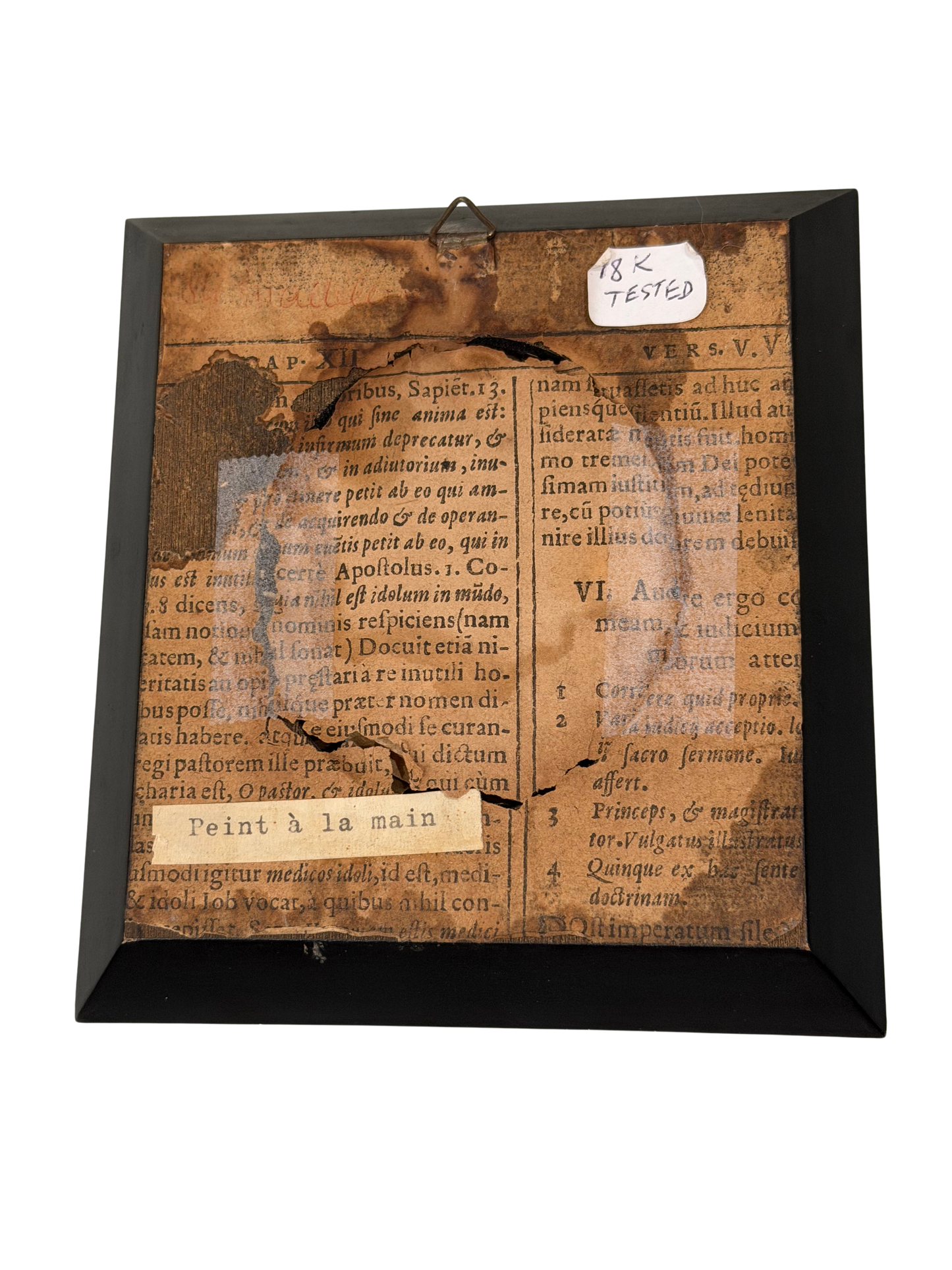
Decorative oval translucent portrait plaque depicting a Renaissance-inspired young woman playing a lute, hand-painted and signed Dimarc at lower right. The plaque is mounted within a tested 18K yellow gold oval bezel and displayed in an ebonized shadowbox frame with a gilt liner. The reverse retains its original French label reading "Peint à la main" ("Hand Painted").
The translucent plaque produces a soft luminous effect when held to the light, characteristic of luxury decorative plaques produced in France during the mid-20th century.
After "Mary Magdalene Playing a Lute" by 16th century Flemish Master of Half-Lengths
Decorative oval translucent portrait plaque depicting a Renaissance-inspired young woman playing a lute, hand-painted and signed Dimarc at lower right. The plaque is mounted within a tested 18K yellow gold oval bezel and displayed in an ebonized shadowbox frame with a gilt liner. The reverse retains its original French label reading "Peint à la main" ("Hand Painted").
The translucent plaque produces a soft luminous effect when held to the light, characteristic of luxury decorative plaques produced in France during the mid-20th century.
5.25"h x 4.75"w x 0.5"d
5.25"h x 4.75"w x 0.5"d
Luxury decorative portrait plaques of this type were produced in France during the mid-20th century using translucent celluloid or cellulose acetate sheets that were hand-painted or hand-enhanced. Renaissance-inspired female subjects remained popular throughout the period, and higher-end examples were occasionally mounted in precious metal bezels before being framed for display. The Dimarc signature is associated with decorative studio work rather than a widely documented fine artist.
Luxury decorative portrait plaques of this type were produced in France during the mid-20th century using translucent celluloid or cellulose acetate sheets that were hand-painted or hand-enhanced. Renaissance-inspired female subjects remained popular throughout the period, and higher-end examples were occasionally mounted in precious metal bezels before being framed for display. The Dimarc signature is associated with decorative studio work rather than a widely documented fine artist.
Circa 1940–1965
Circa 1940–1965
Hand-painted translucent celluloid (or cellulose acetate) plaque
Tested 18K yellow gold oval bezel
Convex glass
Ebonized wood shadowbox frame
Paper backing
Hand-painted translucent celluloid (or cellulose acetate) plaque
Tested 18K yellow gold oval bezel
Convex glass
Ebonized wood shadowbox frame
Paper backing
Austin Estate. Retains original "Peint à la main" label.
Austin Estate. Retains original "Peint à la main" label.
The plaque material is believed to be translucent celluloid or an early cellulose acetate rather than porcelain.
The signature Dimarc has not been conclusively linked to a documented fine artist.
The bezel has been represented as tested 18K gold; absent hallmarks or assay documentation.
The plaque material is believed to be translucent celluloid or an early cellulose acetate rather than porcelain.
The signature Dimarc has not been conclusively linked to a documented fine artist.
The bezel has been represented as tested 18K gold; absent hallmarks or assay documentation.