


Handwritten French Bibliophile Catalog Manuscript — Private Library Sale Notes
Handwritten French Bibliophile Catalog Manuscript — Private Library Sale Notes
Impossible de charger la disponibilité du service de retrait
Partager


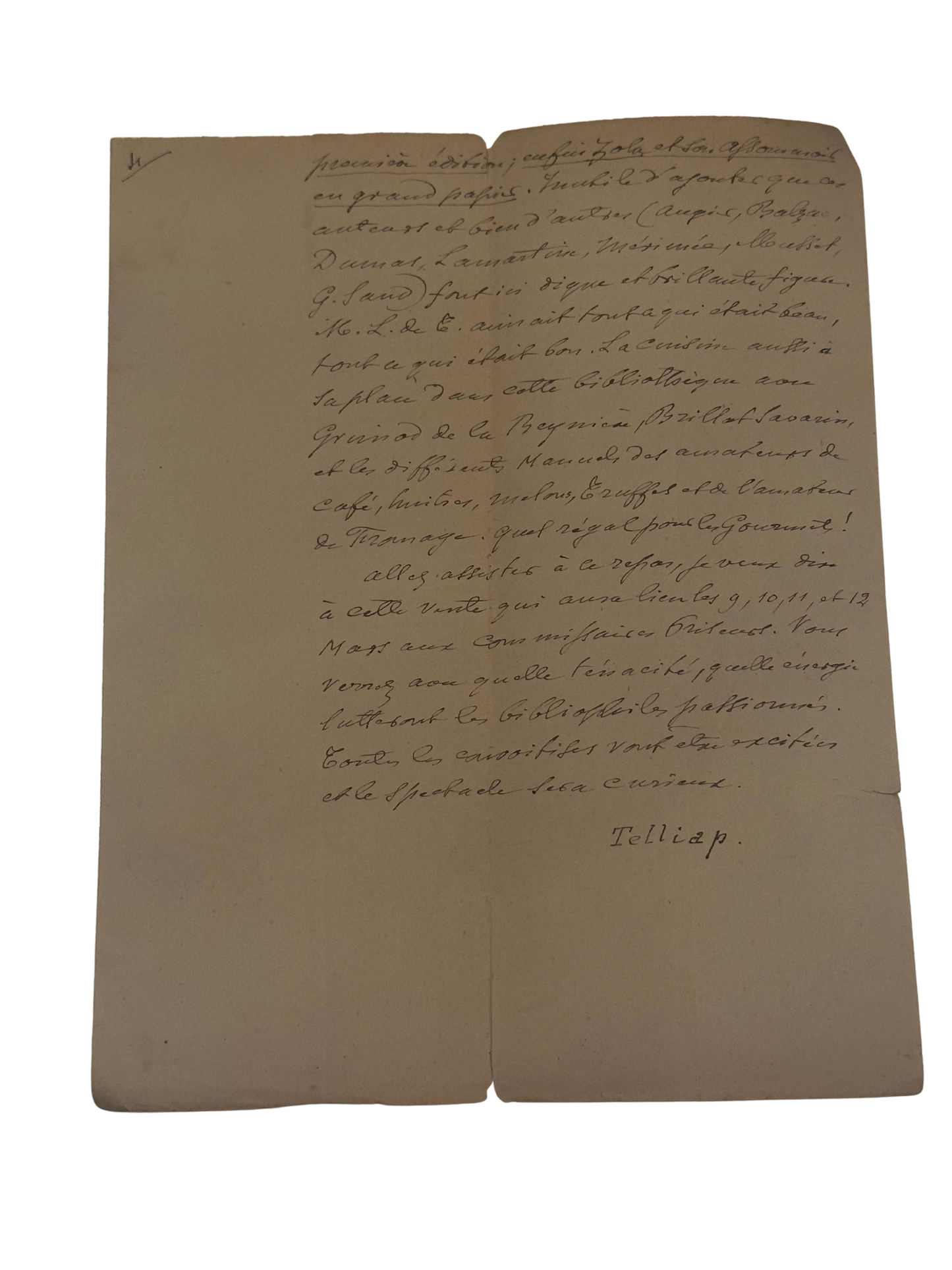
A multi-page handwritten French manuscript titled “Bibliographie”, likely prepared as a draft catalog or descriptive inventory for a private antiquarian book collection or library sale. Written in brown ink on laid paper sheets and organized into numbered sections, the manuscript lists notable literary works, fine bindings, engravings, and bibliophile editions.
The text references luxury bindings (including maroquin leather bindings), manuscript books of hours, engravings by Jacques Callot, and literary works by authors such as Pascal, Victor Hugo, La Fontaine, Stendhal, and Balzac. Several entries describe first editions, large-paper copies (“grand papier”), and finely illustrated works, suggesting the manuscript was prepared by a knowledgeable collector, bookseller, or cataloguer.
Marginal notes indicate formatting instructions such as “italiques,” “petits caractères,” and “capitales,” reinforcing the idea that this document was a working draft for a printed catalog or auction listing rather than a personal letter or literary manuscript.
The final page includes what appears to be a signature reading “Telliez”, possibly the cataloguer, bookseller, or owner of the collection.
An evocative artifact of the antiquarian book trade, this manuscript offers insight into the world of bibliophiles and rare-book collecting in France during the late 19th or early 20th century.
A multi-page handwritten French manuscript titled “Bibliographie”, likely prepared as a draft catalog or descriptive inventory for a private antiquarian book collection or library sale. Written in brown ink on laid paper sheets and organized into numbered sections, the manuscript lists notable literary works, fine bindings, engravings, and bibliophile editions.
The text references luxury bindings (including maroquin leather bindings), manuscript books of hours, engravings by Jacques Callot, and literary works by authors such as Pascal, Victor Hugo, La Fontaine, Stendhal, and Balzac. Several entries describe first editions, large-paper copies (“grand papier”), and finely illustrated works, suggesting the manuscript was prepared by a knowledgeable collector, bookseller, or cataloguer.
Marginal notes indicate formatting instructions such as “italiques,” “petits caractères,” and “capitales,” reinforcing the idea that this document was a working draft for a printed catalog or auction listing rather than a personal letter or literary manuscript.
The final page includes what appears to be a signature reading “Telliez”, possibly the cataloguer, bookseller, or owner of the collection.
An evocative artifact of the antiquarian book trade, this manuscript offers insight into the world of bibliophiles and rare-book collecting in France during the late 19th or early 20th century.
9.25"h x 7"w
9.25"h x 7"w
During the late 19th century, private libraries and bibliophile collections were frequently documented in handwritten draft catalogs before being printed for auction or bookseller distribution. French collectors in particular prized finely bound editions, illustrated works, and early printings of canonical authors.
Bibliographic manuscripts such as this were typically prepared by: antiquarian booksellers, auction cataloguers, or collectors organizing their libraries for sale or publication.
References to binding styles like maroquin, format terms such as in-12, and mentions of manuscript Books of Hours reflect the conventions of the French rare-book trade of the period.
During the late 19th century, private libraries and bibliophile collections were frequently documented in handwritten draft catalogs before being printed for auction or bookseller distribution. French collectors in particular prized finely bound editions, illustrated works, and early printings of canonical authors.
Bibliographic manuscripts such as this were typically prepared by: antiquarian booksellers, auction cataloguers, or collectors organizing their libraries for sale or publication.
References to binding styles like maroquin, format terms such as in-12, and mentions of manuscript Books of Hours reflect the conventions of the French rare-book trade of the period.
Late 19th to early 20th century
Late 19th to early 20th century
Handwritten ink on paper
Handwritten ink on paper
European origin, likely France
European origin, likely France
Age-appropriate toning, edge wear, and minor creasing consistent with loose manuscript sheets. Some pages show handling wear and light discoloration. Handwriting legibility varies slightly between pages.
Age-appropriate toning, edge wear, and minor creasing consistent with loose manuscript sheets. Some pages show handling wear and light discoloration. Handwriting legibility varies slightly between pages.