


Mexican Folk Art Ex-Voto Retablo to the Santo Niño, Dated 1944
Mexican Folk Art Ex-Voto Retablo to the Santo Niño, Dated 1944
Impossible de charger la disponibilité du service de retrait
Partager
Additional Description:
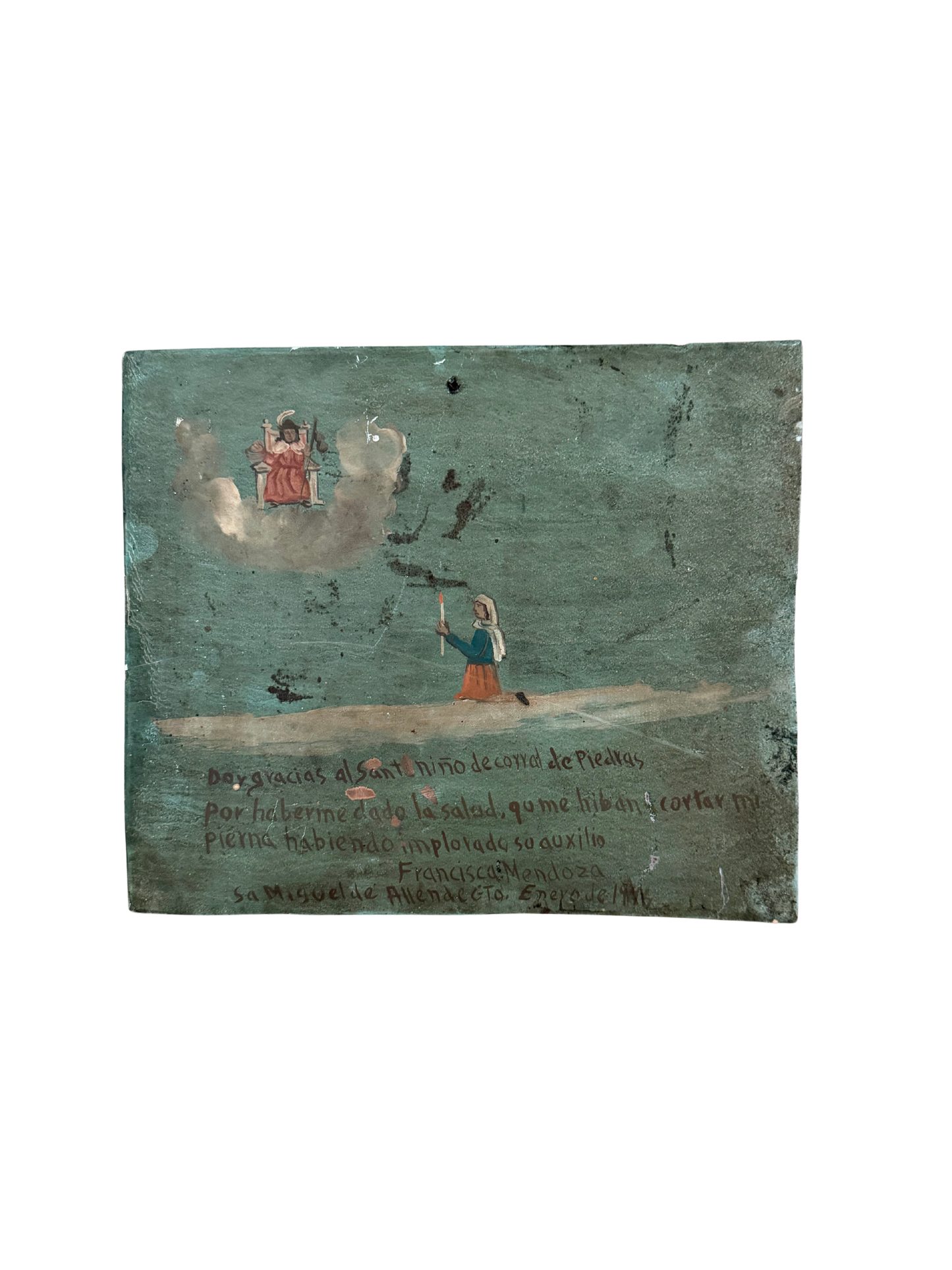
A compelling Mexican devotional ex-voto, or retablo, hand-painted on a thin metal panel. The scene depicts a kneeling woman holding a candle in prayer while a vision of the Santo Niño appears above her amid clouds. Below, a handwritten Spanish inscription records the petitioner’s gratitude for the restoration of her health after she feared her leg would need to be amputated.
The inscription is signed by Francisca Mendoza, identifies San Miguel de Allende, Guanajuato, and is dated January 1944. Loosely translated, the dedication reads:
“I give thanks to the Holy Child … for having restored my health, as they were going to cut off my leg, after I implored his aid.”
"I give thanks to the Holy Child of Corral de Piedras for restoring my health; they were going to amputate my leg, but I implored His aid."
Francisca Mendoza
San Miguel de Allende, January 1944
A highly personal example of Mexican religious folk art, retaining evocative wear and surface patina from age.
Era:
Mexican, dated January 1944
History:
Ex-votos were commissioned or painted as public expressions of gratitude following an illness, accident, or other personal crisis. They were traditionally offered at churches or shrines and commonly depict the devotee, the danger or affliction, the intervening saint, and a written account of the miracle. Painted metal examples became especially widespread in Mexico during the 19th and early 20th centuries.
Provenance:
Private collection
Materials:
Hand-painted pigments on sheet metal
Dimensions:
Dimensions forthcoming
Disclaimers:
Antique and devotional condition with substantial age-related wear. The metal panel has surface oxidation, scratches, abrasions, staining, scattered paint loss, fading, small dents, edge wear, and areas of darkened or worn decoration. There is a pierced hanging hole near the upper edge. The reverse shows extensive oxidation, residue, and surface losses. The Spanish inscription is partially worn and difficult to decipher in places. No restoration has been undertaken. Please review all photographs closely.
Additional Description:
A compelling Mexican devotional ex-voto, or retablo, hand-painted on a thin metal panel. The scene depicts a kneeling woman holding a candle in prayer while a vision of the Santo Niño appears above her amid clouds. Below, a handwritten Spanish inscription records the petitioner’s gratitude for the restoration of her health after she feared her leg would need to be amputated.
The inscription is signed by Francisca Mendoza, identifies San Miguel de Allende, Guanajuato, and is dated January 1944. Loosely translated, the dedication reads:
“I give thanks to the Holy Child … for having restored my health, as they were going to cut off my leg, after I implored his aid.”
"I give thanks to the Holy Child of Corral de Piedras for restoring my health; they were going to amputate my leg, but I implored His aid."
Francisca Mendoza
San Miguel de Allende, January 1944
A highly personal example of Mexican religious folk art, retaining evocative wear and surface patina from age.
Era:
Mexican, dated January 1944
History:
Ex-votos were commissioned or painted as public expressions of gratitude following an illness, accident, or other personal crisis. They were traditionally offered at churches or shrines and commonly depict the devotee, the danger or affliction, the intervening saint, and a written account of the miracle. Painted metal examples became especially widespread in Mexico during the 19th and early 20th centuries.
Provenance:
Private collection
Materials:
Hand-painted pigments on sheet metal
Dimensions:
Dimensions forthcoming
Disclaimers:
Antique and devotional condition with substantial age-related wear. The metal panel has surface oxidation, scratches, abrasions, staining, scattered paint loss, fading, small dents, edge wear, and areas of darkened or worn decoration. There is a pierced hanging hole near the upper edge. The reverse shows extensive oxidation, residue, and surface losses. The Spanish inscription is partially worn and difficult to decipher in places. No restoration has been undertaken. Please review all photographs closely.