

Old Master Engraving after Pietro da Cortona — Mythological Chariot Scene
Old Master Engraving after Pietro da Cortona — Mythological Chariot Scene
Impossible de charger la disponibilité du service de retrait
Partager
Item: Old Master Engraving after Pietro da Cortona — Mythological Chariot Scene
Additional Description:
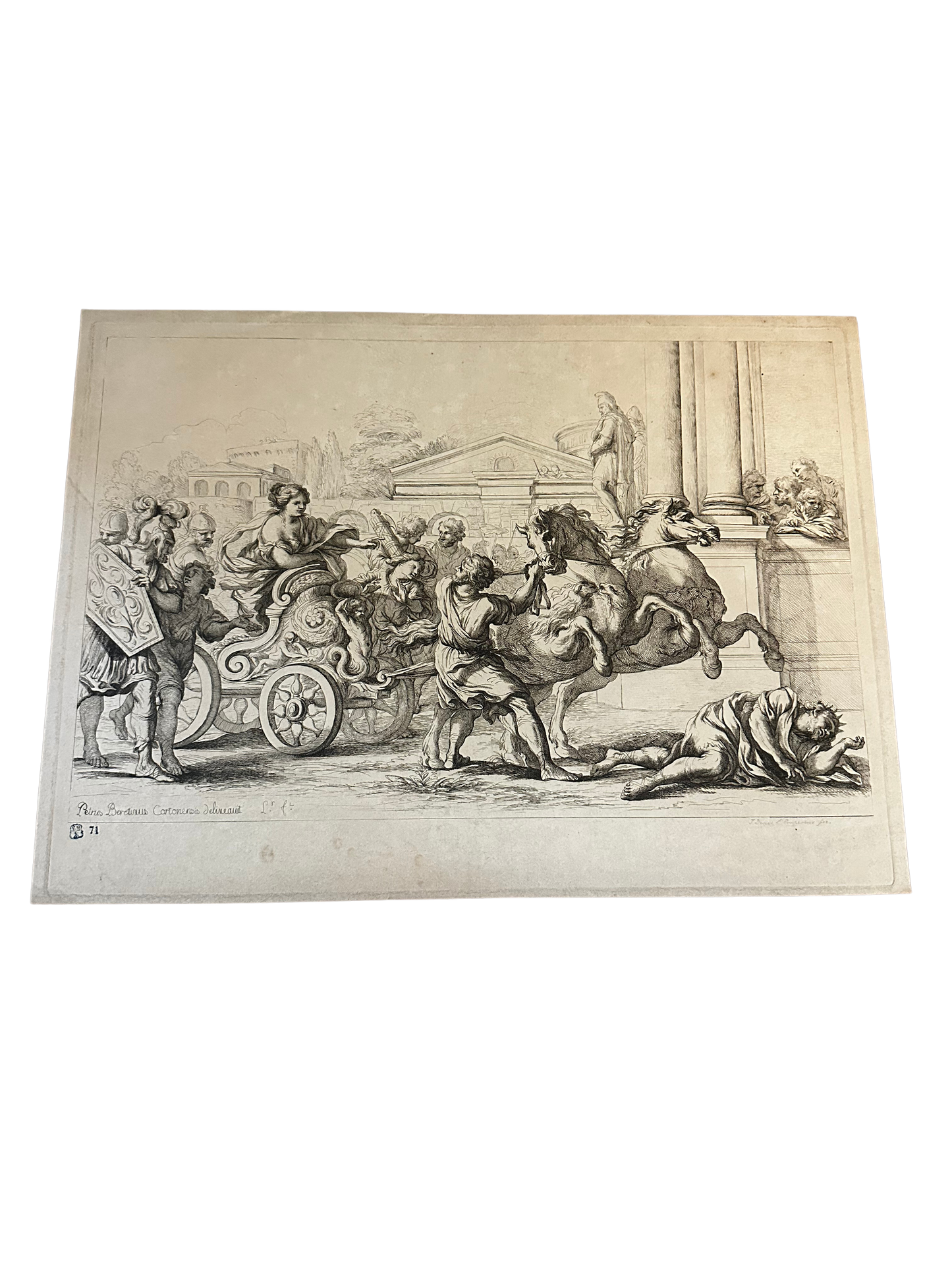
Large copperplate engraving depicting a dramatic mythological procession scene featuring a female figure riding in an ornate classical chariot drawn by two rearing horses, attended by soldiers and figures in classical dress. A fallen figure lies beneath the horses while architectural columns and Roman-style buildings appear in the background.
The lower inscription reads:
“Petrus Berettinus Cortonensis delineavit”
This identifies the designer as Pietro da Cortona (Pietro Berrettini, 1596–1669), one of the most important Italian Baroque painters and designers.
A faint inscription at the lower right appears to read:
“Van Campen exc.” (Venice publisher), consistent with Venetian reproductive engravings after major Italian masters.
A small ink stamp and number (“71”) appear in the lower margin, likely from a collector or print portfolio numbering system.
The engraving shows strong line work, visible plate mark, and printing on laid paper consistent with 17th–18th century intaglio printing.
This type of engraving would likely have been produced as part of a print series reproducing designs by Pietro da Cortona, possibly after fresco decorations or allegorical compositions.
Era:
Late 17th to early 18th century engraving (after a 17th-century Baroque composition)
History:
Pietro da Cortona was a central figure in Roman Baroque art and a major designer of large fresco cycles, allegorical programs, and theatrical compositions.
During the late 1600s and early 1700s, engravers reproduced compositions by major Italian masters so that collectors, artists, and academies across Europe could study them.
Venice was one of the primary centers of print publishing during this period, and engravings after Roman Baroque masters like Cortona were widely circulated.
The energetic figures, dynamic horses, and theatrical composition are characteristic of Cortona’s dramatic Baroque style.
Provenance:
Italian School engraving
Likely published in Venice (Van Campen press)
From an antique print collection
Materials:
Laid paper
Copperplate engraving
Intaglio printing process
Dimensions:
19.75" x 14.25"
Disclaimers:
Age-appropriate toning, foxing, and margin wear present.
Collector stamp and numbering visible in lower margin.
Minor handling marks consistent with antique prints.
Unframed.
Item: Old Master Engraving after Pietro da Cortona — Mythological Chariot Scene
Additional Description:
Large copperplate engraving depicting a dramatic mythological procession scene featuring a female figure riding in an ornate classical chariot drawn by two rearing horses, attended by soldiers and figures in classical dress. A fallen figure lies beneath the horses while architectural columns and Roman-style buildings appear in the background.
The lower inscription reads:
“Petrus Berettinus Cortonensis delineavit”
This identifies the designer as Pietro da Cortona (Pietro Berrettini, 1596–1669), one of the most important Italian Baroque painters and designers.
A faint inscription at the lower right appears to read:
“Van Campen exc.” (Venice publisher), consistent with Venetian reproductive engravings after major Italian masters.
A small ink stamp and number (“71”) appear in the lower margin, likely from a collector or print portfolio numbering system.
The engraving shows strong line work, visible plate mark, and printing on laid paper consistent with 17th–18th century intaglio printing.
This type of engraving would likely have been produced as part of a print series reproducing designs by Pietro da Cortona, possibly after fresco decorations or allegorical compositions.
Era:
Late 17th to early 18th century engraving (after a 17th-century Baroque composition)
History:
Pietro da Cortona was a central figure in Roman Baroque art and a major designer of large fresco cycles, allegorical programs, and theatrical compositions.
During the late 1600s and early 1700s, engravers reproduced compositions by major Italian masters so that collectors, artists, and academies across Europe could study them.
Venice was one of the primary centers of print publishing during this period, and engravings after Roman Baroque masters like Cortona were widely circulated.
The energetic figures, dynamic horses, and theatrical composition are characteristic of Cortona’s dramatic Baroque style.
Provenance:
Italian School engraving
Likely published in Venice (Van Campen press)
From an antique print collection
Materials:
Laid paper
Copperplate engraving
Intaglio printing process
Dimensions:
19.75" x 14.25"
Disclaimers:
Age-appropriate toning, foxing, and margin wear present.
Collector stamp and numbering visible in lower margin.
Minor handling marks consistent with antique prints.
Unframed.