

Pair of French Neoclassical Style Bronze-Mounted Variegated Marble Ewers
Pair of French Neoclassical Style Bronze-Mounted Variegated Marble Ewers
Impossible de charger la disponibilité du service de retrait
Partager
Additional Description:
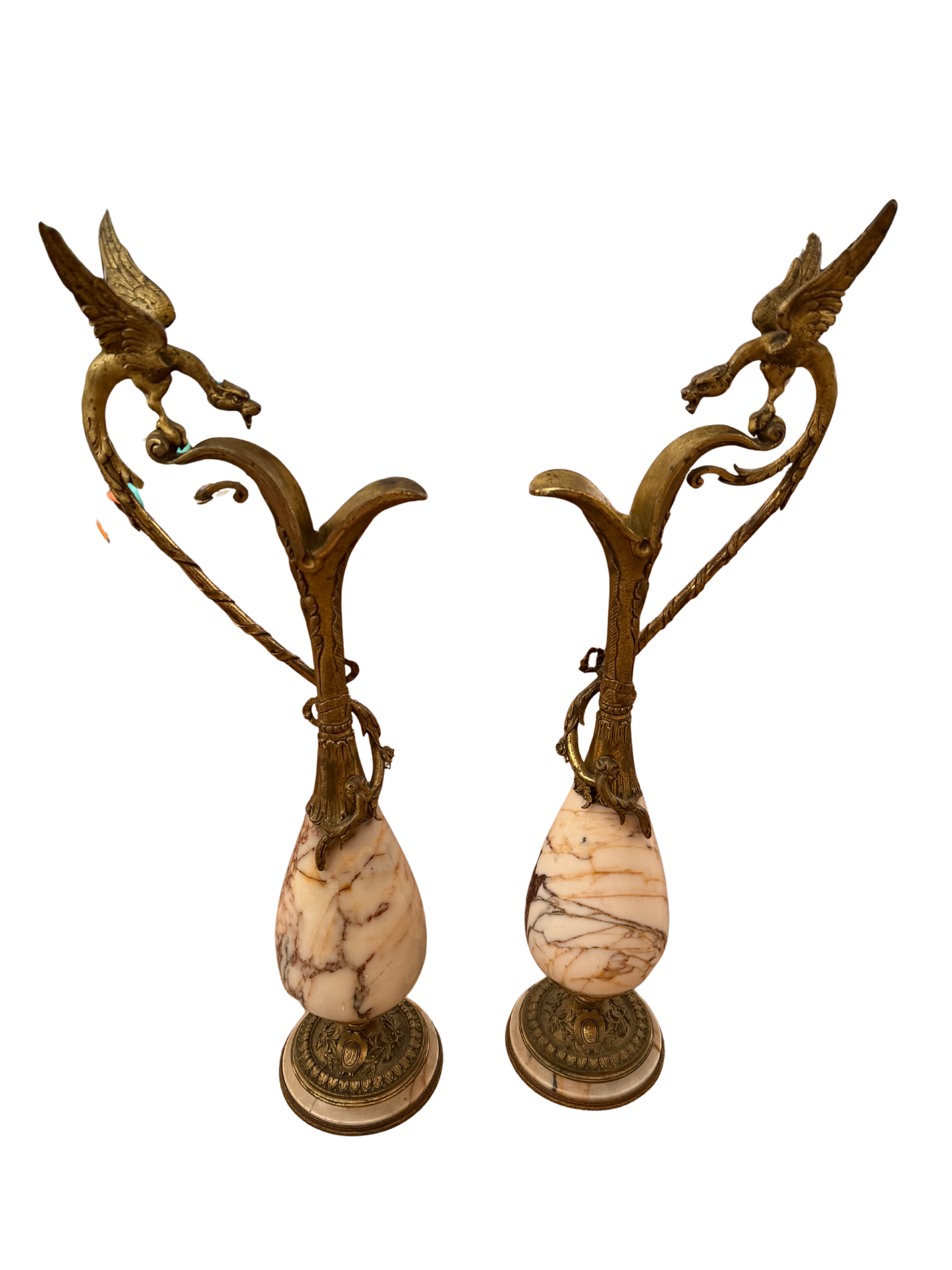
A dramatic pair of tall decorative ewers in the French Renaissance Revival taste, each centered by a polished cream-colored stone body with warm amber, rust, and gray veining. The elongated pear-shaped vessels are raised on circular stone bases enriched with cast gilt-metal collars, laurel decoration, and oval cartouches.
Each ewer is fitted with an elaborate sculptural handle surmounted by a winged griffin or dragon-like creature. The fantastical beasts perch above sweeping foliate scrolls, their extended tails forming long diagonal supports toward the shoulders of the vessels. The upper mounts terminate in broad open spouts decorated with stylized leaves, while smaller animal and foliate elements wrap around the necks.
The combination of richly veined stone, architectural metalwork, and mythological creatures gives the pair a commanding, highly ornamental presence suitable for a mantel, console, or library interior.
Era:
French or Continental European, late 19th approximately 1880–1900
History:
During the late 19th century, French and Continental designers revived Renaissance and Mannerist decorative forms for luxury interiors. Griffins, dragons, grotesques, scrollwork, and classical foliage were frequently incorporated into ewers, urns, clocks, and mantel garnitures.
These vessels were produced primarily as decorative objects rather than functional pouring pieces. Their sculptural mounts and symmetrical composition suggest they may originally have formed part of a larger mantel or salon garniture.
Provenance:
Private collection
Materials:
Polished alabaster or marble, cast gilt metal, metal fasteners
Dimensions:
23.5"h, 7.5"w, 4.75"d
Disclaimers:
Antique condition with age-appropriate wear throughout. The stone bodies display natural veining, color variation, inclusions, and surface irregularities inherent to the material. Scattered scratches, abrasions, dull areas, small edge losses, and minor chips may be present. One base shows a visible hairline or natural fissure extending through the stone.
The cast metal mounts show tarnish, oxidation, darkening, rubbing, scratches, accumulated residue, and losses to the gilt finish. Minor casting irregularities, small bends, looseness, separations, and possible old repairs may be present among the projecting wings, tails, scrolls, spouts, and animal elements. The ewers should be handled from their stone bodies and bases rather than by the handles or upper mounts.
The underside of each base has a central securing bolt; one underside bears faint handwritten or scratched inventory markings. No maker’s mark has been located. The precise composition of the metal has not been tested and may be bronze, brass, or gilt spelter. Please review all photographs closely.
Additional Description:
A dramatic pair of tall decorative ewers in the French Renaissance Revival taste, each centered by a polished cream-colored stone body with warm amber, rust, and gray veining. The elongated pear-shaped vessels are raised on circular stone bases enriched with cast gilt-metal collars, laurel decoration, and oval cartouches.
Each ewer is fitted with an elaborate sculptural handle surmounted by a winged griffin or dragon-like creature. The fantastical beasts perch above sweeping foliate scrolls, their extended tails forming long diagonal supports toward the shoulders of the vessels. The upper mounts terminate in broad open spouts decorated with stylized leaves, while smaller animal and foliate elements wrap around the necks.
The combination of richly veined stone, architectural metalwork, and mythological creatures gives the pair a commanding, highly ornamental presence suitable for a mantel, console, or library interior.
Era:
French or Continental European, late 19th approximately 1880–1900
History:
During the late 19th century, French and Continental designers revived Renaissance and Mannerist decorative forms for luxury interiors. Griffins, dragons, grotesques, scrollwork, and classical foliage were frequently incorporated into ewers, urns, clocks, and mantel garnitures.
These vessels were produced primarily as decorative objects rather than functional pouring pieces. Their sculptural mounts and symmetrical composition suggest they may originally have formed part of a larger mantel or salon garniture.
Provenance:
Private collection
Materials:
Polished alabaster or marble, cast gilt metal, metal fasteners
Dimensions:
23.5"h, 7.5"w, 4.75"d
Disclaimers:
Antique condition with age-appropriate wear throughout. The stone bodies display natural veining, color variation, inclusions, and surface irregularities inherent to the material. Scattered scratches, abrasions, dull areas, small edge losses, and minor chips may be present. One base shows a visible hairline or natural fissure extending through the stone.
The cast metal mounts show tarnish, oxidation, darkening, rubbing, scratches, accumulated residue, and losses to the gilt finish. Minor casting irregularities, small bends, looseness, separations, and possible old repairs may be present among the projecting wings, tails, scrolls, spouts, and animal elements. The ewers should be handled from their stone bodies and bases rather than by the handles or upper mounts.
The underside of each base has a central securing bolt; one underside bears faint handwritten or scratched inventory markings. No maker’s mark has been located. The precise composition of the metal has not been tested and may be bronze, brass, or gilt spelter. Please review all photographs closely.