

Pair of French Rococo Revival Framed Aubusson-Style Tapestry Panels
Pair of French Rococo Revival Framed Aubusson-Style Tapestry Panels
Impossible de charger la disponibilité du service de retrait
Partager
Additional Description:
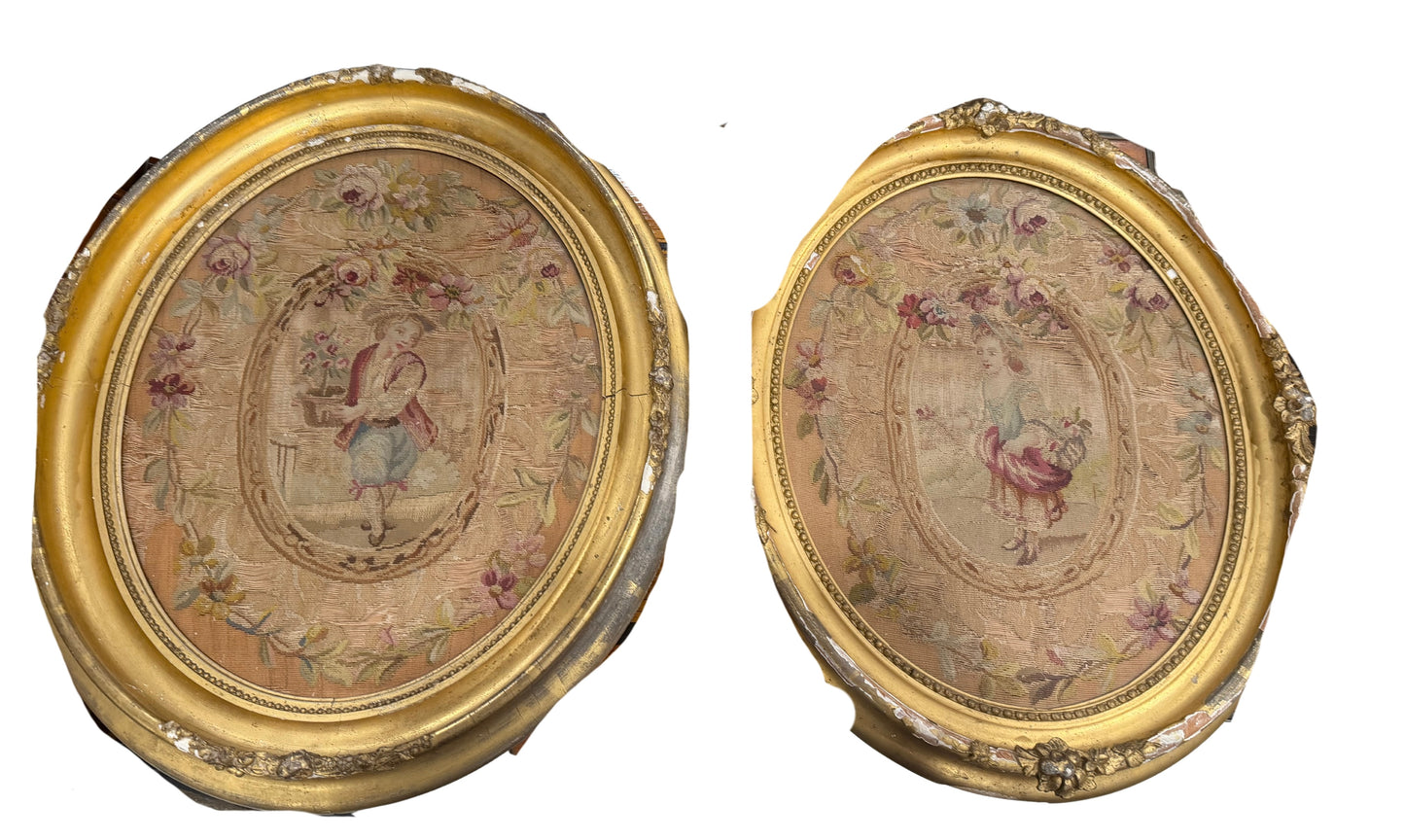
A decorative pair of large oval-framed Aubusson-style woven tapestry panels featuring romantic pastoral figures surrounded by floral garlands and Rococo ornamentation. Each textile depicts an 18th-century-inspired courtly figure within an oval reserve: one panel portraying a young flower seller carrying baskets of blossoms, and the companion panel depicting an elegantly dressed female figure holding flowers in a pastoral garden setting.
The tapestries are woven in soft muted tones of blush pink, dusty rose, sage green, cream, pale blue, and faded gold, creating the delicate palette associated with Louis XV and Rococo decorative aesthetics. Flowing floral swags, scrolling cartouches, and garden motifs frame the central figures in a manner reminiscent of 18th-century French Aubusson and Beauvais textile designs.
Both works are housed in substantial oval giltwood frames with molded borders, beaded inner trim, and applied floral corner ornaments. The frames retain a beautifully aged gilded surface with visible wear and losses that contribute to their antique character.
The textiles exhibit extensive age-related fragility and deterioration throughout, including significant horizontal thread loss, thinning, splitting, and fabric breakdown across large sections of the woven ground. Despite the condition issues, the panels retain strong decorative impact and possess a romantic faded grandeur highly sought after in layered European-inspired interiors.
Era:
Late 19th century to early 20th century, circa 1880–1910.
History:
During the late 19th century, there was renewed fascination with 18th-century French decorative arts, particularly Louis XV and Rococo aesthetics. Aubusson-inspired tapestries and woven textile panels became fashionable decorative elements in Victorian and Belle Époque interiors.
These decorative woven panels were often produced as wall hangings or furniture inserts inspired by earlier French courtly scenes. Their romantic pastoral imagery reflected the enduring popularity of idyllic aristocratic fantasies derived from the works of artists such as François Boucher and Jean-Honoré Fragonard.
Large framed tapestry fragments and decorative textile panels became especially prized for salons, boudoirs, and formal drawing rooms where they softened interiors and added an air of Continental refinement.
Provenance:
Likely French or Continental European origin; acquired through the secondary antiques market.
Materials:
Woven textile tapestry panels, giltwood frames, applied composition floral ornament, glass coverings.
Dimensions:
Each: 21.25” H x 17” W
Disclaimers:
Significant age-related wear and textile deterioration throughout, including thread loss, splitting, thinning, fading, and fragility to the woven surfaces. Visible losses and wear to gilt surfaces and applied ornament on the frames. Surface abrasions, cracking, and losses consistent with age and handling. Sold as decorative antique textile artworks with condition reflective of age.
Additional Description:
A decorative pair of large oval-framed Aubusson-style woven tapestry panels featuring romantic pastoral figures surrounded by floral garlands and Rococo ornamentation. Each textile depicts an 18th-century-inspired courtly figure within an oval reserve: one panel portraying a young flower seller carrying baskets of blossoms, and the companion panel depicting an elegantly dressed female figure holding flowers in a pastoral garden setting.
The tapestries are woven in soft muted tones of blush pink, dusty rose, sage green, cream, pale blue, and faded gold, creating the delicate palette associated with Louis XV and Rococo decorative aesthetics. Flowing floral swags, scrolling cartouches, and garden motifs frame the central figures in a manner reminiscent of 18th-century French Aubusson and Beauvais textile designs.
Both works are housed in substantial oval giltwood frames with molded borders, beaded inner trim, and applied floral corner ornaments. The frames retain a beautifully aged gilded surface with visible wear and losses that contribute to their antique character.
The textiles exhibit extensive age-related fragility and deterioration throughout, including significant horizontal thread loss, thinning, splitting, and fabric breakdown across large sections of the woven ground. Despite the condition issues, the panels retain strong decorative impact and possess a romantic faded grandeur highly sought after in layered European-inspired interiors.
Era:
Late 19th century to early 20th century, circa 1880–1910.
History:
During the late 19th century, there was renewed fascination with 18th-century French decorative arts, particularly Louis XV and Rococo aesthetics. Aubusson-inspired tapestries and woven textile panels became fashionable decorative elements in Victorian and Belle Époque interiors.
These decorative woven panels were often produced as wall hangings or furniture inserts inspired by earlier French courtly scenes. Their romantic pastoral imagery reflected the enduring popularity of idyllic aristocratic fantasies derived from the works of artists such as François Boucher and Jean-Honoré Fragonard.
Large framed tapestry fragments and decorative textile panels became especially prized for salons, boudoirs, and formal drawing rooms where they softened interiors and added an air of Continental refinement.
Provenance:
Likely French or Continental European origin; acquired through the secondary antiques market.
Materials:
Woven textile tapestry panels, giltwood frames, applied composition floral ornament, glass coverings.
Dimensions:
Each: 21.25” H x 17” W
Disclaimers:
Significant age-related wear and textile deterioration throughout, including thread loss, splitting, thinning, fading, and fragility to the woven surfaces. Visible losses and wear to gilt surfaces and applied ornament on the frames. Surface abrasions, cracking, and losses consistent with age and handling. Sold as decorative antique textile artworks with condition reflective of age.